Numbers 19
Wycliffe's Bible with Modern Spelling (Enhanced) · Tap a verse to see its cross-references.
The Red Heifer
1And the Lord spake to Moses and to Aaron, and said,
2This is the religion of sacrifice, which the Lord ordained. Command thou to the sons of Israel, that they bring to thee a red cow of whole colour, in which is no wem, neither she hath borne (a) yoke. (This is the law of sacrifice, which the Lord hath ordained. Command thou to the Israelites, that they bring to thee a red cow of whole colour, in which there is no blemish, or fault, nor hath she ever borne a yoke.)
3And ye shall betake her to Eleazar, the priest, that shall offer her, led out of the tents, in the sight of all men. (And ye shall give her to Eleazar, the priest, and when she is led away from the tents, he shall offer her in the sight of all the people.)
4And he shall dip his finger in the blood thereof, and shall sprinkle (it) seven times against the gates of the tabernacle. (And he shall dip his finger in her blood, and he shall sprinkle it seven times towards the front of the Tabernacle.)
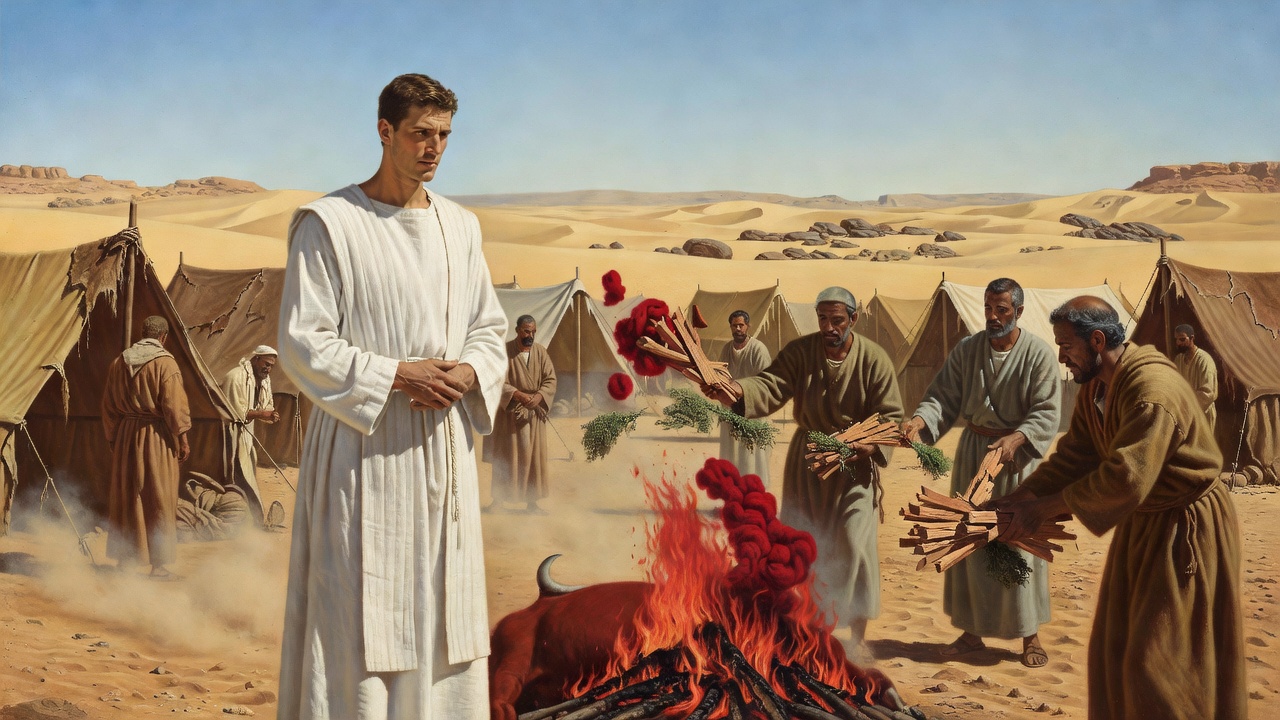
5And he shall burn that cow, while all men see; and he shall give as well the skin, and the flesh thereof, as the blood, and the dung, to [the] burning. (And then a man shall burn that cow, in front of Eleazar; and he shall put its skin, and flesh, and blood, and dung, in the fire.)
6Also the priest shall put cedar wood (or And the priest shall put cedar wood), and hyssop, and red thread dyed twice, into the fire, that burneth the cow.
7And then at the last, when the priest’s clothes and his body be washed, he shall enter into the tents, and he shall be defouled, or unclean, till to eventide. (And then, after the priest hath washed his clothes, and his body, he shall return to the tents, but he shall be defiled, or unclean, until the evening.)
8But also he that burnt the cow, shall wash his clothes, and his body, and he shall be unclean till to eventide. (And the man who burned the cow, shall also wash his clothes, and his body, and he shall also be unclean until the evening.)
9Soothly a clean man shall gather the ashes of the cow, and he shall pour them out without the tents, in a place most clean, that those ashes be to the multitude of the sons of Israel into keeping, and into water of sprinkling; for that cow is burnt for sin. (And a man who is clean shall gather up the cow’s ashes, and he shall pour them out away from the tents, in a most clean place, so that those ashes can be used for the multitude of the Israelites to make the water of cleansing, or of purification; for that cow is burnt as a sin offering.)
10And when he that bare out the ashes of the cow, hath washed his clothes, he shall be unclean till to eventide. And the sons of Israel, and the comelings that dwell among them, shall have, or hold, this (to be) holy by (an) everlasting law.
Purification of the Unclean
11He that toucheth a dead body of a man, and is unclean for this by seven days, (He who toucheth someone’s dead body, is made unclean by this for seven days,)
12shall be sprinkled of this water in the third [day], and in the seventh day; and so he shall be cleansed. If he is not sprinkled in the third day, he shall not be able to be cleansed in the seventh day. (and he shall be sprinkled with the water of cleansing, or of purification, on the third day, and on the seventh day; and then he shall be clean again. If he is not sprinkled on both the third day, and on the seventh day, he shall not be made clean.)
13Each that toucheth the dead body by itself of (a) man’s soul, and is not sprinkled with this meddling ( of water and ashes), defouleth the tabernacle of the Lord, and he shall perish from Israel; for he is not sprinkled with the water of cleansing, he shall be unclean, and his filth shall dwell upon him. (Anyone who toucheth a dead body, and is not sprinkled with this mixture of water and ashes, defileth the Tabernacle of the Lord, and he shall be cut off, or be put out, from Israel; and because he is not sprinkled with the water of cleansing, he shall remain unclean, and his filth shall remain upon him.)
14This is the law of a man that dieth in the tabernacle; all that enter into his tent, and all the vessels that be there, shall be defouled by seven days. (This is the law for anyone who dieth in a tent; all who enter into his tent, and all the vessels that be there, shall be defiled, or unclean, for seven days.)
15A vessel that hath not a covering, neither a binding above, shall be unclean. (Any open vessel there, that hath not a cover, or a lid on top of it, shall be unclean.)
16If any man toucheth the dead body of a man slain in the field, either dead by himself, either a bone of him, either his sepulchre, he shall be unclean by seven days. (If anyone toucheth the dead body of someone killed in the field, that is, outside, or who hath died naturally, or who toucheth one of their bones, or their grave, or their tomb, they shall be unclean for seven days.)
17And they shall take of the ashes of the burning, and of the sin (offering), that is, of the cow offered for sin, and they shall put quick waters into a vessel, upon those ashes; (And they shall take some of the ashes from the burning of that sin offering, that is, some of the ashes of the cow offered for sin, and they shall put those ashes into a vessel with fresh water;)
18in which when a clean man hath dipped hyssop, he shall sprinkle therewith the tent, and all the purtenance of the household, and the men also defouled with such defouling (or and also anyone defiled with such defilement).
19And in this manner a clean man shall cleanse an unclean thing, in the third (day) and in the seventh day; and he shall be cleansed in the seventh day. And he shall wash himself, and his clothes, and he shall be unclean till to eventide. (And in this manner a clean man shall sprinkle an unclean thing on the third day, and on the seventh day; and it shall be clean on the seventh day. And then he shall wash himself, and his clothes, but he shall be unclean until the evening.)
20If any man is not cleansed by this custom, ( or rite), the soul of him shall perish from the midst of the church (or that person shall be cut off, or shall be put out, from among the congregation); for he defouleth the saintuary of the Lord, and he is not sprinkled with the water of cleansing.
21This behest shall be a lawful thing everlasting. Also he that shall sprinkle the waters (of cleansing) shall wash his clothes; each man that toucheth the waters of cleansing, shall be unclean till to eventide. (This rule shall be an everlasting law. He who shall sprinkle the water of cleansing shall wash his clothes; and anyone who toucheth the water of cleansing shall be unclean until the evening.)
22Whatever thing an unclean man toucheth, he shall make unclean; and a soul that toucheth any of these things defouled so, shall be unclean till to eventide. (Whatever thing an unclean person toucheth, they shall make that unclean; and anyone who toucheth any of these things that be so defiled, shall be unclean until the evening.)
Did you know?
The Red Heifer and Purification from Death
- Unlike typical sacrifices offered at the tabernacle altar, the unblemished red heifer that had never worn a yoke was taken outside the camp. There it was slaughtered in the presence of the priest Eleazar and burned whole along with cedar wood, hyssop, and scarlet wool.Sources: the Bible text itself · Eleazar
- The ashes of the heifer were stored outside the camp to prepare the water of purification. Paradoxically, while this mixture purified individuals who were defiled by death, everyone who handled the burning heifer, gathered its ashes, or sprinkled the water became temporarily unclean until evening.Sources: the Bible text itself
- Contact with a corpse, a human bone, a grave, or merely being inside a tent where someone died caused seven days of ceremonial uncleanness. To be restored, the person had to be sprinkled with the purification water on the third and seventh days and wash their clothes and body.Sources: the Bible text itself
Notes written with AI assistance from open sources (Theographic Bible Metadata, CC BY-SA 4.0; Easton’s Bible Dictionary, public domain) and reviewed before publishing.
Credits and license for this translation
Wycliffe's Bible with Modern Spelling (Enhanced)
English: Wycliffe's Bible Modern Spelling (Enhanced) (with Deuterocanon)
Copyright © 2001,2010,2011,2012,2013,2015 Terry Noble
Language: English
Dialect: Archaic
Translation by: Terry Noble
Wycliffe's Bible with Modern Spelling (Enhanced)
Wycliffe’s Bible with Modern Spelling (Enhanced) is a composite of my Wycliffe’s Bible, a modern-spelling version of the 14th century Middle English translation, consisting of Wycliffe’s Old Testament and Wycliffe’s New Testament, and my modern-spelling version of Wycliffe’s Apocrypha. These books contain literally tens of thousands of rewritten verses, presented in parentheses “( ) “, to provide help in comprehending the 14th century Middle English vocabulary and grammar. Wycliffe’s Apocrypha also includes the books of the Apocrypha from the 1st edition of the King James Version of the Bible.
This translation is made available to you under the terms of the
Creative Commons Attribution-Noncommercial-No Derivatives license 4.0.
You may share and redistribute this Bible translation or extracts from it in any format, provided that:
You include the above copyright and source information.
You do not sell this work for a profit.
You do not change any of the words or punctuation of the Scriptures.
Pictures included with Scriptures and other documents on this site are licensed just for use with those Scriptures and documents.
For other uses, please contact the respective copyright owners.
2019-09-25
Section headings adapted from the Berean Standard Bible (public domain); they are not part of this translation’s text.
Source: http://ebible.org/engwyc2018/ · eBible.org