Nehemiah 8
Wycliffe's Bible with Modern Spelling (Enhanced) · Tap a verse to see its cross-references.
Ezra Reads the Law
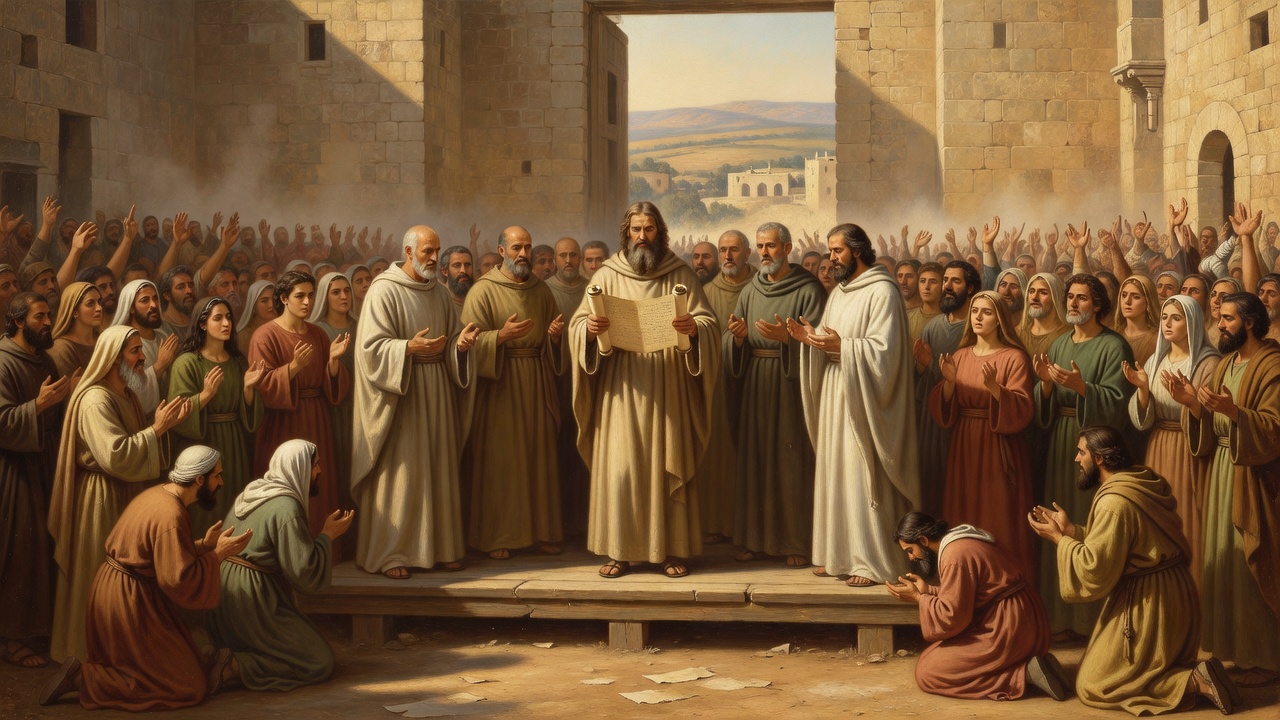
1And all the people was gathered together as one man, (in)to the street which is before the gate of waters. And they said to Ezra, the scribe, or the writer, that he should bring the book of the law of Moses, which the Lord had commanded to Israel. (And then all the people gathered together as one person, in the square in front of the Water Gate. And they said to Ezra, the writer or the teacher of the Law, that he should bring The Book of the Law of Moses, which the Lord had commanded to Israel.)
2Therefore Ezra, the priest, brought the law before the multitude of men and of women, and before all that might understand, in the first day of the seventh month. (And so Ezra, the priest, brought The Book of the Law before the multitude of men and women, yea, to all who might understand it, in the first day of the seventh month.)
3And he read in it openly in the street that was before the gate of waters, from the morrowtide till to midday, in the sight of men and of women, and of wise men; and the ears of all the people were raised up to the book to hear the law. (And he read from it openly in the square that was in front of the Water Gate, from the morning until noon, before men and women, yea, to all who were wise enough to understand it; and the ears of all the people were attentive to hear the Law from the book.)
4And Ezra the writer stood on the degrees of wood, that he had made to speak upon to the people; and Mattithiah, and Shema, and Anaiah, and Urijah, and Hilkiah, and Maaseiah stood beside him, at his right half; and Pedaiah, Mishael, and Malchiah, Hashum, and Hashbadana, and Zechariah, and Meshullam, stood at the left half. (And Ezra the writer or the teacher of the Law stood on a wooden platform, made for him so that he could speak to the people; and Mattithiah, Shema, Anaiah, Urijah, Hilkiah, and Maaseiah stood beside him, at his right hand; and Pedaiah, Mishael, Malchiah, Hashum, Hashbadana, Zechariah, and Meshullam, stood at his left hand.)
5And Ezra opened the book before all the people; for he appeared over all the people; and when he had opened the book, all the people stood to hear. (And Ezra opened the book before all the people; for he was above all the people; and when he had opened the book, all the people stood up to hear him.)
6And Ezra blessed the Lord God with great voice; and all the people answered, Amen, Amen, raising up their hands. And they were bowed, and they worshipped God, lowly upon the earth. (And Ezra blessed the Lord God, the great God; and all the people answered, Amen, Amen, and raised up their hands. And they bowed their heads, and then worshipped God, low upon the ground.)
7And Jeshua, and Bani, and Sherebiah, Jamin, Akkub, Shabbethai, Hodijah, Maaseiah, Kelita, Azariah, Jozabad, Hanan, Pelaiah, deacons, made silence in the people, for to hear the law. And the people stood in their degree. (And then Jeshua, Bani, Sherebiah, Jamin, Akkub, Shabbethai, Hodijah, Maaseiah, Kelita, Azariah, Jozabad, Hanan, and Pelaiah, all Levites, expounded the Law to them. And all the people stood there in their places.)
8And they read in the book of God’s law distinctly, and openly, to understand it; and they understood, when it was read. (And they read from The Book of God’s Law openly, and distinctly, and then expounded, or explained, it; and when it was read to the people in this way, they could understand it.)
9Forsooth Nehemiah said, he is (the) Tirshatha, and Ezra, the priest and writer, and the deacons, expounding to all the people, This is a day hallowed to the Lord our God; do not ye mourn, and do not ye weep. For all the people wept, when it heard the words of the law. (And Nehemiah, he was the governor, and Ezra, the priest and writer or the priest and teacher of the Law, and the Levites, expounding the Law to all the people, said to them, This day is holy to the Lord our God; do not ye mourn, and do not ye weep. For all the people had wept, when they had heard the words of the Law.)
10And he said to them, Go ye, and eat ye fat things, and drink ye wine made sweet with honey, and send ye parts to them, that made not ready to themselves, for it is an holy day of the Lord; do not ye be sorry, for the joy of the Lord is your strength. (And he said to them, Now go ye, and eat ye rich food, and drink ye mead, and send ye portions to those who cannot provide for themselves, for this day is holy to the Lord; do not ye be sorrowful, or sad, for the joy of the Lord is your strength.)
11And the deacons made silence in all the people, and said, Be ye still, for this is an holy day, and make ye no sorrow. (And the Levites silenced all the people, and said, Be ye quiet, for this day is holy, and so do not ye be sad.)
12Therefore all the people went for to eat, and (to) drink, and to send parts (or and to send portions to the needy), and to make great gladness; for they understood the words, which he had taught them.
The Feast of Tabernacles
13And in the second day, the princes of families, and all the peoples, priests, and deacons, were gathered to Ezra, the writer, that he should expound to them the words of the law. (And on the second day, the leaders of the families, and all the people, and the priests, and the Levites, were gathered before Ezra, the writer or the teacher of the Law, so that he could expound to them the words of the Law.)
14And they found written in the law, that the Lord commanded in the hand of Moses, that the sons of Israel dwell in tabernacles in the solemn day (s), in the seventh month; (And they found written in the Law, that the Lord had commanded through Moses, that the Israelites should live in booths, or shelters, during the Feast of Tabernacles, that is, the Harvest Festival, in the seventh month;)
15and that they (should) preach, and publish a voice in all their cities, and in Jerusalem; and say, Go ye out into the hill (s), and bring ye (back) boughs of the olive tree, and boughs of the fairest tree, the boughs of a myrtle tree, and the branches of a palm tree, and the boughs of a tree full of wood, that tabernacles be made of the boughs, as it is written, (or so that booths, or shelters, can be made out of the boughs, as it is written).
16And all the people went out, and they brought (back) with them boughs, and they made to themselves tabernacles, each man in his house roof, and in their streets, either foreyards, and in the large places of God’s house, and in the street of the gate of waters, and in the street of the gate of Ephraim. (And all the people went out, and they brought back some branches, and made booths, or shelters, for themselves, yea, each person on the flat roof of his house, or in their yard, or in the courtyards of the House of God, or in the public squares by the Water Gate, and the Ephraim Gate.)
17Therefore all the church, or congregation, of them, that is, (all) the gathering together (of them), that came again from [the] captivity, made tabernacles, and they dwelled in those tabernacles. Certainly the sons of Israel had not done such things from the days of Joshua, the son of Nun, unto that day; and full great gladness was there among them. (And so all the congregation, or the community, of them, who had returned from the captivity, made booths, or shelters, and they lived in those shelters. And truly the Israelites had not done such things from the days of Joshua, the son of Nun, until that day; and so there was much gladness among them.)
18And Ezra read in the book of God’s law by all days of the solemnity, from the first day unto the last day; and they made the solemnity by seven days; and in the eighth day they made a gathering, ( or collection), of silver, by the custom. (And Ezra read from The Book of God’s Law for all the days (of the Feast, or the Festival), from the first day until the last day; and they held the Feast for seven days; and then on the eighth day (they held) a closing ceremony, as was the custom.)
Did you know?
The Reading of the Law and the Feast of Booths
- Ezra the scribe, a priest descended from Aaron who had led exiles back from Babylon, read the Book of the Law of Moses from daybreak until noon to the assembly in Jerusalem. Standing on a high wooden platform in the square before the Water Gate, he read while Levites explained the text so the entire crowd could understand.Sources: the Bible text itself · Ezra · Water Gate · Jerusalem
- When the people wept upon hearing the Law read, Nehemiah the governor, Ezra, and the Levites instructed them not to grieve on a holy day. The people were told to celebrate with rich food and sweet drinks, share portions with those who had nothing prepared, and take comfort in the joy of the Lord.Sources: the Bible text itself
- After discovering the command in the Law to live in booths during the seventh month, the returned exiles gathered palm, olive, and myrtle branches to build shelters across Jerusalem's rooftops, courts, and squares by the Water Gate and the Gate of Ephraim. The text notes that the Israelites had not celebrated this feast in such a manner since the time of Joshua son of Nun.Sources: the Bible text itself · Water Gate · Gate of Ephraim
Notes written with AI assistance from open sources (Theographic Bible Metadata, CC BY-SA 4.0; Easton’s Bible Dictionary, public domain) and reviewed before publishing.
Places in this chapter
- Water Gate · Today: in Jerusalem · 31.777, 35.234 · verses 1, 3, 16
- Jerusalem · 31.777, 35.234 · verse 15
- Ephraim Gate · Today: in Jerusalem · 31.777, 35.234 · verse 16
Only places identified with high confidence are shown (90% or more according to the scholarly sources compiled by OpenBible). Period map: DARE (Digital Atlas of the Roman Empire), CC BY 4.0; modern map: © OpenStreetMap contributors; places: OpenBible.info (CC BY 4.0).
Credits and license for this translation
Wycliffe's Bible with Modern Spelling (Enhanced)
English: Wycliffe's Bible Modern Spelling (Enhanced) (with Deuterocanon)
Copyright © 2001,2010,2011,2012,2013,2015 Terry Noble
Language: English
Dialect: Archaic
Translation by: Terry Noble
Wycliffe's Bible with Modern Spelling (Enhanced)
Wycliffe’s Bible with Modern Spelling (Enhanced) is a composite of my Wycliffe’s Bible, a modern-spelling version of the 14th century Middle English translation, consisting of Wycliffe’s Old Testament and Wycliffe’s New Testament, and my modern-spelling version of Wycliffe’s Apocrypha. These books contain literally tens of thousands of rewritten verses, presented in parentheses “( ) “, to provide help in comprehending the 14th century Middle English vocabulary and grammar. Wycliffe’s Apocrypha also includes the books of the Apocrypha from the 1st edition of the King James Version of the Bible.
This translation is made available to you under the terms of the
Creative Commons Attribution-Noncommercial-No Derivatives license 4.0.
You may share and redistribute this Bible translation or extracts from it in any format, provided that:
You include the above copyright and source information.
You do not sell this work for a profit.
You do not change any of the words or punctuation of the Scriptures.
Pictures included with Scriptures and other documents on this site are licensed just for use with those Scriptures and documents.
For other uses, please contact the respective copyright owners.
2019-09-25
Section headings adapted from the Berean Standard Bible (public domain); they are not part of this translation’s text.
Source: http://ebible.org/engwyc2018/ · eBible.org