Job 8
Wycliffe's Bible with Modern Spelling (Enhanced) · Tap a verse to see its cross-references.
Bildad: Job Should Repent
1Then Bildad (the) Shuhite answered, and said,
2How long shalt thou speak such things? The spirit of the word of thy mouth is manyfold (or The many words from thy mouth be just so much wind).
3Whether God supplanteth, either deceiveth, doom, and whether Almighty God destroyeth that, that is just? (Did God ever pervert judgement, or did Almighty God ever destroy what is fair?)
4Yea, though thy sons sinned against him, and he left them in the hand of their wickedness;
5nevertheless, if thou risest early to God, and beseechest Almighty God,
6if thou goest clean and rightful, anon he shall wake fully to thee, and shall make peaceable the dwelling place of thy rightfulness; (if thou goest clean and upright, at once he shall watch over thee, and he shall make the dwelling place of thy righteousness prosperous;)
7in so much that thy former things were little, and that thy last things be multiplied greatly. (in so much that though thy first things were few, but thy last things shall be greatly multiplied.)
8For why, ask thou the former generations, and seek thou diligently the mind of [the] fathers (or and diligently seek thou the wisdom of the forefathers).
9For we be men of yesterday, and know not (anything); for our days be as (a) shadow on the earth.
10And they shall teach thee, [and] they shall speak to thee, and (out) of their heart they shall bring forth true speeches (or and they shall bring forth truth from their hearts).
11Whether a (bul)rush may grow without moisture? either a reed (can grow) without water?
12When it is yet in the flower, neither it is taken with hand, it waxeth dry before all herbs. (When it is still flowering, and it hath not yet been picked by hand, it groweth dry before all the other plants.)
13So be the ways of all men, that forget God (or who forget God); and the hope of an hypocrite shall perish.
14His cowardice shall not please God, and his trust shall be as a web of spiders.
15He shall lean, either rest, upon his house, and it shall not stand; he shall underset it, and it shall not rise up altogether. (He shall lean, or shall rest, upon his house, but it shall not stand; he shall undergird it, but it shall not endure.)
16The (bul)rush seemeth moist, before that the sun come; and in the rising of the sun, the seed thereof shall go out.
17The roots thereof shall be made thick upon an heap of stones, and it shall dwell among [the] stones.
18If a man draweth it out of the place thereof, that place shall deny it, and it shall say (in effect), I know thee not.
19For this is the gladness of his way, that again other rushes spring out of the earth. (For this is the joy of its way, that other bulrushes shall spring out of the earth.)
20Forsooth God shall not cast away a simple man, neither he shall address his hand to (help) wicked men; (But God shall not throw away a person who is without guile, nor shall he direct his hand to help the wicked;)
21till thy mouth be filled with laughter, and thy lips with hearty song.
22They that hate thee shall be clothed with shame; and the tabernacle of wicked men shall not stand (or and the tents, or the homes, of the wicked shall not stand).
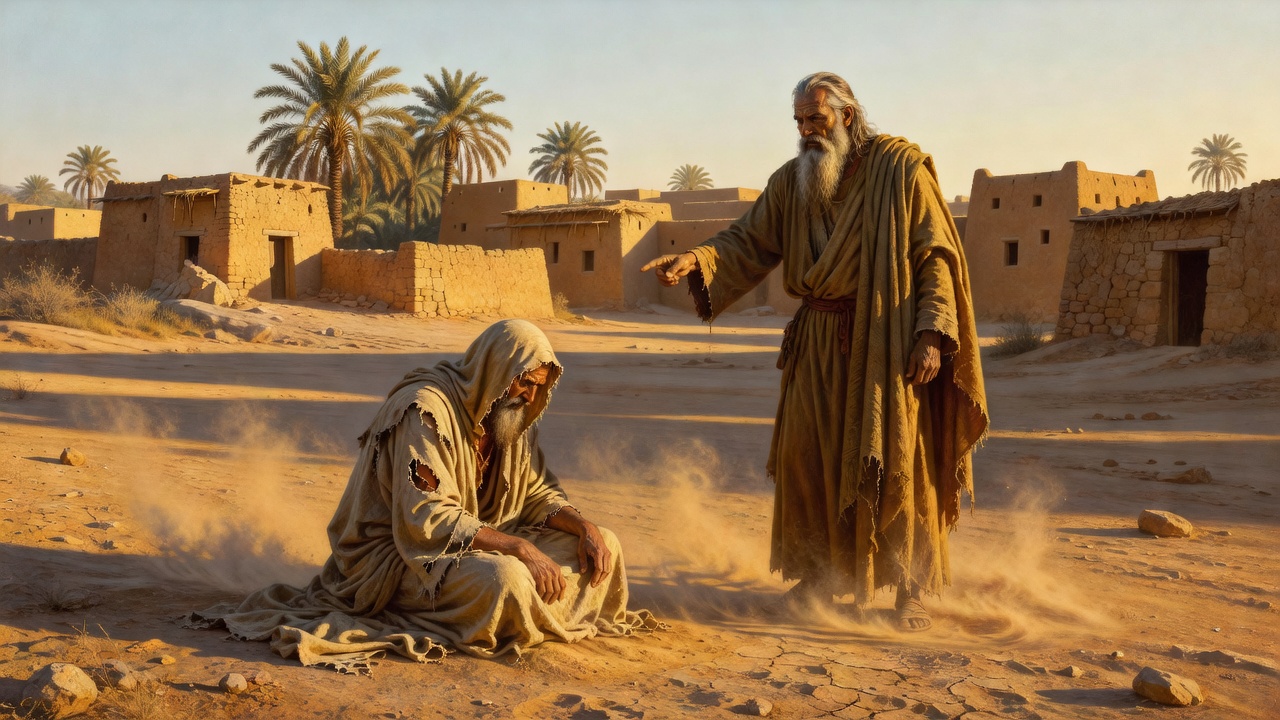
Did you know?
Bildad’s Appeal to Ancient Wisdom
- Bildad is identified as a Shuhite, which likely associates him with Shuah, an Arabian region settled by the descendants of Abraham and Keturah. In this chapter, he delivers the first of his three stern speeches to Job, maintaining that divine justice is absolute and unwavering.Sources: Bildad · the Bible text itself
- Rather than relying on personal experience, Bildad appeals to the accumulated knowledge of ancestral generations, describing human life as brief as a shadow. To argue that the wicked inevitably fall, he uses natural metaphors of marsh reeds withering without water and the fragility of a spider's web.Sources: the Bible text itself
Notes written with AI assistance from open sources (Theographic Bible Metadata, CC BY-SA 4.0; Easton’s Bible Dictionary, public domain) and reviewed before publishing.
Credits and license for this translation
Wycliffe's Bible with Modern Spelling (Enhanced)
English: Wycliffe's Bible Modern Spelling (Enhanced) (with Deuterocanon)
Copyright © 2001,2010,2011,2012,2013,2015 Terry Noble
Language: English
Dialect: Archaic
Translation by: Terry Noble
Wycliffe's Bible with Modern Spelling (Enhanced)
Wycliffe’s Bible with Modern Spelling (Enhanced) is a composite of my Wycliffe’s Bible, a modern-spelling version of the 14th century Middle English translation, consisting of Wycliffe’s Old Testament and Wycliffe’s New Testament, and my modern-spelling version of Wycliffe’s Apocrypha. These books contain literally tens of thousands of rewritten verses, presented in parentheses “( ) “, to provide help in comprehending the 14th century Middle English vocabulary and grammar. Wycliffe’s Apocrypha also includes the books of the Apocrypha from the 1st edition of the King James Version of the Bible.
This translation is made available to you under the terms of the
Creative Commons Attribution-Noncommercial-No Derivatives license 4.0.
You may share and redistribute this Bible translation or extracts from it in any format, provided that:
You include the above copyright and source information.
You do not sell this work for a profit.
You do not change any of the words or punctuation of the Scriptures.
Pictures included with Scriptures and other documents on this site are licensed just for use with those Scriptures and documents.
For other uses, please contact the respective copyright owners.
2019-09-25
Section headings adapted from the Berean Standard Bible (public domain); they are not part of this translation’s text.
Source: http://ebible.org/engwyc2018/ · eBible.org