John 10
Wycliffe's Bible with Modern Spelling (Enhanced) · Tap a verse to see its cross-references.
Jesus the Good Shepherd
1Truly, truly, I say to you, (or Truly, I tell you the truth), he that cometh not in by the door into the fold of [the] sheep, but ascendeth [up] by another way, is a night thief and a day thief.
2But he that entereth by the door, is the shepherd of the sheep.
3To this the porter openeth, and the sheep hear his voice, and he calleth his own sheep by name, and leadeth them out.
4And when he hath done out [or he hath sent out] his own sheep, he goeth before them, and the sheep (pur)sue him (or and the sheep follow him); for they know his voice.
5But they (pur)sue not an alien, but flee from him; for they have not known the voice of aliens. (But they do not follow a stranger, but flee from him; for they do not know the voice of strangers.)
6Jesus said to them this proverb; but they knew not what he spake to them.
7Therefore Jesus said to them again, Truly, truly, I say to you, (or Truly, I tell you the truth), I am the door of the sheep.
8As many as have come, were night thieves and day thieves, but the sheep heard not them (or but the sheep did not listen to them).
9I am the door. If any man shall enter by me, he shall be saved; and he shall go in, and shall go out, and he shall find pastures.
10A night thief cometh not, [no] but that he steal, slay, and lose, (or except to steal, kill, and destroy); and I came, (so) that they (can) have life, and have (it) more plenteously.
11I am a good shepherd; a good shepherd giveth his life for his sheep.
12But an hired hind, and that is not the shepherd, (or But a hired hand, and who is not the shepherd), whose be not the sheep his own [or whose the sheep be not his own], seeth a wolf coming, and he leaveth the sheep, and fleeth; and the wolf ravisheth (or snatcheth up), and scattereth the sheep.
13And the hired hind fleeth, for he is an hired hind, (or And the hired hand fleeth, for he is but a hired hand), and it pertaineth not to him of the sheep.
14I am a good shepherd, and I know my sheep, and my sheep know me.
15As the Father hath known me, I know the Father; and I put (forth or lay down) my life for my sheep.
16I have other sheep, that be not of this fold, and it behooveth me to bring them together, and they shall hear my voice; and there shall be made one fold and one shepherd.
17Therefore the Father loveth me, for I put (forth) my life, that again I take it. (And so the Father loveth me, for I lay down my life, so that I can receive it back again.)
18No man taketh it from me, but I put it of myself. I have power to put it, and I have power to take it again. This commandment I have taken of my Father. (No one taketh it from me, but I lay it down by myself. I have the power to put it forth, and I have the power to receive it back again. This commandment I have received from my Father.)
19Again dissension was made among the Jews for these words.
20And many of them said, He hath a devil, and maddeth, [or waxeth mad]; what hear ye him? (or why listen to him?)
21Other men said, These words be not of a man that hath a devil. Whether the devil may open the eyes of blind men? [or Whether a devil may open the eyes of blind men?]
Jesus at the Feast of Dedication
22But the feasts of (the) hallowing of the temple (or the Feast or the Festival of Dedication) were made in Jerusalem, and it was winter.
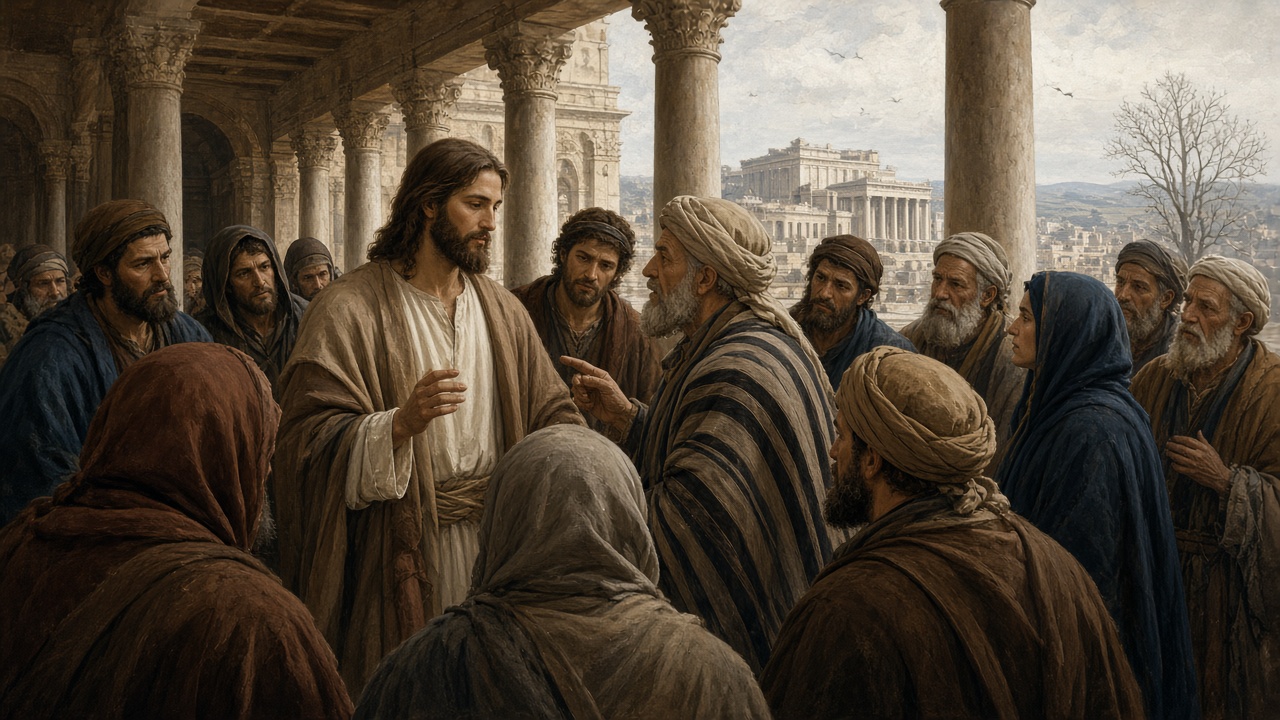
23And Jesus walked in the temple, in (or on) the porch of Solomon.
24Therefore the Jews came about him, and said to him, How long takest thou away our soul? if thou art Christ (or if thou art the Messiah), say thou to us openly [or plainly].
25Jesus answered to them, I speak to you, and ye believe not; the works that I do in the name of my Father, bear witnessing of me (or testify about me).
26But ye believe not, for ye be not of my sheep.
27My sheep hear my voice, and I know them, and they (pur)sue me (or and they follow me).
28And I give to them everlasting life, and they shall not perish [into] without end, and none shall ravish them out of mine hand. (And I give them eternal life, and they shall never perish, and no one shall snatch them out of my hand.)
29That thing that my Father gave to me, is more than all things; and no man may ravish (them), (or can snatch them), from my Father’s hand.
30I and the Father be one.
31The Jews took up stones, to stone him.
32Jesus answered to them, I have showed to you many good works of my Father, for which work of them stone ye me?
33The Jews answered to him, We stone thee not of good work, but of blasphemy, (or We stone thee not for good works, but for thy blasphemy), and for thou, since thou art a man, makest thyself God.
34Jesus answered to them, Whether it is not written in your law, That I said, Ye be gods?
35If he said that they were gods, to whom the word of God was made, and the scripture may not be undone (or and the Scripture cannot be destroyed),
36that that the Father hath hallowed, and hath sent into the world, ye say, That thou blasphemest, for I said, I am God’s Son?
37If I do not the works of my Father, do not ye believe to me;
38but if I do, though ye will not believe to me, believe ye to the works (or believe in the works); (so) that ye know and believe, that the Father is in me, and I in the Father.
39Therefore they sought to take (hold of) him, and he went out of their hands.
John’s Testimony Confirmed
40And he went again over (the) Jordan (or And he went over again to the other side of the Jordan River), into that place where John was first baptizing, and he dwelt there.
41And many came to him, and said, For John did no miracle [or sign]; and all things whatever John said of this (man), were sooth (or were true).
42And many believed in him.
Did you know?
The Good Shepherd
- During the Feast of Dedication in Jerusalem it was winter, and Jesus was walking in the temple courts in Solomon's Colonnade. The name Jerusalem, in a dual form, means "possession of peace" or "foundation of peace"; that form probably refers to the mountains of Zion and Moriah, or, as some suppose, to the upper and lower city. Solomon's Hebrew name, Shelomoh, means "peaceful."Sources: the Bible text itself · Jerusalem · Solomon
- A chronology of Gospel events dates the Good Shepherd teaching to AD 29, and dates a time of teaching and healing from Perea to Jerusalem to AD 30.Sources: The Good Shepherd Teaching · Teaching and Healing in Perea to Jerusalem
- Jesus then went back across the Jordan to the place where John had first been baptizing, and many people there believed in him. John was of priestly descent: his father, Zacharias, was a priest of the course of Abia, and his mother, Elisabeth, was of the daughters of Aaron. His birth, six months before that of Jesus, was foretold by an angel; those who came said that John never performed a sign, yet everything he had said about Jesus was true.Sources: the Bible text itself · John the Baptist
Notes written with AI assistance from open sources (Theographic Bible Metadata, CC BY-SA 4.0; Easton’s Bible Dictionary, public domain) and reviewed before publishing.
Places in this chapter
- Jerusalem · 31.777, 35.234 · verse 22
- Solomon’s Portico · Today: in Jerusalem · 31.777, 35.234 · verse 23
- Jordan · Today: Jordan River · 31.761, 35.558 · verse 40
Only places identified with high confidence are shown (90% or more according to the scholarly sources compiled by OpenBible). Period map: DARE (Digital Atlas of the Roman Empire), CC BY 4.0; modern map: © OpenStreetMap contributors; places: OpenBible.info (CC BY 4.0).
Credits and license for this translation
Wycliffe's Bible with Modern Spelling (Enhanced)
English: Wycliffe's Bible Modern Spelling (Enhanced) (with Deuterocanon)
Copyright © 2001,2010,2011,2012,2013,2015 Terry Noble
Language: English
Dialect: Archaic
Translation by: Terry Noble
Wycliffe's Bible with Modern Spelling (Enhanced)
Wycliffe’s Bible with Modern Spelling (Enhanced) is a composite of my Wycliffe’s Bible, a modern-spelling version of the 14th century Middle English translation, consisting of Wycliffe’s Old Testament and Wycliffe’s New Testament, and my modern-spelling version of Wycliffe’s Apocrypha. These books contain literally tens of thousands of rewritten verses, presented in parentheses “( ) “, to provide help in comprehending the 14th century Middle English vocabulary and grammar. Wycliffe’s Apocrypha also includes the books of the Apocrypha from the 1st edition of the King James Version of the Bible.
This translation is made available to you under the terms of the
Creative Commons Attribution-Noncommercial-No Derivatives license 4.0.
You may share and redistribute this Bible translation or extracts from it in any format, provided that:
You include the above copyright and source information.
You do not sell this work for a profit.
You do not change any of the words or punctuation of the Scriptures.
Pictures included with Scriptures and other documents on this site are licensed just for use with those Scriptures and documents.
For other uses, please contact the respective copyright owners.
2019-09-25
Section headings adapted from the Berean Standard Bible (public domain); they are not part of this translation’s text.
Source: http://ebible.org/engwyc2018/ · eBible.org