Jeremiah 24
Wycliffe's Bible with Modern Spelling (Enhanced) · Tap a verse to see its cross-references.
The Good and Bad Figs
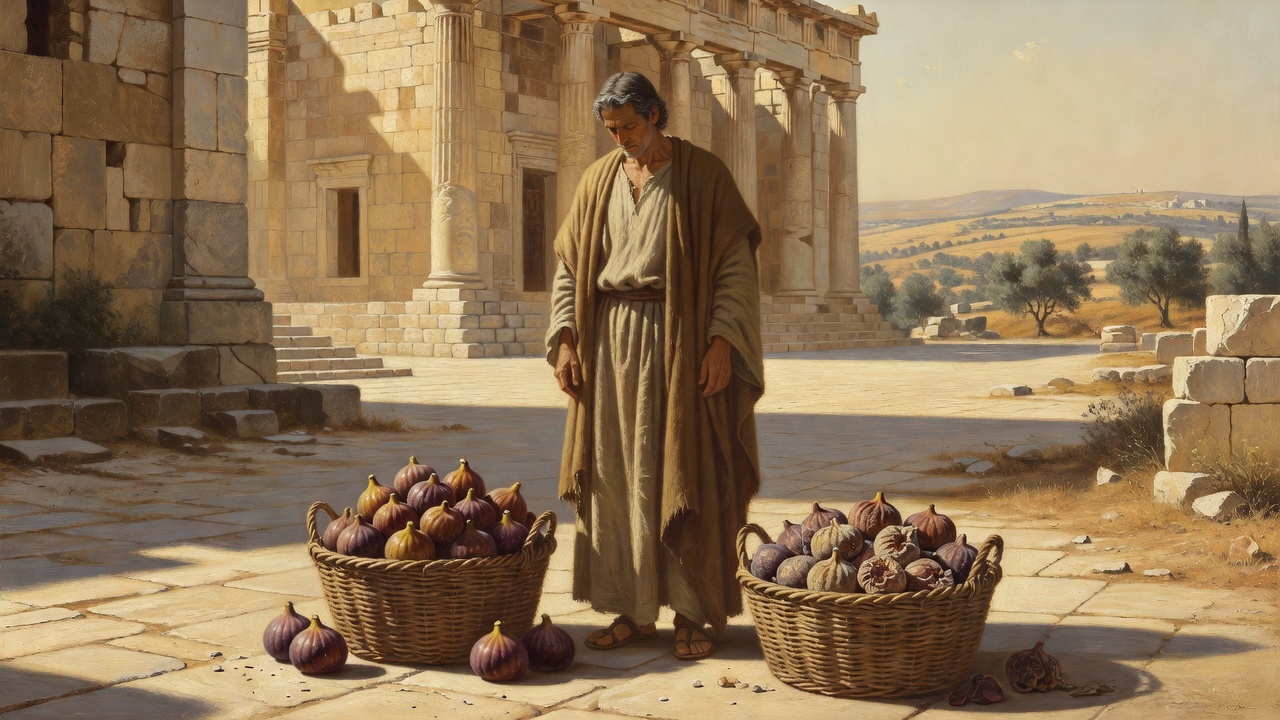
1The Lord showed to me, and lo! two panniers full of figs were set before the temple of the Lord, after that Nebuchadnezzar, king of Babylon, translated Jeconiah, the son of Jehoiakim, the king of Judah, and the princes of him, and a subtle craftsman, and a goldsmith, from Jerusalem, and brought them into Babylon. (The Lord showed to me, and behold! two baskets full of figs (were) put before the Temple of the Lord, after that Nebuchadnezzar, the king of Babylon, had carried away captive Jeconiah, the son of Jehoiakim, the king of Judah, and his princes, (or his leaders), and the craftsmen, and the goldsmiths, from Jerusalem, and brought them to Babylon.)
2And one pannier had full good figs, as figs of the first time be wont to be; and one pannier had full evil figs, that might not be eaten, for those were evil figs.
3And the Lord said to me, Jeremy, what thing seest thou? And I said, Figs, good figs, full good; and evil figs, full evil, that may not be eaten, for those be evil figs. (And the Lord said to me, Jeremiah, what seest thou? And I said, Figs, good figs, very good; and bad figs, very bad, that cannot be eaten, for they be bad, or rotten, figs.)
4And the word of the Lord was made to me, and said,
5The Lord God of Israel saith these things, As these figs be good, so I shall know the transmigration of Judah, which I sent out from this place into the land of Chaldees, into good. (The Lord God of Israel saith these things, Like these figs be good, so I consider those of Judah who be carried away captive, yea, whom I sent out from this place to the land of the Chaldeans, to be good.)
6And I shall set mine eyes on them to please (or And I shall put my eyes on them to do good for them), and I shall bring them again into this land; and I shall build them, and I shall not destroy them; and I shall plant them, and I shall not draw (them) up by the root.
7And I shall give to them an heart, that they (would) know me, for I am the Lord; and they shall be into a people to me, and I shall be into God to them, for they shall turn again to me in all their heart. (And I shall give them a heart, that they would desire to know me, for I am the Lord; and they shall be my people, and I shall be their God, for they shall return to me with all their heart.)
8And as the worst figs be, that may not be eaten, for those be evil figs, the Lord saith these things, So I shall give Zedekiah, the king of Judah, and the princes of him, and other men of Jerusalem, that dwell in this city, and that dwell in the land of Egypt. (And as for the worst figs that cannot be eaten, for they be evil figs, saith the Lord, so I shall consider Zedekiah, the king of Judah, and his princes, or his leaders, and the other people of Jerusalem, who live in this city, and who live in the land of Egypt.)
9And I shall give them into travailing and (into) torment in all (the) realms of (the) earth, into reproof (or into reproach), and into parable, and into a proverb, and into cursing, in all places to which I casted them out.
10And I shall send in them sword, and hunger, and pestilence, till they be wasted from the land which I gave to them, and to the fathers of them. (And I shall send against them the sword, and hunger, and pestilence, until they be wasted from off the land which I gave to them, and to their forefathers.)
Did you know?
The Two Baskets of Figs
- Jeremiah received this vision after King Nebuchadnezzar of Babylon deported King Jeconiah (also called Jehoiachin), along with the officials, craftsmen, and metalsmiths of Jerusalem. Nebuchadnezzar subsequently installed Zedekiah as king over the remaining population in Judah.Sources: the Bible text itself · Jehoiachin · Zedekiah · Nebuchadnezzar
- In the vision set before the temple, the basket of prime, early-ripening figs symbolizes the exiles carried off to Babylon. The Lord promises to preserve them, give them a heart to know him, and restore them to their land.Sources: the Bible text itself
- In contrast, the basket of rotten, inedible figs symbolizes King Zedekiah, his leaders, and the remnant staying in Judah or fleeing to Egypt. Instead of finding security, they are warned of disaster, famine, disease, and derision among the nations.Sources: the Bible text itself · Zedekiah · Egypt
Notes written with AI assistance from open sources (Theographic Bible Metadata, CC BY-SA 4.0; Easton’s Bible Dictionary, public domain) and reviewed before publishing.
Places in this chapter
- Babylon · 32.543, 44.422 · verse 1
- Jerusalem · 31.777, 35.234 · verses 1, 8
- Chaldea · 30.962, 46.104 · verse 5
- Egypt · 30.129, 31.308 · verse 8
Only places identified with high confidence are shown (90% or more according to the scholarly sources compiled by OpenBible). Period map: DARE (Digital Atlas of the Roman Empire), CC BY 4.0; modern map: © OpenStreetMap contributors; places: OpenBible.info (CC BY 4.0).
Credits and license for this translation
Wycliffe's Bible with Modern Spelling (Enhanced)
English: Wycliffe's Bible Modern Spelling (Enhanced) (with Deuterocanon)
Copyright © 2001,2010,2011,2012,2013,2015 Terry Noble
Language: English
Dialect: Archaic
Translation by: Terry Noble
Wycliffe's Bible with Modern Spelling (Enhanced)
Wycliffe’s Bible with Modern Spelling (Enhanced) is a composite of my Wycliffe’s Bible, a modern-spelling version of the 14th century Middle English translation, consisting of Wycliffe’s Old Testament and Wycliffe’s New Testament, and my modern-spelling version of Wycliffe’s Apocrypha. These books contain literally tens of thousands of rewritten verses, presented in parentheses “( ) “, to provide help in comprehending the 14th century Middle English vocabulary and grammar. Wycliffe’s Apocrypha also includes the books of the Apocrypha from the 1st edition of the King James Version of the Bible.
This translation is made available to you under the terms of the
Creative Commons Attribution-Noncommercial-No Derivatives license 4.0.
You may share and redistribute this Bible translation or extracts from it in any format, provided that:
You include the above copyright and source information.
You do not sell this work for a profit.
You do not change any of the words or punctuation of the Scriptures.
Pictures included with Scriptures and other documents on this site are licensed just for use with those Scriptures and documents.
For other uses, please contact the respective copyright owners.
2019-09-25
Section headings adapted from the Berean Standard Bible (public domain); they are not part of this translation’s text.
Source: http://ebible.org/engwyc2018/ · eBible.org