Jeremiah 18
Wycliffe's Bible with Modern Spelling (Enhanced) · Tap a verse to see its cross-references.
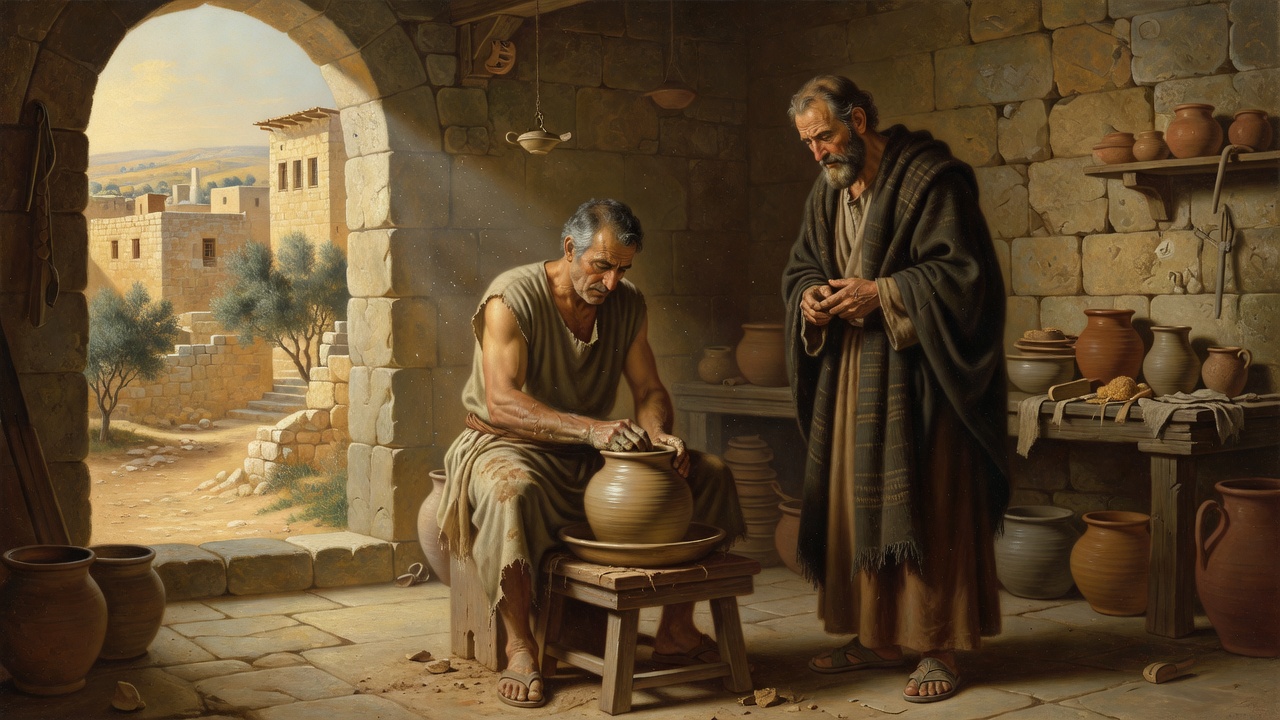
The Potter and the Clay
1The word that was made of the Lord to Jeremy, and said, (The word of the Lord that was made to Jeremiah, and said,)
2Rise thou, and go down into the house of a potter, and there thou shalt hear my words.
3And I went down into the house of a potter, and lo! he made a work on a wheel.
4And the vessel was destroyed, which he made of clay with his hands; and he turned it, and made it another vessel, as it pleased in his eyes to make. (And when the vessel, which he made out of clay with his hands, was not acceptable, he turned it again, and made it into another vessel, which did please his eyes.)
5And the word of the Lord was made to me, and he said,
6Whether as this potter doeth, I may not do to you, the house of Israel? saith the Lord. Lo! as clay is in the hand of a potter, so ye, the house of Israel, be in mine hand, (or Behold! like clay (is) in a potter’s hands, so ye, the house of Israel, (be) in my hands).
7Suddenly I shall speak against a folk, and against a realm, that I draw (it) out, and destroy (it), and lose it.
8If that folk doeth penance of his evil, which I spake against it, also I shall do penance on the evil, which I thought to do to it. (But if that nation doeth penance for their evil, for which I spoke against them, then I shall do penance for the evil, which I thought to do to them.)
9And I shall speak suddenly of a folk, and of a realm, that I build, and plant it. (And at any moment I shall speak of a nation, or of a kingdom, that I build it, or that I plant it.)
10(But) If it doeth evil before mine eyes, (and) that it hear not my voice, (then) I shall do penance on the good which I spake, that I should do to it.
11Now therefore say thou to a man of Judah, and to the dweller of Jerusalem, and say, The Lord saith these things, Lo! I make evil against you, and I think a thought against you; each man turn again from his evil way, and (ad)dress ye your ways and your studies. (And so now say thou to the people of Judah, and to the inhabitants of Jerusalem, The Lord saith these things, Behold! I make evil plans against you, and I think thoughts against you; each person turn away from their evil ways, and direct, (or amend), ye your ways and your deeds.)
12Which said, We have despaired, for we shall go after our thoughts, and we shall do each man the shrewdness of his evil heart. (But they said, We despair, for we feel that we must go after our own thoughts, and each person doeth the depravity of his own evil heart.)
13Therefore the Lord saith these things, Ask ye heathen men, who heard such horrible things, which the virgin of Israel hath done greatly? (And so the Lord saith these things, Ask ye the heathen, who hath heard of such a horrible thing, as that which the virgin of Israel hath done?)
14Whether [the] snow of the Lebanon shall fail from the stone of the field? either cold waters breaking out, and floating down, may be taken away? (Shall the snow in Lebanon fail to fall on the stones of the field? or shall cold water breaking out, and flowing down, not be taken away?)
15For my people hath forgotten me, and they offered sacrifices in vain, and stumbled in their ways, and in the paths of the world, (or and stumbled on their own ways, and on the paths of the world), (so) that they went by those in a way not trodden;
16that the land of them should be into desolation, and into an hissing everlasting; for why each that passeth by it, shall be astonied, and shall move his head. (so that their land now be into desolation, and into an everlasting hissing; for each person who passeth by it shall be astonished, and shall move their head.)
17As a burning wind I shall scatter them before the enemy (or Like a burning wind I shall scatter them before the enemy); I shall show to them the back and not the face, in the day of the perdition of them.
Another Plot against Jeremiah
18And they said, Come ye, and think we thoughts against Jeremy; for why the law shall not perish from a priest, neither counsel shall perish from a wise man, neither word shall perish from a prophet, (or for the Law shall never perish from, (or be lost to), a priest, nor good advice from a wise man, nor (God’s) word from a prophet); come ye, and smite we him with (the) tongue, and take we none heed to all the words of him.
19Lord, give thou attention to me, and hear thou the voice of mine adversaries.
20Whether evil is yielded for good, for they have digged a pit to my soul; have thou mind, that I stood in thy sight, to speak good for them, and to turn away thine indignation from them. (Shall evil be yielded for good, for they have dug a pit for me; remember, O Lord, that I stood in thy sight, to speak good of them, and to turn away thy indignation from them.)
21Therefore give thou the sons of them into hunger, and lead forth them into the hands of [the] sword; the wives of them be made without children, and be made widows, and the husbands of them be slain by death; the young men of them be pierced together by sword in battle. (And so give thou their sons into hunger, and lead them forth into the hands of the sword; let their wives be made without children, and be made widows, and let their husbands be killed; and let their young men be altogether pierced by the sword in battle.)
22Cry be heard of the houses of them, for thou shalt bring suddenly a thief on them; for they digged a pit to take me, and hid snares to my feet. (Let a cry be heard from their houses, for thou shalt suddenly bring a thief upon them; for they dug a pit to catch me, and hid snares for my feet.)
23But thou, Lord, knowest all the counsel of them against me into death; do thou not mercy to the wickedness of them, and the sin of them be not done away from thy face; be they made falling down in thy sight, in the time of thy strong vengeance; use thou them to other thing than they were ordained (or use thou them for something other than what they were ordained for).
Did you know?
The Potter and the Clay
- At the potter's house, Jeremiah observes an artisan reshaping a spoiled vessel on the wheel into another pot. The passage uses this craft to illustrate divine authority and conditional judgment: if a nation turns from evil after being warned, disaster is averted, but if a nation turns to evil, intended blessings are withheld.Sources: the Bible text itself
- The prophecy contrasts Israel's abandonment of God with the constancy of the natural world, asking if the snow of Lebanon ever departs from its rocky crags. The mountain range of Lebanon, whose name means white, was notable for its lofty peaks and enduring cold streams.Sources: Lebanon · the Bible text itself
- The conspiracy against Jeremiah was driven by opponents who assumed religious security, arguing that instruction would never be lost to the priest, counsel to the wise, or the divine word to the prophet. Jeremiah's message of impending ruin directly challenged this institutional confidence.Sources: Jeremiah · the Bible text itself
Notes written with AI assistance from open sources (Theographic Bible Metadata, CC BY-SA 4.0; Easton’s Bible Dictionary, public domain) and reviewed before publishing.
Places in this chapter
- Jerusalem · 31.777, 35.234 · verse 11
- Lebanon · 33.540, 35.584 · verse 14
- Mount Hermon · 33.400, 35.850 · verse 14
Only places identified with high confidence are shown (90% or more according to the scholarly sources compiled by OpenBible). Period map: DARE (Digital Atlas of the Roman Empire), CC BY 4.0; modern map: © OpenStreetMap contributors; places: OpenBible.info (CC BY 4.0).
Credits and license for this translation
Wycliffe's Bible with Modern Spelling (Enhanced)
English: Wycliffe's Bible Modern Spelling (Enhanced) (with Deuterocanon)
Copyright © 2001,2010,2011,2012,2013,2015 Terry Noble
Language: English
Dialect: Archaic
Translation by: Terry Noble
Wycliffe's Bible with Modern Spelling (Enhanced)
Wycliffe’s Bible with Modern Spelling (Enhanced) is a composite of my Wycliffe’s Bible, a modern-spelling version of the 14th century Middle English translation, consisting of Wycliffe’s Old Testament and Wycliffe’s New Testament, and my modern-spelling version of Wycliffe’s Apocrypha. These books contain literally tens of thousands of rewritten verses, presented in parentheses “( ) “, to provide help in comprehending the 14th century Middle English vocabulary and grammar. Wycliffe’s Apocrypha also includes the books of the Apocrypha from the 1st edition of the King James Version of the Bible.
This translation is made available to you under the terms of the
Creative Commons Attribution-Noncommercial-No Derivatives license 4.0.
You may share and redistribute this Bible translation or extracts from it in any format, provided that:
You include the above copyright and source information.
You do not sell this work for a profit.
You do not change any of the words or punctuation of the Scriptures.
Pictures included with Scriptures and other documents on this site are licensed just for use with those Scriptures and documents.
For other uses, please contact the respective copyright owners.
2019-09-25
Section headings adapted from the Berean Standard Bible (public domain); they are not part of this translation’s text.
Source: http://ebible.org/engwyc2018/ · eBible.org