Isaiah 64
Wycliffe's Bible with Modern Spelling (Enhanced) · Tap a verse to see its cross-references.
A Prayer for God’s Power
1I would that thou brakest heavens, and camest down, that hills floated away from thy face, (O that thou wouldest break open the heavens, and come down, and that the hills would flow down before thee,)
2and failed, [or vanish away], as the burning of fire, and (as) [waters] burnt in (the) fire; that thy name were made known to thine enemies, and folks were troubled of thy face. (and tremble, and perish, like something burned in the fire, or like water boiled by the fire; so that thy name was made known to thy enemies, and the nations were troubled before thee.)
3When thou shalt do marvels, we shall not abide. Thou camest down, and hills floated away from thy face. (There was a time when thou camest down, and did terrible things, which we did not expect; and the hills flowed down before thee.)
4From the world they heard not, neither perceived with ears; God, none eye saw, without thee, what things thou hast made ready to them that abide thee. (From the beginning of the world, none have heard of, nor have perceived with their ears; and not one eye hath seen anyone besides thee, O God, who hath made such things as thou hast, for those who wait for thee.)
5Thou mettest him that is glad, and doeth rightfulness; in thy ways they shall bethink on thee. Lo! thou art wroth, and we sinned; in those sins we were ever, and we shall be saved. (Thou meetest him who is happy to do what is right; yea, all those who remember thee in thy ways. But behold! thou wast angry, for we sinned; and we were ever in those (sins).)
6And all we be made as an unclean man; all our rightfulnesses be as the cloth of a woman in menstruation, or unclean blood; and all we fell down as a leaf, and our wickednesses, as (the) wind, have taken away us. (And we all be made like an unclean man; all our righteousnesses be like the cloth of a woman in menstruation, or in unclean blood; and we all fell down like a leaf, and our wickednesses have taken us away, like the wind.)
7None is, that calleth thy name to help, that riseth, and holdeth thee; thou hast hid thy face from us, and thou hast hurtled down us in (to) the hand of our wickedness. (There is no one who calleth on thy name for help, or who riseth up, and taketh hold of thee; and so thou hast hid thy face from us, and thou hast hurtled us down into the hand, or the power, of our own wickedness.)
8And now, Lord, thou art our father; forsooth we be clay, and thou art our maker, and all we be the works of thine hands. (But now, Lord, thou art our father; and we be but clay, and thou art our Maker, and we all be the works of thy hands.)
9Lord, be thou not wroth (any more than) enough, and have thou no more mind on our wickedness. Lo! Lord, behold thou, all we be thy people. (Lord, be thou not angry any more than enough, and no more remember thou our wickedness. Behold! Lord, behold thou, we all (be) thy people.)
10The city of thy holy, either saintuary, is forsaken, Zion is made desert, Jerusalem is made desolate; (Thy holy cities be deserted, Zion is made a wilderness, Jerusalem is made desolate;)
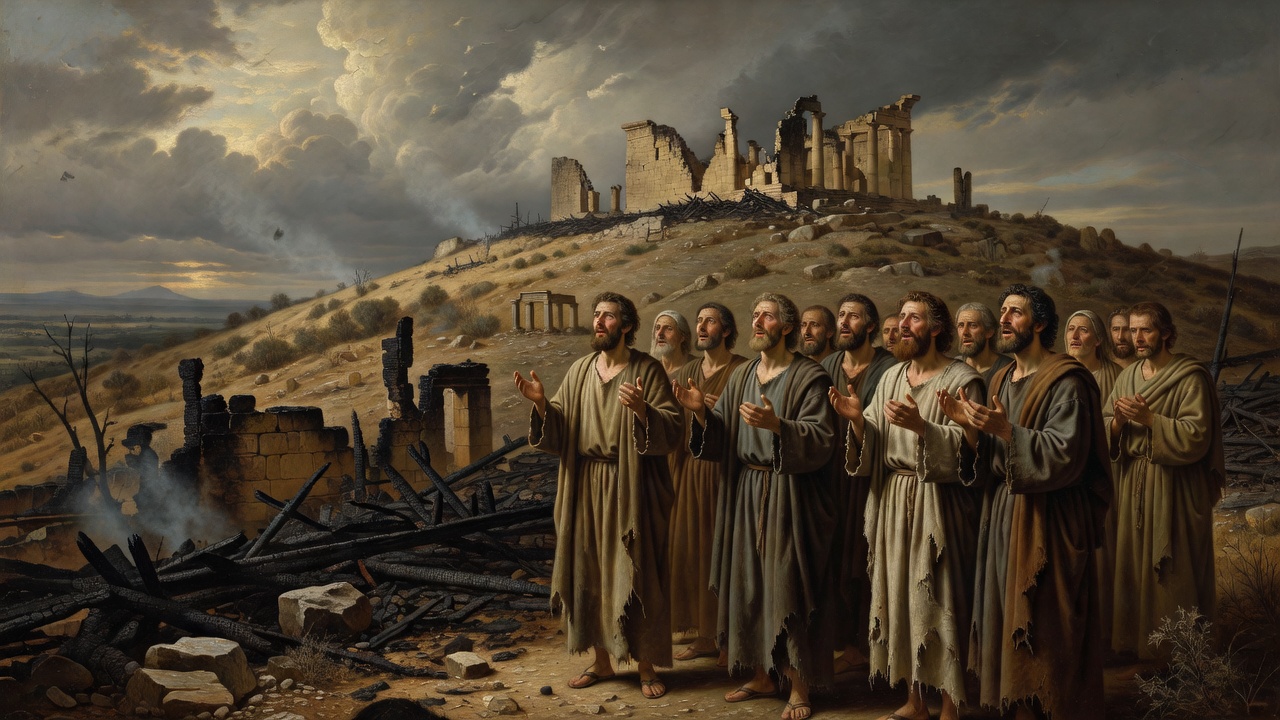
11the house of our hallowing and of our glory, where our fathers praised thee, is made into (a) burning of fire; and all our desirable things be turned into fallings. (our glorious holy Temple, where our forefathers praised thee, hath been burned into ashes; and all the things that we desired, or cherished, be turned into ruins.)
12Lord, whether on these things thou shalt withhold thee? shalt thou be still, and shalt thou torment us greatly? (Lord, shalt thou still withhold thyself after all these things that have happened? shalt thou still be silent, and shalt thou still greatly torment us?)
Did you know?
A Prayer for Mercy Amid Ruin
- The passage opens with a plea for God to rend the heavens and descend with world-shaking power, like fire that kindles brushwood. Yet it contrasts this desire for divine presence with a confession of human unworthiness, comparing people to withering leaves swept away by their own iniquities.Sources: the Bible text itself
- In Isaiah 64, the community appeals to God as a Father and craftsman, declaring, "we are the clay, and You are the potter." This imagery emphasizes human frailty and total dependence on God, pleading for divine mercy despite their acknowledged guilt.Sources: the Bible text itself
- The chapter laments the destruction of sacred spaces, describing Zion and Jerusalem as desolate wastelands. It specifically mourns the burning and ruin of the holy temple where past generations had offered praise.Sources: the Bible text itself · Zion · Jerusalem
Notes written with AI assistance from open sources (Theographic Bible Metadata, CC BY-SA 4.0; Easton’s Bible Dictionary, public domain) and reviewed before publishing.
Places in this chapter
Only places identified with high confidence are shown (90% or more according to the scholarly sources compiled by OpenBible). Period map: DARE (Digital Atlas of the Roman Empire), CC BY 4.0; modern map: © OpenStreetMap contributors; places: OpenBible.info (CC BY 4.0).
Credits and license for this translation
Wycliffe's Bible with Modern Spelling (Enhanced)
English: Wycliffe's Bible Modern Spelling (Enhanced) (with Deuterocanon)
Copyright © 2001,2010,2011,2012,2013,2015 Terry Noble
Language: English
Dialect: Archaic
Translation by: Terry Noble
Wycliffe's Bible with Modern Spelling (Enhanced)
Wycliffe’s Bible with Modern Spelling (Enhanced) is a composite of my Wycliffe’s Bible, a modern-spelling version of the 14th century Middle English translation, consisting of Wycliffe’s Old Testament and Wycliffe’s New Testament, and my modern-spelling version of Wycliffe’s Apocrypha. These books contain literally tens of thousands of rewritten verses, presented in parentheses “( ) “, to provide help in comprehending the 14th century Middle English vocabulary and grammar. Wycliffe’s Apocrypha also includes the books of the Apocrypha from the 1st edition of the King James Version of the Bible.
This translation is made available to you under the terms of the
Creative Commons Attribution-Noncommercial-No Derivatives license 4.0.
You may share and redistribute this Bible translation or extracts from it in any format, provided that:
You include the above copyright and source information.
You do not sell this work for a profit.
You do not change any of the words or punctuation of the Scriptures.
Pictures included with Scriptures and other documents on this site are licensed just for use with those Scriptures and documents.
For other uses, please contact the respective copyright owners.
2019-09-25
Section headings adapted from the Berean Standard Bible (public domain); they are not part of this translation’s text.
Source: http://ebible.org/engwyc2018/ · eBible.org