Isaiah 15
Wycliffe's Bible with Modern Spelling (Enhanced) · Tap a verse to see its cross-references.
The Burden against Moab
1The burden of Moab. For Ar was destroyed in (the) night, Moab was still; for the wall was destroyed in the night, Moab was still. (The burden of Moab. For Ar was destroyed in the night, Moab is now silent; and for Kir was destroyed in the night, Moab is now silent.)
2The king’s house, and Dibon ascended to high places, into wailing; on Nebo, and on Medeba, Moab shall yell. In all heads thereof shall be baldness, and each beard shall be shaved. (The daughter, or the people, of Dibon go up to the hill shrines to weep; Moab shall yell, or shall wail, about Nebo, and about Medeba. On all their heads shall be baldness, and each beard shall be shaved.)
3In the meeting of three ways thereof they be girded in a sackcloth, all yelling on the houses thereof, and in the streets thereof; it shall go down into weeping (or they shall go down weeping).
4Heshbon shall cry (out), and Elealeh, (and) the voice of them is heard till to Jahaz (or and their voice is heard unto Jahaz); on this thing the ready men of Moab shall yell (with fear), the soul thereof shall yell to itself (in fear).
5Mine heart shall cry to Moab, the bars thereof till to Zoar, a cow calf of three years, (or My heart shall cry out for Moab, for its barons, or its nobles, have fled unto Zoar, and unto Eglath Shelishiyah). For why a weeper shall go up by the going up of Luhith, and in the way of Horonaim they shall raise (up a) cry of sorrow.
6For why the waters of Nimrim shall be forsaken; for the herb dried up, burgeoning failed, all greenness perished. (For the waters of Nimrim shall dry up; and the herbs shall dry up, and the burgeoning shall fail, and all greenness shall perish.)
7By the greatness of work, and the visiting of them, to the strand of sallows they shall lead them. (And they shall carry their abundance, and all that they possess, over the Stream, or the Valley, of the Willows.)
8For why (their) cry compassed the end of Moab; till to Eglaim the yelling thereof, and the cry thereof till to the well of Elim. (For their cry went about unto the end of Moab; their yelling unto Eglaim, and their cry unto Beerelim.)
9For the waters of Dimon be filled with blood; for I shall set increasings on Dimon, to those men of Moab that fled from the lion, and to the remnants of the land. (And the waters of Dimon be filled with blood; and I shall put more troubles upon Dimon, yea, I shall send lions upon those people who fled from Moab, and upon the remnants of the land.)
Did you know?
The Oracle Concerning Moab
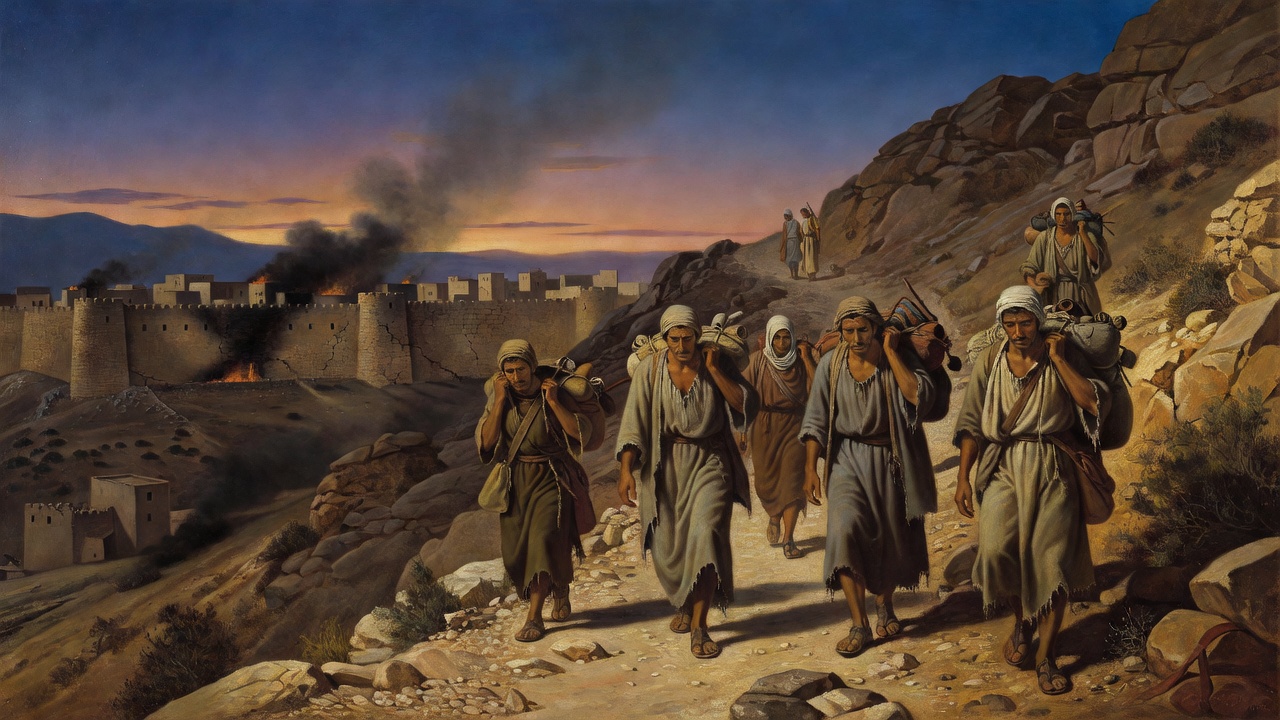
- Moab was a territory situated east of the Dead Sea and the Jordan River, containing ancient settlements such as Ar, Kir, and Medeba. In this chapter, the prophet laments the sudden overnight destruction and wailing throughout these Moabite towns and high places.Sources: Moab · Medeba · the Bible text itself
- The chapter depicts traditional ancient mourning rituals practiced across the region in times of catastrophe. As grief overtakes the land, the people of Moab shave their heads, cut off their beards, and put on sackcloth while weeping publicly in the squares and on flat rooftops.Sources: the Bible text itself
- The city of Dibon, situated north of the Arnon River and east of the Dead Sea, is also identified as Dimon in Isaiah 15:9. The oracle vividly portrays the severity of the invasion by describing the waters of Dimon filled with blood while surviving refugees flee.Sources: Dibon · the Bible text itself
Notes written with AI assistance from open sources (Theographic Bible Metadata, CC BY-SA 4.0; Easton’s Bible Dictionary, public domain) and reviewed before publishing.
Places in this chapter
- Moab · Today: Moab 1 · 31.181, 35.701 · verses 1, 2, 4, 5, 8, 9
- Dibon · Today: Tall Dhiban · 31.502, 35.777 · verse 2
- Medeba · Today: Madaba · 31.716, 35.795 · verse 2
Only places identified with high confidence are shown (90% or more according to the scholarly sources compiled by OpenBible). Period map: DARE (Digital Atlas of the Roman Empire), CC BY 4.0; modern map: © OpenStreetMap contributors; places: OpenBible.info (CC BY 4.0).
Credits and license for this translation
Wycliffe's Bible with Modern Spelling (Enhanced)
English: Wycliffe's Bible Modern Spelling (Enhanced) (with Deuterocanon)
Copyright © 2001,2010,2011,2012,2013,2015 Terry Noble
Language: English
Dialect: Archaic
Translation by: Terry Noble
Wycliffe's Bible with Modern Spelling (Enhanced)
Wycliffe’s Bible with Modern Spelling (Enhanced) is a composite of my Wycliffe’s Bible, a modern-spelling version of the 14th century Middle English translation, consisting of Wycliffe’s Old Testament and Wycliffe’s New Testament, and my modern-spelling version of Wycliffe’s Apocrypha. These books contain literally tens of thousands of rewritten verses, presented in parentheses “( ) “, to provide help in comprehending the 14th century Middle English vocabulary and grammar. Wycliffe’s Apocrypha also includes the books of the Apocrypha from the 1st edition of the King James Version of the Bible.
This translation is made available to you under the terms of the
Creative Commons Attribution-Noncommercial-No Derivatives license 4.0.
You may share and redistribute this Bible translation or extracts from it in any format, provided that:
You include the above copyright and source information.
You do not sell this work for a profit.
You do not change any of the words or punctuation of the Scriptures.
Pictures included with Scriptures and other documents on this site are licensed just for use with those Scriptures and documents.
For other uses, please contact the respective copyright owners.
2019-09-25
Section headings adapted from the Berean Standard Bible (public domain); they are not part of this translation’s text.
Source: http://ebible.org/engwyc2018/ · eBible.org