Ezekiel 17
Wycliffe's Bible with Modern Spelling (Enhanced) · Tap a verse to see its cross-references.
The Parable of Two Eagles and a Vine
1And the word of the Lord was made to me, and he said,
2Son of man, set forth a dark speech, and tell thou a parable to the house of Israel;
3and thou shalt say, The Lord God saith these things. A great eagle of great wings, with long stretching out of members, full of feathers and of diversity, came to the Lebanon, and took away the marrow of the cedar.
4He pulled away the highness of (the) boughs thereof, and bare it over into the land of Canaan, and setted it in the city of merchants. (He pulled away the highness of its branches, and carried it into the land of merchandising, and put it in the city of merchants.)
5And he took of the seed of the land, and setted it in the land for seed, that it should make steadfast root on many waters (or so that it would make a steadfast root by many waters); and he setted it in the higher part.
6And when it had grown, it increased into a larger vinery, in low stature; for the boughs thereof beheld to that eagle, and the roots thereof were under that eagle; therefore it was made a vinery, and it made fruit into scions, and sent out boughs. (And when it had grown, it increased into a long spreading vine, on the ground; for its branches looked upward to that eagle, and its roots were under that eagle; and so it was made a vine, and it made its fruit among the leaves, and sent out its branches.)
7And another great eagle was made, with great wings, and many feathers; and lo! this vinery as sending his roots to that eagle, stretched forth his scions to that eagle, that he should moist it (out) of the cornfloors of his seed. (And another great eagle was made, with great wings, and many feathers; and behold! this vine sending its roots toward that (eagle), stretched forth its leaves toward that (eagle), so that it could water itself from the threshing floors of its seed.)
8Which is planted in a good land on many waters, that it make boughs, and bear fruit, that it be into a great vinery. (Which is planted in a good land by many waters, so that it can make branches, and bear fruit, and so that it be a great vine.)
9Say thou, Ezekiel, The Lord God saith these things, Therefore whether he shall have prosperity? Whether Nebuchadnezzar shall not pull away the roots of him, and shall constrain the fruits of him? And he shall make dry all the scions of burgeoning thereof, and it shall be dry; and not in great arm, neither in much people, that he should draw it out by the roots. (Say thou, Ezekiel, The Lord God saith these things, And so shall it have prosperity? Shall Nebuchadnezzar not pull away its roots, and shall constrain its fruit? And he shall make dry all the leaves of its burgeoning, and it shall be dry; and he shall not need a great arm, nor a great many people, to draw it out by its roots.)
10Lo! it is planted, therefore whether it shall have prosperity? Whether not when burning wind shall touch it, it shall be made dry, and shall wax dry in the cornfloors of his seed? (or and shall grow dry on the threshing floors of its seed?)
The Parable Explained
11And the word of the Lord was made to me, and he said,
12Say thou to the house (of Israel) stirring (me) to wrath, Know ye not what these things signify? Say thou, Lo! the king of Babylon cometh into Jerusalem; and he shall take the king and the princes thereof, and he shall lead them to himself into Babylon, (or and he shall take hold of the king and its princes, or its leaders, and he shall bring them back with himself to Babylon).
13And he shall take of the seed of the realm, and shall smite with it a bond of peace, and he shall take of it an oath; but also he shall take away the strong men of the land, (And he shall take one of the king’s children, and shall strike a covenant, or a treaty, with him, and he shall make him swear an oath; and he shall also take away the strong men of the land,)
14that it be a meek realm, and be not raised [up], but that it keep the covenant of him, and hold it. (so that it be a humble kingdom, and not be raised up, but that it keep his covenant, and hold it firm.)
15Which went away from him, and sent messengers into Egypt, that it should give to him horses and much people. Whether he that did these things, shall have prosperity, either shall get health? and whether he that breaketh [a] covenant, shall escape? (Who then went away from him, and sent messengers to Egypt, that they should give him horses and a great many people. Shall he who did these things, have prosperity, or shall get salvation, or deliverance? and shall he who breaketh a covenant, be able to escape?)
16(As) I live, saith the Lord God, for in the place of the king that made him king (or for there in the place of the king who made him king), whose oath he made void, and brake the covenant, which he had with him, (there) in the midst of Babylon he shall die.
17And not in great host, neither in much people, Pharaoh shall make battle against him, in the casting (up) of [an heap of] earth, and in building of pales, that he slay many persons. (And not with a great army, nor with a great many people, shall Pharaoh make battle against him, in the throwing up of heaps of earth, and in the building of stockades, that he kill many people.)
18For he despised the oath, that he should break the bond of peace, and lo! he gave his hand; and when he hath done all these things, he shall not escape. (For he had so despised the oath, that he broke the covenant, (or the treaty), and behold! he had raised up his hand, (or he had sworn an oath to it); and now that he hath done all these things, he shall not escape.)
19Therefore the Lord God saith these things, (As) I live, for I shall set on his head the oath which he despised, and the bond of peace which he brake (or and the covenant which he broke).
20And I shall spread abroad my net [up] on him, and he shall be taken in my net, and I shall bring him into Babylon; and there I shall deem him in the trespassing, by which he despised me, (or and there I shall judge him for the trespassing, by which he despised me).
21And all his fleers-away with all his company shall fall down by sword, forsooth the remnants shall be scattered into each wind; and ye shall know, that I the Lord spake.
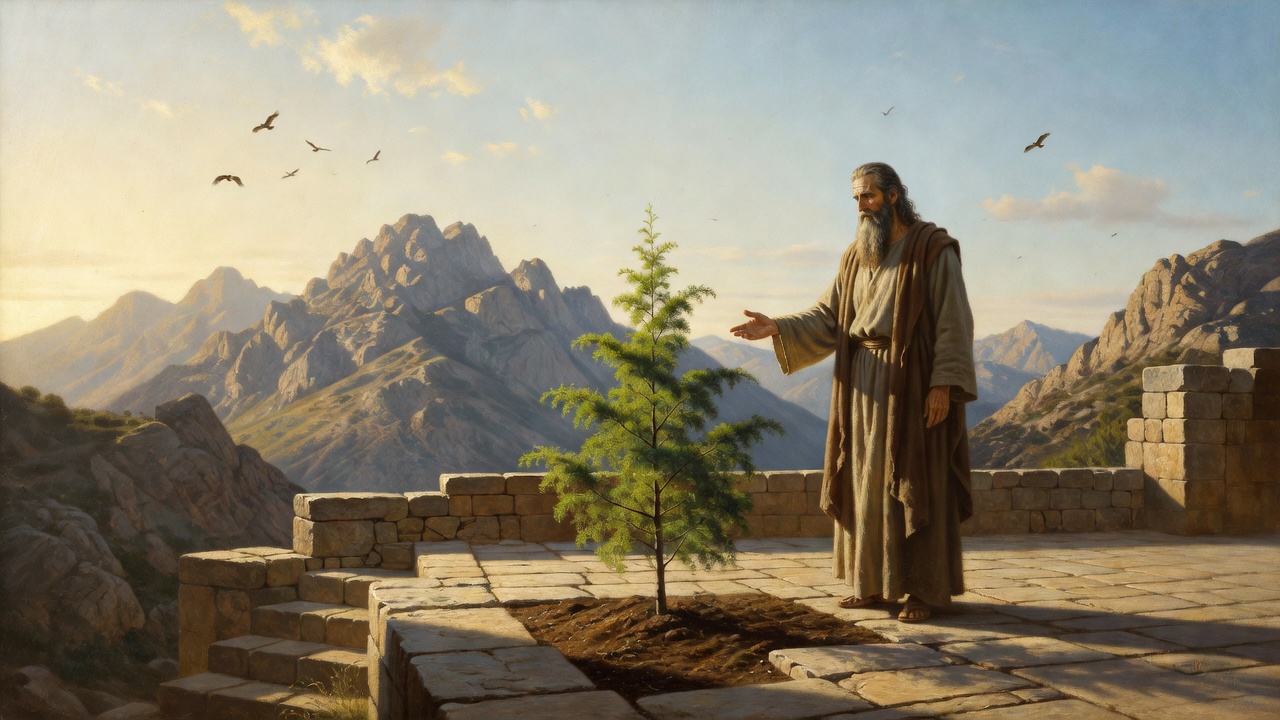
22The Lord God saith these things, And I shall take of the marrow of an high cedar, and I shall set a tender thing of the top of his branches (or and I shall break a tender thing from off the top of its branches); I shall constrain (it), and I shall plant (it) on an high hill, and appearing far (off).
23In the high hill of Israel I shall plant it; and it shall break out into burgeoning, and it shall make fruit, and it shall be into a great cedar, and all birds shall dwell under it; each volatile shall make (a) nest under the shadow of his boughs. (On the high hill of Israel I shall plant it; and it shall break out into burgeoning, and it shall make fruit, and it shall be a great cedar, and all the birds shall live under it; each bird shall make a nest under the shadow of its branches.)
24And all [the] trees of the country shall know, that I am the Lord; I made low the high tree, and I enhanced the low tree, and I made dry the green tree, and I made the dry tree to bring forth boughs; I the Lord have spoken, and I have done. (And all the trees of the countryside shall know, that I am the Lord; I made low the high tree, and I lifted, or I raised, up the low tree, and I dried up the green tree, and I made the dry tree to bring forth branches; I the Lord have spoken, and I have done it.)
Did you know?
The Parable of the Eagles and the Cedar
- Ezekiel presents a political allegory where the first great eagle represents the king of Babylon, who captured Jerusalem's royal leadership and established a vassal king under a solemn covenant. The second eagle represents Egypt and its Pharaoh, to whom the Judean ruler turned for cavalry and military assistance in defiance of his sworn allegiance.Sources: the Bible text itself · Babylon · Egypt · Pharaoh
- In the prophetic message, breaking a political vassal oath made under Babylon was treated not merely as diplomatic rebellion, but as spiritual treason against God, who regarded the sworn pledge as His own oath.Sources: the Bible text itself
- The chapter concludes with a reversal of human political schemes: God Himself promises to take a tender shoot from the top of the cedar and plant it upon the mountain heights of Israel, where it will grow into a majestic tree offering shelter to birds of every kind.Sources: the Bible text itself
Notes written with AI assistance from open sources (Theographic Bible Metadata, CC BY-SA 4.0; Easton’s Bible Dictionary, public domain) and reviewed before publishing.
Places in this chapter
- Lebanon · 33.540, 35.584 · verse 3
- Canaan · 32.767, 35.333 · verse 4
- Babylon · 32.543, 44.422 · verses 12, 14, 15, 16, 17, 20
- Jerusalem · 31.777, 35.234 · verses 12, 17
- Egypt · 30.129, 31.308 · verse 15
Only places identified with high confidence are shown (90% or more according to the scholarly sources compiled by OpenBible). Period map: DARE (Digital Atlas of the Roman Empire), CC BY 4.0; modern map: © OpenStreetMap contributors; places: OpenBible.info (CC BY 4.0).
Credits and license for this translation
Wycliffe's Bible with Modern Spelling (Enhanced)
English: Wycliffe's Bible Modern Spelling (Enhanced) (with Deuterocanon)
Copyright © 2001,2010,2011,2012,2013,2015 Terry Noble
Language: English
Dialect: Archaic
Translation by: Terry Noble
Wycliffe's Bible with Modern Spelling (Enhanced)
Wycliffe’s Bible with Modern Spelling (Enhanced) is a composite of my Wycliffe’s Bible, a modern-spelling version of the 14th century Middle English translation, consisting of Wycliffe’s Old Testament and Wycliffe’s New Testament, and my modern-spelling version of Wycliffe’s Apocrypha. These books contain literally tens of thousands of rewritten verses, presented in parentheses “( ) “, to provide help in comprehending the 14th century Middle English vocabulary and grammar. Wycliffe’s Apocrypha also includes the books of the Apocrypha from the 1st edition of the King James Version of the Bible.
This translation is made available to you under the terms of the
Creative Commons Attribution-Noncommercial-No Derivatives license 4.0.
You may share and redistribute this Bible translation or extracts from it in any format, provided that:
You include the above copyright and source information.
You do not sell this work for a profit.
You do not change any of the words or punctuation of the Scriptures.
Pictures included with Scriptures and other documents on this site are licensed just for use with those Scriptures and documents.
For other uses, please contact the respective copyright owners.
2019-09-25
Section headings adapted from the Berean Standard Bible (public domain); they are not part of this translation’s text.
Source: http://ebible.org/engwyc2018/ · eBible.org