Esther 4
Wycliffe's Bible with Modern Spelling (Enhanced) · Tap a verse to see its cross-references.
Mordecai Appeals to Esther
1And when Mordecai had heard these things, he rent his clothes, and he was clothed in a sackcloth, and he sprinkled ashes upon his head, and he cried with great voice in the street of the midst of the city, and showed the bitterness of his soul, (And when Mordecai had heard these things, he tore his clothes, and then he was clothed in a sackcloth, and he sprinkled ashes on his head, and he cried with a great voice in the streets in the midst of the city, and told of the bitterness in his soul,)
2and he went with this yelling unto the gates of the palace; for it was not leaveful (for) a man clothed with a sackcloth to enter into the hall of the king (or for it was not lawful for someone clothed in sackcloth to enter into the king’s hall).
3Also in all provinces, cities, and places, to which the cruel sentence of the king was come, there was great wailing, fasting, and weeping, and yelling with the Jews, and many Jews used a sackcloth and ashes for their bed. (And in all the provinces, and cities, and places, to which the cruel sentence of the king had come, there was great wailing, and fasting, and weeping, and yelling from the Jews, and many Jews lay in sackcloth and ashes.)
4And the damsels, and the honest servants and chaste of Esther entered in (or and the honest and chaste servants of Esther entered in), and told this thing to Esther; which thing she heard, and was astonished; and she sent a cloth (or a cloak) to Mordecai, that when the sackcloth was taken away, he should clothe him (self) therein; the which cloth he would not take. (And Esther’s young women, and the eunuchs, came in, and told her about (this); and when she had heard about it, she was astonished, (or shocked); and she sent some clothes (to Mordecai), so that he would put away the sackcloth, and clothe himself in them; but he would not take the clothes.)
5And after that, Hatach, the honest servant and chaste (or the honest and chaste servant), was called, whom the king had given (as) a minister to her, and she commanded, that he should go to Mordecai, and learn of him, why he did this thing. (And after that, the eunuch Hatach was called, whom the king had given to her for a servant, and Esther commanded that he go to Mordecai, and learn from him why he did this thing.)
6And Hatach went forth, and he came to Mordecai standing in the street of the city, before the gate (s) of the palace;
7and he showed to Hatach all things that had befallen, how Haman had promised to bring silver into the treasures of the king, for the death of the Jews. (and he told Hatach about all the things that had happened to him, and how Haman had promised to pay a great deal of silver into the king’s treasury, for the death of all the Jews.)
8Also Mordecai gave to Hatach the copy of the king’s behest, that hanged in Susa, to show to the queen, and to admonish her for to enter to the king, and to beseech him for her people. (And Mordecai gave Hatach a copy of the king’s order, which was hung up in Susa, and told him to show it to the queen, and then to admonish her to go to the king, and to beseech him for her people.)
9And Hatach went again, and told to Esther all things, which Mordecai had said. (And Hatach came back, and told Esther all the things, which Mordecai had said to him.)
10And she answered to Hatach, and said, that he should say to Mordecai,
11All the servants of the king, and all the provinces which be under his lordship, know, that whether man either woman, not called of the king, entereth into the inner hall of the king, he shall be slain anon without any tarrying, but if in hap the king hold forth to him the golden rod for a token of mercy, and that he may live so; therefore how may I enter to the king, that am not called to him now by thirty days? (All the king’s servants, and all the people in the provinces that be under his rule, know that if a man or a woman, not called by the king, entereth into the inner court of the king, that person shall be killed at once, without any tarrying, unless perhaps the king hold forth to him the gold sceptre as a token of mercy, and then he shall live; and so how can I go to the king, when I have not been called to him now for thirty days?)
12And when Mordecai had heard this thing,
13he sent again to Esther, and said, Guess thou not, that thou shalt deliver only thy life, for thou art in the house of the king, before all (the) Jews; (he sent back word to Esther, saying, Do not thou think, that since thou art in the king’s palace, thou shalt save thy own life, even though the other Jews shall not escape;)
14for if thou art still now, the Jews shall be delivered by another way, and thou and the house of thy father shall perish; and who knoweth, whether therefore thou camest to the realm, that thou shouldest be made ready in such a time to help? (for if thou art silent now, the Jews shall be saved by another way, but thou and thy father’s house shall all perish; and who knoweth, whether thou camest to the kingdom, (that is, to thy crown), so that now thou couldest (help) in such a time of need?)
15And again Esther sent these words to Mordecai, saying, (And Esther sent back an answer to Mordecai, saying,)
16Go thou, and gather together all the Jews, which thou findest in Susa, and pray ye for me; eat ye not, that is, fast ye, neither drink ye, in three days and three nights, and I with mine handmaidens shall fast in like manner; and then I not called, shall enter in to the king, and I shall do against the law, and I shall betake me to death and to peril. (Go thou, and gather together all the Jews, whom thou findest in Susa, and pray ye for me; eat ye not, that is, fast ye, and drink ye not, for three days and three nights, and I shall fast with my servantesses in like manner; and then though I be not called, I shall go to the king, and I shall go against the law, and I shall deliver myself unto peril and even death.)
17Therefore Mordecai went, and did all things, that Esther had commanded to him. (And so Mordecai went, and did everything, that Esther had bidden him to do.)
Did you know?
Esther's Decision to Plead for Her People
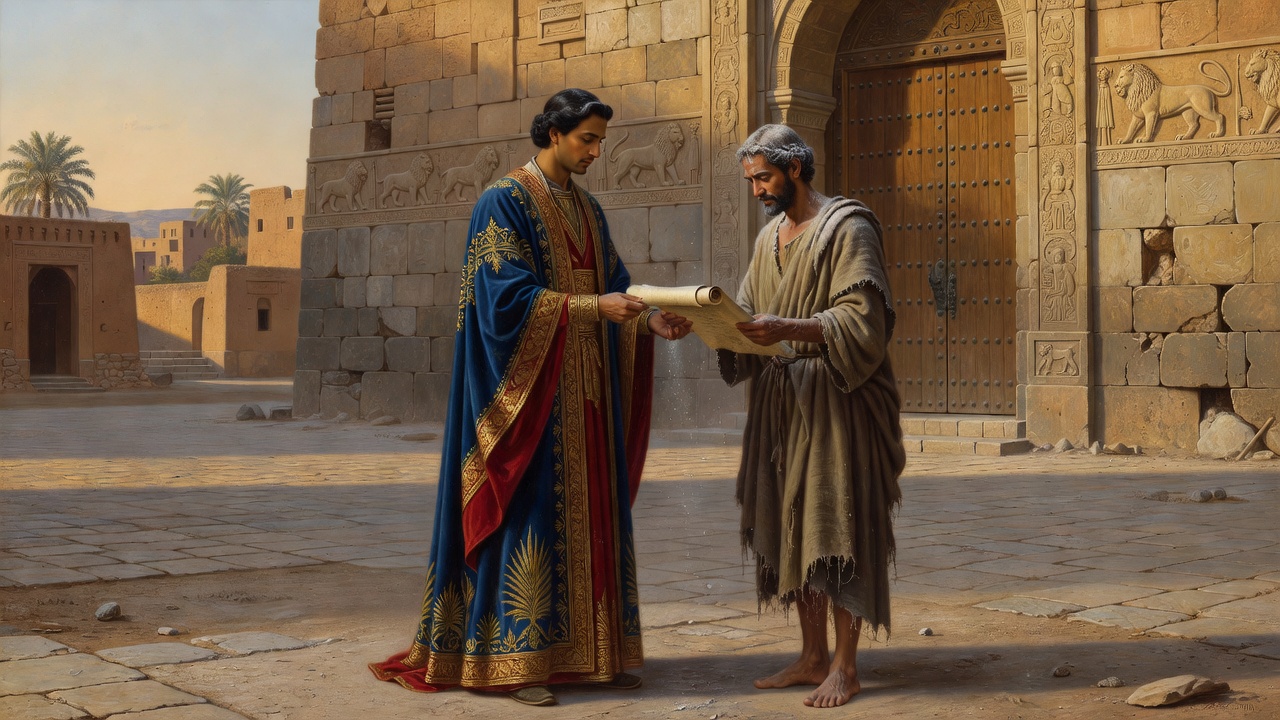
- When Mordecai learned of the decree against the Jews, he put on sackcloth and ashes, but royal law strictly prohibited anyone wearing mourning attire from passing through the king's gate.Sources: the Bible text itself
- Because Queen Esther resided inside the royal palace and Mordecai remained outside in mourning clothes, communication between them was conducted through Hathach, a royal eunuch appointed to attend the queen.Sources: the Bible text itself · Hatach
- Persian court law decreed that any person who approached the king in the inner court without being summoned was subject to execution, unless the monarch spared them by extending his golden scepter.Sources: the Bible text itself
Notes written with AI assistance from open sources (Theographic Bible Metadata, CC BY-SA 4.0; Easton’s Bible Dictionary, public domain) and reviewed before publishing.
Places in this chapter
Only places identified with high confidence are shown (90% or more according to the scholarly sources compiled by OpenBible). Period map: DARE (Digital Atlas of the Roman Empire), CC BY 4.0; modern map: © OpenStreetMap contributors; places: OpenBible.info (CC BY 4.0).
Credits and license for this translation
Wycliffe's Bible with Modern Spelling (Enhanced)
English: Wycliffe's Bible Modern Spelling (Enhanced) (with Deuterocanon)
Copyright © 2001,2010,2011,2012,2013,2015 Terry Noble
Language: English
Dialect: Archaic
Translation by: Terry Noble
Wycliffe's Bible with Modern Spelling (Enhanced)
Wycliffe’s Bible with Modern Spelling (Enhanced) is a composite of my Wycliffe’s Bible, a modern-spelling version of the 14th century Middle English translation, consisting of Wycliffe’s Old Testament and Wycliffe’s New Testament, and my modern-spelling version of Wycliffe’s Apocrypha. These books contain literally tens of thousands of rewritten verses, presented in parentheses “( ) “, to provide help in comprehending the 14th century Middle English vocabulary and grammar. Wycliffe’s Apocrypha also includes the books of the Apocrypha from the 1st edition of the King James Version of the Bible.
This translation is made available to you under the terms of the
Creative Commons Attribution-Noncommercial-No Derivatives license 4.0.
You may share and redistribute this Bible translation or extracts from it in any format, provided that:
You include the above copyright and source information.
You do not sell this work for a profit.
You do not change any of the words or punctuation of the Scriptures.
Pictures included with Scriptures and other documents on this site are licensed just for use with those Scriptures and documents.
For other uses, please contact the respective copyright owners.
2019-09-25
Section headings adapted from the Berean Standard Bible (public domain); they are not part of this translation’s text.
Source: http://ebible.org/engwyc2018/ · eBible.org