Ecclesiastes 5
Wycliffe's Bible with Modern Spelling (Enhanced) · Tap a verse to see its cross-references.
Approaching God with Awe
1Thou that enterest into the house of God, keep thy foot, and nigh thou for to hear; for why much better is obedience, than the sacrifice of fools, that know not what evil they do. (Thou who enterest into the House of God, keep thy foot, and draw close to hear; for obedience is much better than the sacrifice of fools, who know not what evil they do.)
2Speak thou not anything follily (or Do not thou say anything foolish), neither (let) thine heart be swift to bring forth a word before God; for God is in heaven, and thou art on earth, therefore (let) thy words be few.
3Dreams follow many busynesses, and folly shall be found in many words.
4If thou hast avowed anything to God, tarry thou not to yield it; for an unfaithful and fond promise displeaseth him; but yield thou whatever thing thou hast avowed;
5and it is much better to make not a vow, than after a vow to yield not the promises. (and it is much better to not make a vow, than to make a vow and then not yield the promises.)
6Give thou not thy mouth, that thou make thy flesh to do sin; neither say thou before an angel, No purveyance there is; lest peradventure the Lord be wroth on thy words, and destroy all the works of thine hands. (Give thou not thy mouth, that thou make thy flesh to do sin; nor then say thou before an angel, This is but a mistake; lest perhaps the Lord be angry with thy words, and destroy all the works of thy hands.)
7Where be many dreams, be full many vanities, and words without number; but dread thou God. (Where there be many dreams, there is much that is empty and futile, and words without number; rather, fear thou God, or have thou reverence for God.)
The Futility of Wealth
8If thou seest false challenges of needy men, and violent dooms, (or If thou seest the poor oppressed, and grave injustice), and that rightfulness is destroyed in the province, wonder thou not on this doing; for another is higher than an high man, and also other men be more high above these men;
9and furthermore the king of all (the) earth commandeth to the servant. (and ultimately the King of all the earth commandeth to all his servants.)
10An avaricious man shall not be [ful] filled of money; and he that loveth riches shall not take (the) fruits of them; and therefore this is vanity. (A greedy person shall never be fulfilled, or filled full, with money; and he who loveth riches shall never truly enjoy their fruits, or their earnings; and so this is empty and futile.)
11Where there be many riches, also many men there be, that eat those, (or Where there be many riches, there also be many people, who shall eat them); and what profiteth it to the holder, but that he seeth [the] riches with his eyes?
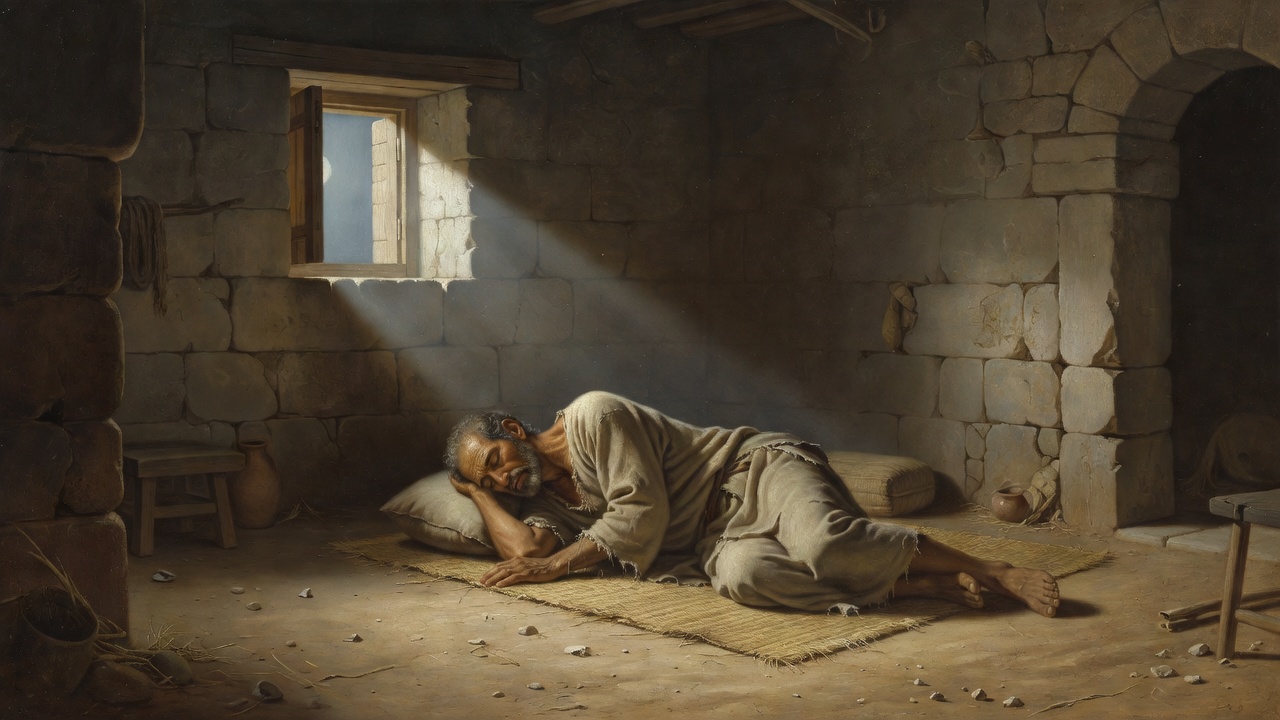
12Sleep is sweet to him that worketh, whether he eat little either much; but the fullness of a rich man suffereth not him to sleep. (Sleep is sweet to him who worketh, whether he eat a little or a great deal; but a rich person’s fullness will not allow him to sleep.)
13Also another sickness is full evil, which I saw under the sun; riches (that) be kept into the harm of their lord.
14For they perish in the worst torment; (and) he begat a son, that shall be in sovereign neediness. (And then those riches be lost in a terrible calamity; and so he hath begotten a son, who shall be left in great neediness.)
15As he went naked out of his mother’s womb, so he shall turn again; and he shall take away with him nothing of his travail. (As he went naked out of his mother’s womb, so he shall return; and he shall not take away with him anything gained from all his labour.)
16Utterly it is a wretched sickness; as he came, so he shall turn again. What profiteth it to him, that he travailed into the wind? ( Yea, it is utterly a wretched sickness; as he came, so he shall return. What hath it profited him? he hath only laboured for the wind!)
17In all the days of his life he ate in darknesses, and in many busynesses, and in neediness, and sorrow.
18Therefore this seemed good to me, that a man eat, and drink, and use gladness of his travail, in which he travailed under the sun, in the number of days of his life, which God gave to him; and this is his part. (And so it seemed good to me, that a person should eat, and drink, and enjoy, or get happiness from, the fruits of his labour, for which he laboured under the sun, in the days of his life, which God gave to him; yea, this is his portion.)
19And to each man, to whom God gave riches, and chattel, and gave power to him to eat of those, and to use his part, and to be glad of his travail; this is the gift of God. (And to each person, to whom God gave riches, and substance, and gave the power to him to enjoy them, and to use his portion, and to be happy in his labour, or in his work; this is the gift of God.)
20For he shall not think much on the days of his life, for God occupieth his heart with delights.
Did you know?
Reverence, Justice, and the Limits of Wealth
- The author cautions against hasty speech in worship, reminding worshippers that God is in heaven while mortals are on earth. Vows made to God were considered serious commitments; the text warns that delaying or failing to fulfill a vow is foolish, making it better not to make a vow at all.Sources: the Bible text itself
- When addressing injustice and the oppression of the poor within a province, the author points to layered government bureaucracy, where each official is watched by a higher authority. Despite this administrative hierarchy, all tiers, including the king, ultimately depend on the produce of the fields.Sources: the Bible text itself
- The chapter contrasts the restless sleeplessness of the wealthy with the sweet sleep of a common laborer, noting that the pursuit of riches brings no lasting satisfaction. True contentment comes when a person accepts their lot and enjoys food, drink, and honest labor as gifts from God.Sources: the Bible text itself
Notes written with AI assistance from open sources (Theographic Bible Metadata, CC BY-SA 4.0; Easton’s Bible Dictionary, public domain) and reviewed before publishing.
Credits and license for this translation
Wycliffe's Bible with Modern Spelling (Enhanced)
English: Wycliffe's Bible Modern Spelling (Enhanced) (with Deuterocanon)
Copyright © 2001,2010,2011,2012,2013,2015 Terry Noble
Language: English
Dialect: Archaic
Translation by: Terry Noble
Wycliffe's Bible with Modern Spelling (Enhanced)
Wycliffe’s Bible with Modern Spelling (Enhanced) is a composite of my Wycliffe’s Bible, a modern-spelling version of the 14th century Middle English translation, consisting of Wycliffe’s Old Testament and Wycliffe’s New Testament, and my modern-spelling version of Wycliffe’s Apocrypha. These books contain literally tens of thousands of rewritten verses, presented in parentheses “( ) “, to provide help in comprehending the 14th century Middle English vocabulary and grammar. Wycliffe’s Apocrypha also includes the books of the Apocrypha from the 1st edition of the King James Version of the Bible.
This translation is made available to you under the terms of the
Creative Commons Attribution-Noncommercial-No Derivatives license 4.0.
You may share and redistribute this Bible translation or extracts from it in any format, provided that:
You include the above copyright and source information.
You do not sell this work for a profit.
You do not change any of the words or punctuation of the Scriptures.
Pictures included with Scriptures and other documents on this site are licensed just for use with those Scriptures and documents.
For other uses, please contact the respective copyright owners.
2019-09-25
Section headings adapted from the Berean Standard Bible (public domain); they are not part of this translation’s text.
Source: http://ebible.org/engwyc2018/ · eBible.org