Amos 6
Wycliffe's Bible with Modern Spelling (Enhanced) · Tap a verse to see its cross-references.
Woe to Those at Ease in Zion
1Woe to you, that be full of riches in Zion, and trust in the hill of Samaria, ye principal men, the heads of peoples, that go proudly to the house of Israel. (Woe to you, who be very rich in Zion, and trust in the hill of Samaria, ye principal men, yea, the leaders of the people, whom the house of Israel proudly followeth.)
2Go ye into Calneh, and see ye, and go ye from thence into Hemath the great; and go ye down into Gath of Palestines, and to all the best realms of them, if their term be broader than your term. (Go ye into Calneh, and see ye, and go ye from there into the great city of Hamath; and go ye down into Gath of the Philistines, for be those kingdoms any better than yours? or be their territories any broader, or larger, than your territories?)
3And ye be parted into the evil day, and nigh to the seat of wickedness; (And ye declare that the evil day is far off, and yet ye do the very wicked things that shall bring it nigh;)
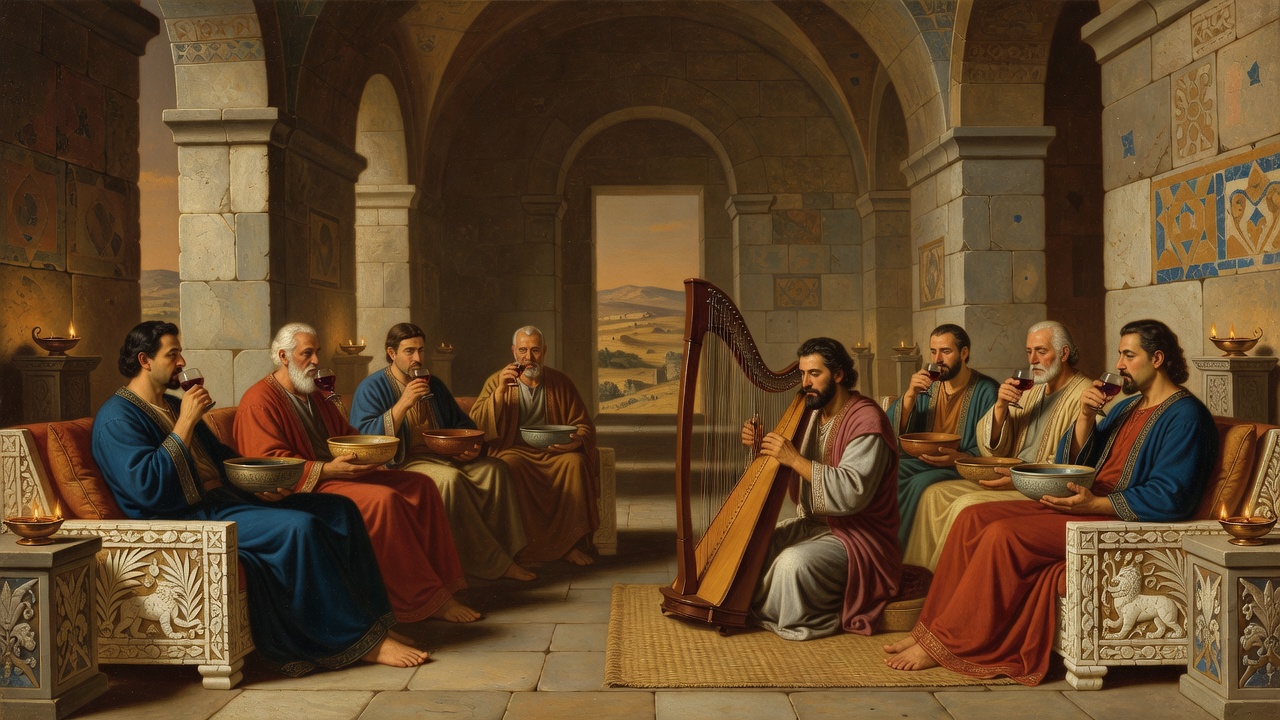
4and ye sleep in beds of ivory, and do lechery in your beds; and ye eat a lamb of the flock, and calves of the middle of the drove, (or and ye eat a lamb from the flock, and calves out of the midst of the herd);
5and ye sing at the voice of (the) psaltery. As David they guessed them, for to have (made) instruments of song, (and ye sing with the voice of the lute, for ye think yourselves like David, and so make instruments of song;)
6and drink wine in vials; and with best ointment they were anointed; and in nothing they had compassion on the sorrow, either defouling, of Joseph. (and drink wine from basins, and anoint yourselves with the best ointment; but ye have no compassion on the sorrow, or on the defiling, of Joseph.)
7Wherefore now they shall pass in the head of men passing over, and the doing, or treason, of men doing lechery, shall be done away. (And so now ye shall be the first to go into captivity, and then the treason of people doing lechery, shall be done away, or shall be ended.)
The Pride of Israel
8The Lord God swore in his soul, saith the Lord God of hosts, I loathe the pride of Jacob, and I hate the houses of him, and I shall betake the city with his dwellers; (The Lord God swore in his soul, saith the Lord God of hosts, yea, I loathe Jacob’s pride, or his arrogance, and I hate his houses, and I shall deliver the city and its inhabitants unto the enemy;)
9that if ten men be left in one house, and they shall die. (and if only ten men be left in one house, they shall still all die.)
10And his neighbour shall take him, and shall burn him, that he bear out (the) bones of the house. And he shall say to him, that is in the privy place of the house, Whether there is yet (any) with thee? And he shall answer, An end is. And he shall say to him, Be thou still, and think thou not on the name of the Lord. (And his friend, or his relative, shall take him up, to bury him, and he shall carry his bones out of the house. And he shall say to him who is in the private place of the house, Is there anyone left in there with thee? And he shall answer, No. And he shall say to him, Be thou silent, and do not thou even say the Lord’s name.)
11For lo! the Lord shall command, and shall smite the greater house with fallings, and the less (er) house with carvings, either (with) breakings.
12Whether horses may run in stones, either it may be eared with wild oxen? For ye turned doom into bitterness, and the fruit of rightwiseness into wormwood. (Can horses run on stones, or can the sea be plowed with oxen? For ye turned justice into bitterness, and the fruit of righteousness into wormwood.)
13And ye be glad in nought, and ye say, Whether not in our strength we took to us horns? (And ye be happy over nothing, and ye say, Did we not get our power by our own strength?)
14Lo! I shall raise on you, the house of Israel, saith the Lord God of hosts, a folk; and it shall all-break you from the entry of Hemath unto the stream of desert. (Behold! O house of Israel, I shall raise up a nation against you, saith the Lord God of hosts; and it shall altogether break you from the entrance to Hamath unto the Stream of the Arabah, (or the Brook of the Desert).)
Did you know?
Complacency and Impending Exile
- Amos addresses the ruling elite who felt secure in both Zion, the fortified hill of Jerusalem, and Mount Samaria, the capital of the northern kingdom built on an elevated summit by King Omri. Despite the natural defenses and prestige of these cities, their leaders are warned that their ease and overconfidence would end in captivity.Sources: Zion · Samaria · the Bible text itself
- The prophet challenges Israel to look at renowned foreign cities such as Calneh near the Euphrates, Hamath on the Orontes in Upper Syria, and the Philistine stronghold of Gath. These neighboring powers were neither smaller nor less protected, yet they could not escape destruction.Sources: Calneh · Hamath · Gath · the Bible text itself
- Amos criticizes the aristocracy for indulging in extravagant banquets, resting on beds inlaid with ivory, and improvising music on harps like David, all while ignoring the impending ruin of Joseph. The name Joseph here designates the northern tribes of Israel, whose moral decay and social injustice were neglected by their wealthy leaders.Sources: David · Joseph (son of Jacob) · the Bible text itself
Notes written with AI assistance from open sources (Theographic Bible Metadata, CC BY-SA 4.0; Easton’s Bible Dictionary, public domain) and reviewed before publishing.
Places in this chapter
- Samaria · 32.276, 35.195 · verses 1, 8
- Zion · Today: Jerusalem · 31.777, 35.234 · verse 1
- Hamath · Today: Hama · 35.136, 36.750 · verse 2
- Philistia · 31.664, 34.546 · verse 2
Only places identified with high confidence are shown (90% or more according to the scholarly sources compiled by OpenBible). Period map: DARE (Digital Atlas of the Roman Empire), CC BY 4.0; modern map: © OpenStreetMap contributors; places: OpenBible.info (CC BY 4.0).
Credits and license for this translation
Wycliffe's Bible with Modern Spelling (Enhanced)
English: Wycliffe's Bible Modern Spelling (Enhanced) (with Deuterocanon)
Copyright © 2001,2010,2011,2012,2013,2015 Terry Noble
Language: English
Dialect: Archaic
Translation by: Terry Noble
Wycliffe's Bible with Modern Spelling (Enhanced)
Wycliffe’s Bible with Modern Spelling (Enhanced) is a composite of my Wycliffe’s Bible, a modern-spelling version of the 14th century Middle English translation, consisting of Wycliffe’s Old Testament and Wycliffe’s New Testament, and my modern-spelling version of Wycliffe’s Apocrypha. These books contain literally tens of thousands of rewritten verses, presented in parentheses “( ) “, to provide help in comprehending the 14th century Middle English vocabulary and grammar. Wycliffe’s Apocrypha also includes the books of the Apocrypha from the 1st edition of the King James Version of the Bible.
This translation is made available to you under the terms of the
Creative Commons Attribution-Noncommercial-No Derivatives license 4.0.
You may share and redistribute this Bible translation or extracts from it in any format, provided that:
You include the above copyright and source information.
You do not sell this work for a profit.
You do not change any of the words or punctuation of the Scriptures.
Pictures included with Scriptures and other documents on this site are licensed just for use with those Scriptures and documents.
For other uses, please contact the respective copyright owners.
2019-09-25
Section headings adapted from the Berean Standard Bible (public domain); they are not part of this translation’s text.
Source: http://ebible.org/engwyc2018/ · eBible.org