Acts 27
Wycliffe's Bible with Modern Spelling (Enhanced) · Tap a verse to see its cross-references.
Paul Sails for Rome
1But as it was deemed (for) him to ship into Italy, they betook Paul with other keepers [or with other men kept] to a centurion, by (the) name (of) Julius, of the company of knights of the emperor. (And when it was decided that he should sail to Italy, they delivered Paul with other prisoners to a centurion, named Julius, from the Emperor’s cohort or regiment of soldiers.)
2And we went up into the ship of Adramyttium, and began to sail, and were borne about the places of Asia, while Aristarchus of Macedonia, Thessalonica, dwelled still with us.
3And in the day (pur)suing, we came to Sidon; and Julius treated courteously Paul, and suffered [him] to go to friends, and to do his needs [or and to do the care of him]. (And on the following day, we came to Sidon; and Julius treated Paul courteously, and allowed him to go to his friends, and to get his needs filled, or and for them to take care of him.)
4And when we removed from thence [or And when we were taken up from thence], we under-sailed to Cyprus, for that (the) winds were contrary.
5And we sailed in the sea of Cilicia and Pamphylia, and came to Lystra, that is Lycia.
6And there the centurion found a ship of Alexandria, sailing into Italy, and putted us over into it.
7And when in many days we sailed slowly, and scarcely came against Cnidus, for the wind hindered us, we sailed to Crete, beside Salmone.
8And scarcely we sailed beside, and came into a place, that is called of good haven, to whom the city Lasea was nigh.
9And when much time was passed, and when sailing then was not secure, for that (the time of) fasting was passed, Paul comforted them (or Paul strengthened them),
10and said to them, Men, I see that (the) sailing beginneth to be with wrong and much harm, not only of the charge, and of the ship, but also of our lives, (or not only for the cargo, and for the ship, but also even for our own lives).
11But the centurion believed more to the governor, and to the lord of the ship, than to these things that were said of Paul. (But the centurion trusted more in what the captain and the owner of the ship said, than what was said by Paul.)
12And when the haven was not able [for] to dwell in (over) winter, full many ordained counsel to sail from thence, if on any manner [or if in any manner] they might come to Phenice, (for) to dwell in winter at the haven of Crete, which beholdeth to Africa, that is, (to the) southwest, and to Corum, that is, (to the) northwest.
The Storm at Sea
13And when the south blew, they guessed them (selves) to hold purpose; and when they had removed [or had taken up] from Assos, they sailed to Crete.
14And not after much [time], the wind Tifonyk, that is called (the) northeast, [or (the) wind of tempest], was against it.
15And when the ship was ravished, and might not enforce against the wind [or into the wind], when the ship was given (over) to the blowings of the wind, we were borne (And when the ship was snatched, or was seized, and could not endeavour against the wind, when the ship was given over to the blowing of the wind, we were borne)
16with course into an isle, that is called Cauda; and scarcely we might get a little boat (under control in these circumstances). (with course by an island called Cauda; and we were barely able to control the ship’s little boat under such circumstances.)
17And when this (little boat) was taken up, they used helps, girding together the ship; and dreaded (or and feared), lest they should fall into sandy places. And when the vessel was under-set, so they were borne.
18And for we were thrown with (a) strong tempest, in the day (pur)suing they made casting out. (And because we were tossed about by a strong tempest, on the following day they began to throw out the cargo.)
19And the third day with their hands they cast away the instruments of the ship.
20And when [neither] the sun neither the stars were seen by many days, and tempest not a little nighed, now all the hope of our health was done away. (And when neither the sun nor the stars were seen for many days, and a great tempest approached, now all the hope for our deliverance was gone.)
21And when much fasting had been, then Paul stood in the middle of them, and said, A! men [or O! men], it behooved, when ye heard me, not to have taken away the ship from Crete, and get this wrong and (this) casting out.
22And now I counsel you to be of good comfort [or of good heart], for loss of no person of you shall be [or soothly there shall be loss of no soul of you], (no), except of the ship.
23For an angel of God, whose I am, and to whom I serve, stood nigh to me in this night,
24and said, Paul, dread thou not (or fear not); it behooveth thee to stand before the emperor [or it behooveth thee to stand nigh to Caesar]. And lo! God hath given to thee all that be in the ship with thee.
25For which thing, ye men, be of good comfort [or be of good heart]; for I believe to my God (or for I believe my God), that so it shall be, as it is said to me.
26And it behooveth us to come into some isle.
The Shipwreck
27But afterward that in the fourteen day the night came on us sailing in the stony sea (or But then on the fourteenth day when the night came upon us sailing on the stormy sea), about midnight the shipmen supposed some country to appear to them.
28And they cast down a plummet [or Which sent down a plummet], and found twenty fathoms of deepness. And after a little they were departed from thence, and found fifteen fathoms.
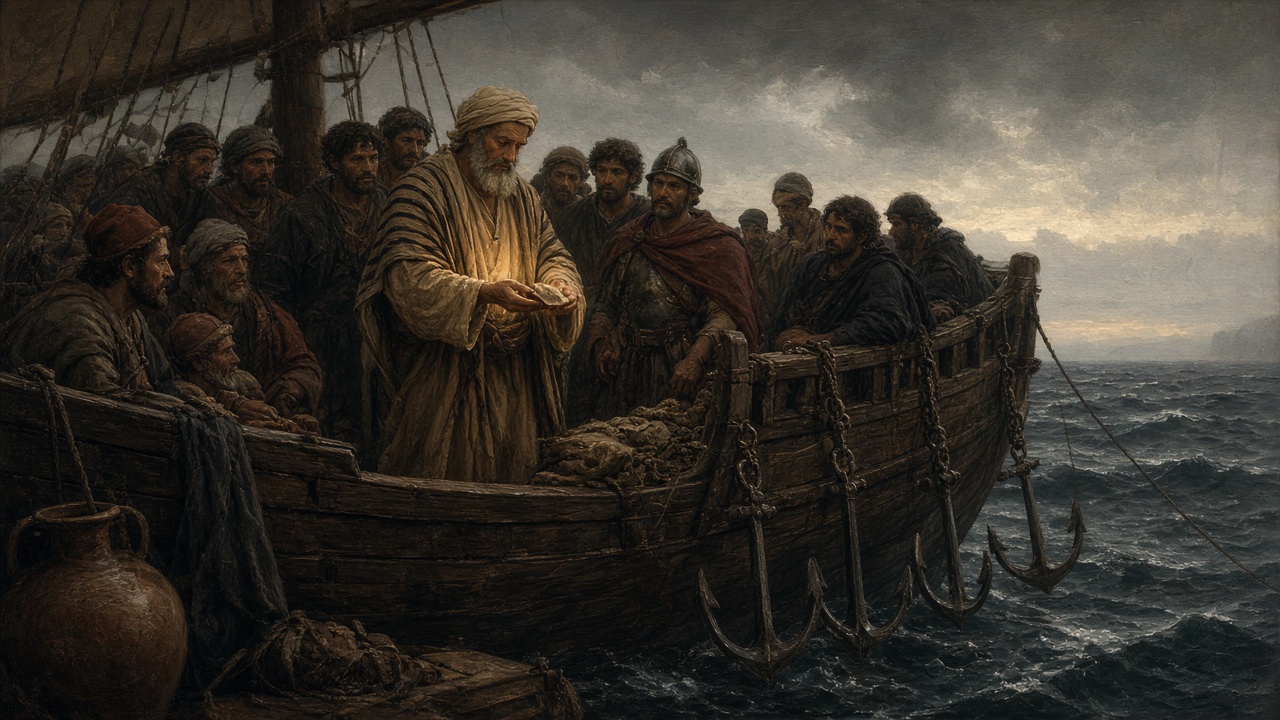
29And they dreaded (or feared), lest we should have fallen into sharp places; and from the last part of the ship they sent (out) four anchors, and desired that the day had become. [Soothly they dreaded, lest we should fall into sharp places; and from the last part of the ship they sent (out) four anchors, and desired that the day were made.]
30And when the shipmen sought to flee from the ship, when they had sent a little boat into the sea (or when they had sent the little boat into the sea), under colour as they should begin to stretch forth the anchors from the former part of the ship,
31Paul said to the centurion and to the knights, But these dwell in the ship, ye may not be made safe. (Paul said to the centurion and to the soldiers, Unless these men stay on the ship, ye shall not be saved.)
32Then [the] knights cutted away the cords of the little boat, and suffered it to fall away. (So the soldiers cut away the cords of the little boat, and allowed it to fall away.)
33And when the day was come, Paul prayed all (the) men to take meat (or Paul beseeched all the men to have some food), and said, The fourteenth day this day ye abide, and dwell fasting, and take nothing.
34Wherefore I pray you to take meat, for your health, (or And so I beseech you to have some food, for your own well-being); for of none of you the hair of the head shall perish.
35And when he had said these things, Paul took bread, and did thankings to God in the sight of all (the) men (or and gave thanks to God before all the men); and when he had broken (it), he began to eat (it).
36And all were made of better comfort, [or (were) made more patient, or hardy], and they took meat. (And all were strengthened, after they had eaten some food.)
37And we were all (the) men in the ship, two hundred seventy and six.
38And they were [full-]filled with meat, and discharged the ship, and cast (the) wheat into the sea. (And they were filled full with the food, and discharged the ship, and threw the wheat into the sea.)
39And when the day was come, they knew no land; and they beheld an haven that had a water-bank, into which they thought, if they might (or if they could), to bring up the ship.
40And when they had taken up the anchors, they betook them [in] to the sea (or they dropped them in the sea), and slacked together the jointures of (the) rudders. And with a little sail lifted up, by (the) blowing of the wind they went (forth) to the bank.
41And when we felled into a place of gravel gone all about with the sea, they hurtled the ship. And when the former part was fixed, it dwelled unmoveable, and the last part (of it) was broken of [or by] the strength of the sea.
42And [the] counsel of the knights’ was, to slay (the) men that were in (the) ward [or in the keeping], lest any should escape, when he had swimmed out. (And the soldiers’ plan, or their thinking, was to kill the men who were in the hold, lest anyone would escape, after he had swam away.)
43But the centurion would keep Paul (alive), and forbade it to be done. And he commanded them that might swim, to go [first] into the sea, and escape, and go out to the land.
44And they bare some others on boards, (and) some on those things that were of the ship. And so it was done, that all [the] men escaped to the land.
Did you know?
Storm and Shipwreck on the Way to Rome
- Paul and the other prisoners did not sail straight to Italy. At Caesarea they boarded a ship of Adramyttium, a city on the coast of Mysia in Asia Minor, bound for ports along the coast of Asia, a name Easton's Bible Dictionary takes in this verse as probably Asia Minor, and that ship carried them only as far as Myra in Lycia. There the centurion put them aboard an Alexandrian ship sailing for Italy; the dictionary notes that it was rare for a ship to sail from any port of Palestine direct to Italy.Sources: Adramyttium · Asia · the Bible text itself
- The prisoners were handed over to Julius, a centurion of the Imperial Regiment. Easton's Bible Dictionary identifies him as centurion of the Augustan cohort, or the emperor's body-guard, and describes his courteous regard for Paul. At Sidon, about twenty-five miles north of Tyre, he let Paul visit friends and receive care; later he blocked the soldiers' plan to kill the prisoners so that Paul's life would be spared.Sources: Julius · Sidon · the Bible text itself
- After Cnidus the ship worked along Crete, one of the largest islands in the Mediterranean, about 140 miles long and 35 broad, which Paul visited on this voyage to Rome. The account says the voyage had already become dangerous because it was after the Fast, and Fair Havens was unsuitable for wintering. One chronology dates the start of the journey to Rome to AD 56 and the shipwreck in the storm to AD 57.Sources: Crete · Journey to Rome begins · Paul is shipwrecked by a storm · the Bible text itself
Notes written with AI assistance from open sources (Theographic Bible Metadata, CC BY-SA 4.0; Easton’s Bible Dictionary, public domain) and reviewed before publishing.
Places in this chapter
- Italy · 41.892, 12.485 · verses 1, 6
- Adramyttium · Today: Oren · 39.501, 26.933 · verse 2
- Asia · 38.400, 28.300 · verse 2
- Thessalonica · Today: Thessaloniki · 40.638, 22.946 · verse 2
- Sidon · Today: Sandikli archaeological site in Sidon · 33.561, 35.372 · verse 3
- Cyprus · 35.000, 33.000 · verse 4
- Cilicia · 36.913, 34.892 · verse 5
- Lycia · 36.733, 29.900 · verse 5
- Myra · 36.259, 29.985 · verse 5
- Pamphylia · 37.000, 31.000 · verse 5
- Alexandria · 31.183, 29.896 · verse 6
- Cnidus · 36.686, 27.375 · verse 7
- Crete · 35.310, 24.893 · verses 7, 8, 12, 13, 14, 21
- Salmone · Today: Cape Sideros · 35.316, 26.312 · verse 7
- Fair Havens · Today: Kaloi Limenes · 34.930, 24.800 · verses 8, 12
- Lasea · Today: Lasaea · 34.941, 24.811 · verse 8
- Cauda · Today: Gavdos · 34.833, 24.083 · verse 16
- Syrtis · Today: Sidra · 31.500, 18.000 · verse 17
- Adriatic Sea · Today: Adriatic and Ionian Seas · 38.000, 19.000 · verse 27
Only places identified with high confidence are shown (90% or more according to the scholarly sources compiled by OpenBible). Period map: DARE (Digital Atlas of the Roman Empire), CC BY 4.0; modern map: © OpenStreetMap contributors; places: OpenBible.info (CC BY 4.0).
Credits and license for this translation
Wycliffe's Bible with Modern Spelling (Enhanced)
English: Wycliffe's Bible Modern Spelling (Enhanced) (with Deuterocanon)
Copyright © 2001,2010,2011,2012,2013,2015 Terry Noble
Language: English
Dialect: Archaic
Translation by: Terry Noble
Wycliffe's Bible with Modern Spelling (Enhanced)
Wycliffe’s Bible with Modern Spelling (Enhanced) is a composite of my Wycliffe’s Bible, a modern-spelling version of the 14th century Middle English translation, consisting of Wycliffe’s Old Testament and Wycliffe’s New Testament, and my modern-spelling version of Wycliffe’s Apocrypha. These books contain literally tens of thousands of rewritten verses, presented in parentheses “( ) “, to provide help in comprehending the 14th century Middle English vocabulary and grammar. Wycliffe’s Apocrypha also includes the books of the Apocrypha from the 1st edition of the King James Version of the Bible.
This translation is made available to you under the terms of the
Creative Commons Attribution-Noncommercial-No Derivatives license 4.0.
You may share and redistribute this Bible translation or extracts from it in any format, provided that:
You include the above copyright and source information.
You do not sell this work for a profit.
You do not change any of the words or punctuation of the Scriptures.
Pictures included with Scriptures and other documents on this site are licensed just for use with those Scriptures and documents.
For other uses, please contact the respective copyright owners.
2019-09-25
Section headings adapted from the Berean Standard Bible (public domain); they are not part of this translation’s text.
Source: http://ebible.org/engwyc2018/ · eBible.org