Acts 17
Wycliffe's Bible with Modern Spelling (Enhanced) · Tap a verse to see its cross-references.
The Uproar in Thessalonica
1And when they had passed by Amphipolis and Apollonia, they came to Thessalonica, where was a synagogue of (the) Jews.
2And by custom Paul entered to them, and by three sabbaths he declared to them of the scriptures, (And as was his custom, Paul went to them, and on three Sabbaths he declared the Scriptures to them,)
3and opened, and showed that it behooved Christ to suffer, and rise again from death, [or to suffer, and rise again from (the) dead], and that this is Jesus Christ, whom I tell to you. (and expounded upon them, and showed that it behooved the Messiah to suffer, and to rise again from the dead, and that this is Jesus Christ, about whom I tell you.)
4And some of them believed, and were joined to Paul and to Silas; and a great multitude of heathen men worshipped God, and noble women not a few.
5But the Jews had envy, and took of (or from) the common people some evil men, and when they had made a company, they moved the city. And they came to Jason’s house, and sought to bring them forth among the people (or out to the people).
6And when they found them not, they drew Jason and some brethren to the princes of the city, and cried, That these it be, that moved the world, and hither they came, (And when they found them not, they dragged Jason and some of the brothers to the leaders of the city, and cried, These it be, who stirred up the world, and now they have come here,)
7whom Jason received. And these all do against the commandments of the emperor [or against the commandments of Caesar], and say, that Jesus is another king.
8And they moved the people, and the princes of the city, hearing these things. (And they stirred up the people, and the leaders of the city, when they heard these things.)
9And when satisfaction was taken of Jason, and of others, they let Paul and Silas go.
The Character of the Bereans
10And anon by night, (the) brethren let [Paul and] Silas go into Berea, [or (the) brethren sent Paul and Silas into Berea], (or And at once in the night, the brothers sent Paul and Silas to Berea). And when they came thither, they entered into the synagogue of the Jews.
11But these were the worthier [or the nobler] of them that be at Thessalonica, which received the word with all desire, each day seeking [the] scriptures, if these things had them so.
12And many of them believed, and of heathen women honest and men not a few (or and more than a few honourable heathen men and women). [And soothly many of them believed, and of honest heathen women and men not (a) few.]
13But when the Jews in Thessalonica had known, that also at Berea the word of God was preached of Paul (or that also at Berea the word of God was preached by Paul), they came thither, moving and disturbing [or distroubling] the multitude.
14And then anon (the) brethren delivered [or dismissed] Paul, that he should go to the sea; but Silas and Timothy dwelt there. (And then at once the brothers sent off Paul, so that he could go down to the seacoast; but Silas and Timothy remained there.)
15And they that led forth Paul, led him to Athens. And when they had taken a commandment of him to Silas and Timothy (or And when they had received an order from him for Silas and Timothy), that full hieingly they should come to him, they went forth.
Paul in Athens
16And while Paul abode them at Athens (or And while Paul waited for them in Athens), his spirit was moved in him, for he saw the city given to idolatry.
17Therefore he disputed in the synagogue with the Jews, and with men that worshipped God, and in the doom place, [or in the chapping], by all days to them that heard. (And so he disputed in the synagogue with the Jews, and with the men who worshipped God, and also in the city square, or at the market, every day with all those who would listen.)
18And some Epicureans, and Stoics, and philosophers disputed with him. And some said, What will this sower of words say? And others said, He seemeth to be a teller of new fiends; for he told to them (of) Jesus, and (of) the again-rising, (or for he told them about Jesus, and about the resurrection).
19And they took, and led him to Areopagus, [that is, a common school], and said, May we know, what is this new doctrine, that is said of thee?
20For thou bringest in some new things to our ears; therefore we will know, what these things will be.
21For all men of Athens and comelings (or newcomers) harboured (there), gave attention to none other thing, but either to say, either to hear, some new thing.
Paul’s Address in the Areopagus
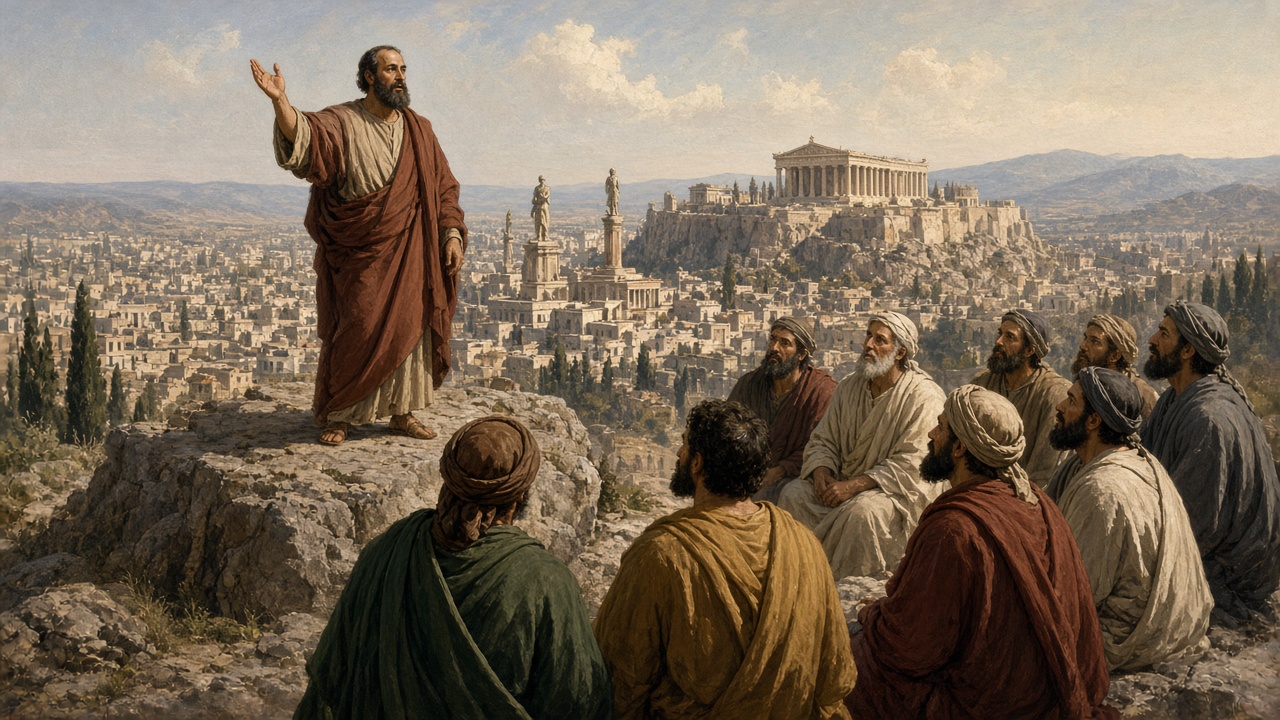
22And Paul stood in the middle of Areopagus, and said, Men of Athens, by all things I see you as vain (or as futile) worshippers.
23For I passed (by), and saw your maumets, [or your simulacra], (or and I saw your idols), and found an altar, in which was written, To the unknown God. Therefore which thing ye unknowing (or not knowing) worship, (or which ye worship in ignorance), this thing I (shall) show to you.
24God that made the world and all things that be in it, this (God), for he is (the) Lord of heaven and earth, dwelleth not in temples made with hand [or made by hand],
25neither is worshipped by man’s hands, neither hath need of anything, for he giveth life to all men, and breathing, and all things;
26and made of one all the kind of men to inhabit on all the face of the earth, determining times ordained, and (the) terms of the dwelling [or of the habitation] of them,
27to seek God, if peradventure they feel him, either find (him), though he be not far from each of you.
28For in him we live, and move, and be. As also some of your poets said, And we be also the kind [or the kin] of him.
29Therefore since we be the kind [or the kin] of God, we shall not deem [or guess] that (a) godly thing is like gold, and silver, either stone, either to (the) (en)graving of craft and thought of man.
30For God despiseth the times of this uncunning, and now showeth to men, that all everywhere do penance; (For God despiseth the times of this unknowing, or this ignorance, and now showeth to all, so that everyone everywhere shall repent;)
31for that he hath ordained a day, in which he shall deem the world in equity (or on which he shall judge the world with fairness), in a man in which he ordained, and gave faith to all men, and raised him from death [or raising him from (the) dead].
32And when they had heard (of) the again-rising of dead men, [or Soothly when they had heard (of) the again-rising of (the) dead], (or And when they had heard of the resurrection of the dead), some scorned, and some said, We shall hear thee again of this thing.
33So Paul went out of the middle of them. (And then Paul went away from their midst.)
34But some men drew [or cleaved] to him, and believed. Among which Dionysius Areopagite was, and a woman, by name Damaris, and other men with them.
Did you know?
From the synagogue to the Areopagus
- Thessalonica was a large, populous city on the Thermaic bay, the capital of one of the four Roman districts of Macedonia, ruled by a praetor. Jason hosted Paul and Silas there; a crowd raided his house, and when the two were not found, Jason and some other brothers were dragged before the city officials. They were accused of welcoming men who defied Caesar's decrees and spoke of another king, Jesus, and the officials released them only after taking bond.Sources: Thessalonica · Jason · the Bible text itself
- Athens, the capital of Attica, was celebrated as a seat of Greek literature and art, and its inhabitants were fond of novelty and remarkable for their zeal in worshiping the gods. A Roman satirist said it was easier to find a god at Athens than a man. The Areopagus, a rocky hill northwest of the Acropolis, was where the Athenian supreme tribunal and court of morals was held, and Paul delivered this chapter's address from some part of that hill.Sources: Athens · Areopagus · the Bible text itself
- Paul and Silas reached Thessalonica only after passing through Amphipolis, a Macedonian city and great Roman military station thirty-three Roman miles from Philippi, and Apollonia, about thirty-six miles from Thessalonica. When trouble followed them to Berea, another city of Macedonia, the brothers sent Paul to the coast, and those who escorted him brought him on to Athens. Silas and Timothy stayed in Berea, with word to join Paul as soon as they could.Sources: Amphipolis · Apollonia · Berea · the Bible text itself
Notes written with AI assistance from open sources (Theographic Bible Metadata, CC BY-SA 4.0; Easton’s Bible Dictionary, public domain) and reviewed before publishing.
Places in this chapter
- Amphipolis · 40.820, 23.847 · verse 1
- Apollonia · 40.624, 23.470 · verse 1
- Thessalonica · Today: Thessaloniki · 40.638, 22.946 · verses 1, 11, 13
- Berea · Today: Veria · 40.518, 22.200 · verses 10, 11, 13, 14, 15
- Athens · 37.972, 23.727 · verses 15, 16, 21, 22
- Areopagus · 37.972, 23.724 · verses 19, 22, 33
Only places identified with high confidence are shown (90% or more according to the scholarly sources compiled by OpenBible). Period map: DARE (Digital Atlas of the Roman Empire), CC BY 4.0; modern map: © OpenStreetMap contributors; places: OpenBible.info (CC BY 4.0).
Credits and license for this translation
Wycliffe's Bible with Modern Spelling (Enhanced)
English: Wycliffe's Bible Modern Spelling (Enhanced) (with Deuterocanon)
Copyright © 2001,2010,2011,2012,2013,2015 Terry Noble
Language: English
Dialect: Archaic
Translation by: Terry Noble
Wycliffe's Bible with Modern Spelling (Enhanced)
Wycliffe’s Bible with Modern Spelling (Enhanced) is a composite of my Wycliffe’s Bible, a modern-spelling version of the 14th century Middle English translation, consisting of Wycliffe’s Old Testament and Wycliffe’s New Testament, and my modern-spelling version of Wycliffe’s Apocrypha. These books contain literally tens of thousands of rewritten verses, presented in parentheses “( ) “, to provide help in comprehending the 14th century Middle English vocabulary and grammar. Wycliffe’s Apocrypha also includes the books of the Apocrypha from the 1st edition of the King James Version of the Bible.
This translation is made available to you under the terms of the
Creative Commons Attribution-Noncommercial-No Derivatives license 4.0.
You may share and redistribute this Bible translation or extracts from it in any format, provided that:
You include the above copyright and source information.
You do not sell this work for a profit.
You do not change any of the words or punctuation of the Scriptures.
Pictures included with Scriptures and other documents on this site are licensed just for use with those Scriptures and documents.
For other uses, please contact the respective copyright owners.
2019-09-25
Section headings adapted from the Berean Standard Bible (public domain); they are not part of this translation’s text.
Source: http://ebible.org/engwyc2018/ · eBible.org