1 Corinthians 7
Wycliffe's Bible with Modern Spelling (Enhanced) · Tap a verse to see its cross-references.
Principles of Marriage
1But of those things that ye have written to me, it is good to a man to touch not a woman (or it is good for a man not to touch a woman).
2But for fornication each man have his own wife, and each woman have her own husband.
3The husband yield debt to the wife, and also the wife to the husband.
4The woman hath not power of her body, but the husband; and the husband hath not power of his body, but the woman [or but the wife]. (The woman hath not power over her body, but the husband; and the husband hath not power over his body, but the wife.)
5Do not ye defraud each to (the) other (or Do not deny yourselves to one another), [no] but peradventure of consent for a time, (so) that ye give attention to prayer; and again turn again to the same thing (or and then return to being together), lest Satan tempt you for your uncontinence.
6But I say this thing as giving leave [or by indulgence], not by commandment.
7For I will (or I desire), that all men be as myself. But each man hath his proper gift of God (or But each man hath his own gift from God); one thus, and another thus.
8But I say to them, that be not wedded, and to widows, it is good to them, if they dwell so as I. (But I say to them, who be not wedded, and to widows, it is good for them, if they remain like I am.)
9And if they contain not themselves, [or be not chaste], be they wedded; for it is better to be wedded, than to be burnt. (And if they cannot contain themselves, or remain chaste, then let them be married; for it is better to be married, than to burn alone.)
10But to them that be joined in matrimony, I command, not I, but the Lord, that the wife depart not from the husband;
11and that if she departeth, that she dwell unwedded, or be reconciled to her husband; and the husband forsake not the wife (or and the husband must not desert the wife).
12But to others I say, not the Lord. If any brother hath an unfaithful, [or heathen], wife, (or If any brother hath a Gentile wife), and she consenteth to dwell with him, leave he her not.
13And if any woman hath an unfaithful (or heathen) husband (or And if any woman hath a Gentile husband), and this consenteth to dwell with her, leave she not the husband.
14For the unfaithful husband is hallowed by the faithful woman, and the unfaithful woman is hallowed by the faithful husband. Else your children were unclean, but now they be holy.
15That if the unfaithful departeth, depart he. For why the brother or sister is not subject to servage in such; for God hath called us in peace. (But if the unfaithful departeth, then let him depart. Because the brother or the sister is not subject to servitude or to slavery in such; for God hath called us to live in peace.)
16And whereof knowest thou, woman, if thou shalt make the man safe; or whereof knowest thou, man, if thou shalt make the woman safe? (And whereof knowest thou, woman, if thou shalt save the man; or whereof knowest thou, man, if thou shalt save the woman?)
Live Your Calling
17[No] But as the Lord hath parted to each, and as God hath called each man, so go he, as I teach in all (the) churches.
18A man circumcised is called, bring he (himself) not (back) to (being) prepuce (or bring he himself not back to being uncircumcised). A man is called in prepuce, be he not circumcised.
19Circumcision is nought, and prepuce is nought, but the keeping of the commandments of God (is everything). (Being circumcised is nothing, and being uncircumcised is nothing, but keeping, or obeying, the commandments of God is everything.)
20Each man in what calling he is called, in that dwell he.
21Thou [a] servant art called, be it no charge to thee (or do not let that be a burden to you); but if thou mayest be made free, use it rather.
22He that is a servant, and is called in the Lord, is a free man of the Lord. Also he that is a free man, and is called, is the servant of Christ (or is a servant of the Messiah).
23With (a) price ye be bought; do not ye be made (the) servants of men.
24Therefore each man in what thing (that) he is called a brother, dwell he in this with God (or remain he in this with God).
The Unmarried and Widowed
25But of virgins I have no commandment of (or from) God; but I give counsel, as he that hath gotten mercy of the Lord (or as he who hath received mercy from the Lord), (so) that I be true.
26Therefore I guess, that this thing is good for the present need; for it is good to a man to be so [or for it is good for a man to be so].
27Thou art bound to a wife, do not thou seek unbinding; thou art unbound from a wife, do not thou seek a wife.
28But if thou hast taken a wife, thou hast not sinned; and if a maiden is wedded, she sinned not; nevertheless such shall have tribulation of flesh. But I spare you.
29Therefore, brethren, I say this thing, The time is short. Another is this, that they that have wives, be as though they had none;
30and they that weep, as they wept not; and they that joy, as they joyed not; and they that buy, as they had not;
31and they that use this world, as they that use [it] not. For why the figure, [or (the) fairness], of this world passeth (or Because the beauty of this world passeth away).
32But I will, that ye be without busyness (or But I desire, that ye be without cares or concerns), for he that is without (a) wife, is busy (with) what things (that) be of the Lord, how he shall please God.
33But he that is with a wife, is busy (with) what things (that) be of the world, how he shall please the wife [or how he shall please his wife], and he is parted (or and he is divided).
34And a woman unwedded and [a] maiden thinketh what things be of the Lord, (so) that she be holy in body and spirit. But she that is wedded, thinketh what things be of the world, how she shall please the husband [or how she shall please her husband].
35And I say these things to your profit, not that I cast to you a snare, but to that that is seemly, and that giveth easiness [or facility], without hindering to make prayers [or to beseech] to the Lord.
36And if any man guesseth himself to be seen foul on his virgin, that she is full waxen [or that she is well old], and so it behooveth to be done, do she that that she will [+or do she what he will]; she sinneth not, if she be wedded, [+or s/he sinneth not, if s/he be wedded].
37For he that ordained stably, [or steadfast (ly)], in his heart, not having need, but having power of his will, and hath deemed in his heart this thing, to keep his virgin (ity), doeth well. (For he who resolutely ordained in his heart, not having need, but having power over his will, and hath determined in his heart, to keep his virginity, doeth well.)
38Therefore he that joineth his virgin (or his betrothed) in matrimony, doeth well, (or And so he who alloweth his daughter to be joined in matrimony, doeth well); and he that joineth not, doeth better.
39The woman is bound to the law, as long (a) time as her husband liveth; and if her husband is dead, she is delivered from the law of the husband, be she wedded to whom she will, only in the Lord.
40But she shall be more blessed, if she dwelleth thus, after my counsel; and I ween (or I guess), that I have the Spirit of God.
Did you know?
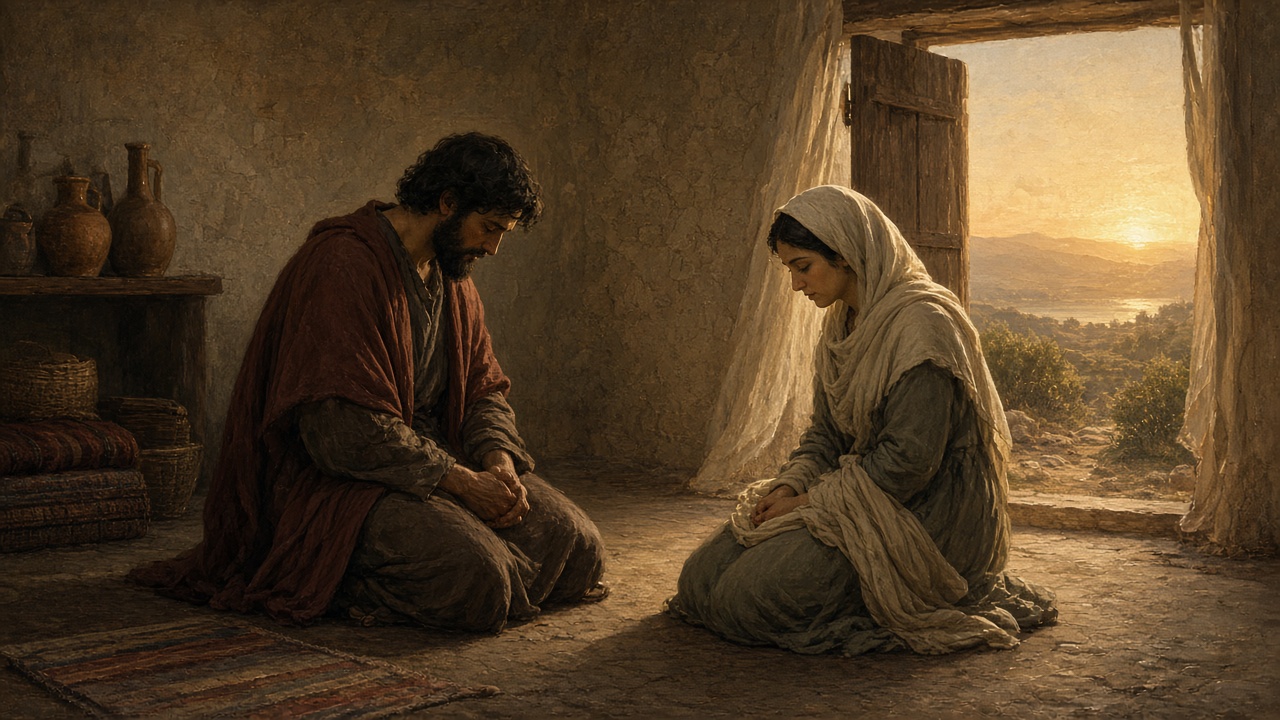
Counsel on marriage and the present crisis
- The chapter opens as a reply to matters the readers had written about. The writer says it is good to abstain from sexual relations, yet, because there is so much sexual immorality, each man should have his own wife and each woman her own husband. He presents this as a concession, not as a command, and says that each person has their own gift from God.Sources: the Bible text itself
- In marriage, the writer says the wife does not have authority over her own body, but the husband does, and likewise the husband does not have authority over his own body, but the wife does. They should not deprive each other except by mutual consent and for a time, so they may devote themselves to prayer, and then come together again, so that Satan will not tempt them through lack of self-control. Easton's Bible Dictionary (1897) presents the name Satan as “adversary” or “accuser,” and notes that he tempted Jesus in the wilderness.Sources: the Bible text itself · Satan
- The writer distinguishes a command he attributes to the Lord—a wife must not separate from her husband, and a husband must not divorce his wife—from his own judgment where he says he, not the Lord, is speaking, including marriages with an unbeliever and questions about virgins. Because of what he calls the present crisis, and because he says the time is short and this world in its present form is passing away, he thinks it good to remain as one is. He adds that to marry is not to sin, though those who marry will face troubles in this life.Sources: the Bible text itself
Notes written with AI assistance from open sources (Theographic Bible Metadata, CC BY-SA 4.0; Easton’s Bible Dictionary, public domain) and reviewed before publishing.
Credits and license for this translation
Wycliffe's Bible with Modern Spelling (Enhanced)
English: Wycliffe's Bible Modern Spelling (Enhanced) (with Deuterocanon)
Copyright © 2001,2010,2011,2012,2013,2015 Terry Noble
Language: English
Dialect: Archaic
Translation by: Terry Noble
Wycliffe's Bible with Modern Spelling (Enhanced)
Wycliffe’s Bible with Modern Spelling (Enhanced) is a composite of my Wycliffe’s Bible, a modern-spelling version of the 14th century Middle English translation, consisting of Wycliffe’s Old Testament and Wycliffe’s New Testament, and my modern-spelling version of Wycliffe’s Apocrypha. These books contain literally tens of thousands of rewritten verses, presented in parentheses “( ) “, to provide help in comprehending the 14th century Middle English vocabulary and grammar. Wycliffe’s Apocrypha also includes the books of the Apocrypha from the 1st edition of the King James Version of the Bible.
This translation is made available to you under the terms of the
Creative Commons Attribution-Noncommercial-No Derivatives license 4.0.
You may share and redistribute this Bible translation or extracts from it in any format, provided that:
You include the above copyright and source information.
You do not sell this work for a profit.
You do not change any of the words or punctuation of the Scriptures.
Pictures included with Scriptures and other documents on this site are licensed just for use with those Scriptures and documents.
For other uses, please contact the respective copyright owners.
2019-09-25
Section headings adapted from the Berean Standard Bible (public domain); they are not part of this translation’s text.
Source: http://ebible.org/engwyc2018/ · eBible.org