Leviticus 27
Wycliffe's Bible with Modern Spelling · Tap a verse to see its cross-references.
Rules about Valuations
1And the Lord spake to Moses and said,
2Speak thou to the sons of Israel, and thou shalt say to them, A man that maketh a vow, and promiseth his soul to God, he shall give the price under value, either appraising thereof.
3If it is a male, from the twentieth year till to the sixtieth year, he shall give fifty shekels of silver, at the measure of the saintuary,
4if it is a woman, she shall give thirty shekels;
5forsooth from the fifth year till to the twentieth year, a male shall give twenty shekels, a woman shall give ten shekels;
6from one month till to the fifth year, five shekels shall be given for a male, three shekels for a woman;
7a male of sixty years and over shall give fifteen shekels, a woman shall give ten shekels.
8If it is a poor man, and [he] may not yield the value, he shall stand before the priest, and as much as the priest appraiseth, and seeth that the poor man may yield, so much he shall give.
9Soothly if any man avoweth a beast, that may be offered to the Lord, it shall be holy,
10and it shall not be able to be changed, that is, neither a better for a worse, neither an evil for a good; and if he changeth it, both that, that is changed, and that, for which it is changed, shall be hallowed to the Lord.
11Soothly if any man avoweth an unclean beast, that may not be offered to the Lord, it shall be brought before the priest,
12and the priest shall deem whether it is good either evil, and he shall set the price;
13which price, if he that offereth will not give, he shall add the fifth part over the value.
14If a man avoweth his house, and halloweth it to the Lord, the priest shall behold, whether it is good either evil, and by the price which is ordained of him, it shall be sold;
15soothly if he that avowed will again-buy it, he shall give the fifth part of the value above, and he shall have the house.
16That if a man avoweth the field of his possession, and halloweth it to the Lord, the price shall be deemed by the measure of [the] seed; if the field is sown with thirty bushels of barley, it shall be sold for fifty shekels of silver.
17If he avoweth the field anon from the year of [the] beginning of the jubilee, as much as it may be worth, by so much it shall be appraised;
18but if it be after some part of time, the priest shall reckon, either determine, the money by the number of the years that be left till to the jubilee, and it shall be withdrawn of the price.
19That if he that avowed will again-buy the field, he shall add the fifth part of the money that is appraised, and he shall wield it;
20but if he will not again-buy it, but it is sold to any other man, he that avowed it shall never be able to again-buy it;
21for when the day of jubilee cometh, that field shall be hallowed to the Lord, and the possession hallowed pertaineth to the right of priests.
22If the field is bought, and is not of the possession of greater men, that is, of ancestors, and it is hallowed to the Lord,
23the priest shall determine the price by the number of years till to the jubilee, and he that avowed the field shall give the price thereof to the Lord;
24forsooth in the jubilee it shall turn again to the former lord that sold it, and he shall have it into the heritage of his possession.
25All the appraising, or value, shall be weighed by the shekel of the saintuary; a shekel hath twenty half-pence.
26No man may hallow and avow the first engendered things that pertain to the Lord, whether it is ox, or sheep, they be the Lord’s part.
27That if the beast is unclean that is avowed, he that offered it shall again-buy it after the value that it is appraised, and he shall add to the fifth part of the price; if he will not again-buy it, it shall be sold to another man, for as much as it is appraised.
28All thing that is hallowed to the Lord, whether it is man, or beast, whether field of his heritage, it shall not be sold, neither it shall be able to be again-bought; whatever thing is hallowed once, it shall be holy of holy things to the Lord,
29and each hallowing which is offered of man, shall not be again-bought, but it shall die by death.
Instruction on Tithes
30All the tithes of [the] earth, whether of fruits of corn, whether of apples of trees, be the Lord’s part, and be hallowed to him;
31soothly if any man will again-buy his tithes, he shall add to the fifth part of those [or them];
32of all the tithes of sheep, and of oxen, and of goats, that pass under the shepherd’s rod, whatever thing cometh to the tenth part, it shall be hallowed to the Lord;
33it shall not be chosen, neither good, neither evil; neither it shall be changed for another; if any man changeth it, both that, that is changed, and that, for which it is changed, shall be hallowed to the Lord, and it shall not be again-bought.
34These be the commandments which the Lord commanded to Moses, and to the sons of Israel, in the hill [or mount] of Sinai.
Did you know?
Vows, Valuations, and the Sinai Laws
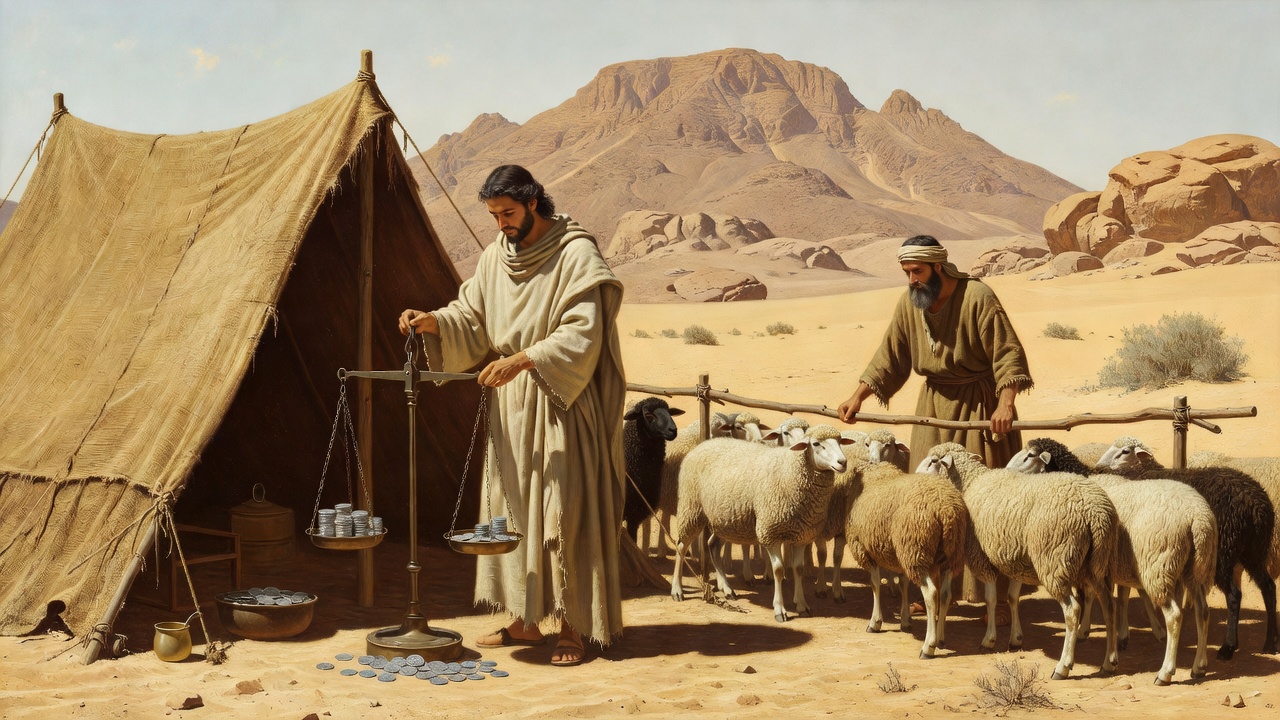
- When Israelites consecrated houses, land, unclean animals, or agricultural tithes to God, they could often redeem them by paying the assessed value plus an additional one-fifth of that price.Sources: the Bible text itself
- Dedicated persons were assigned standard monetary values based on age and sex, calculated using the sanctuary shekel, which was equal to twenty gerahs. If a person making the vow was too poor to pay the fixed amount, the priest set an adjusted price according to their means.Sources: the Bible text itself
- The book of Leviticus concludes by stating that these laws were given to Moses on Mount Sinai, where the Israelites stayed encamped for about a year after the Exodus.Sources: the Bible text itself · Mount Sinai
Notes written with AI assistance from open sources (Theographic Bible Metadata, CC BY-SA 4.0; Easton’s Bible Dictionary, public domain) and reviewed before publishing.
Credits and license for this translation
Wycliffe's Bible with Modern Spelling
English: Wycliffe's Bible Modern Spelling (with Deuterocanon)
Copyright © 2001,2010,2011,2012,2013,2015 Terry Noble
Language: English
Dialect: Archaic
Translation by: Terry Noble
Wycliffe’s Bible with Modern Spelling, was made in response to requests from readers who wanted my Wycliffe’s Old and New Testaments and Apocrypha in one volume. Printing limitations dictated the number of pages available to me and the letter size. In my previous books, Wycliffe’s Bible, Wycliffe’s Old Testament, Vols. 1 amp 2, Wycliffe’s New Testament, and Wycliffe’s Apocrypha, I have tens of thousands of rewritten verses, presented in parentheses “( )”, to provide help in comprehending the 14th century Middle English vocabulary and grammar. In this present volume, with space at a premium, those “helps” had to be eliminated, to make room for the text of the Apocrypha.
This translation is made available to you under the terms of the
Creative Commons Attribution-Noncommercial-No Derivatives license 4.0.
You may share and redistribute this Bible translation or extracts from it in any format, provided that:
You include the above copyright and source information.
You do not sell this work for a profit.
You do not change any of the words or punctuation of the Scriptures.
Pictures included with Scriptures and other documents on this site are licensed just for use with those Scriptures and documents.
For other uses, please contact the respective copyright owners.
2019-09-26
Section headings adapted from the Berean Standard Bible (public domain); they are not part of this translation’s text.
Source: http://ebible.org/engwyc2017/ · eBible.org