Job 39
Wycliffe's Bible with Modern Spelling · Tap a verse to see its cross-references.
The LORD Speaks of His Creation
1Whether thou knowest the time of [the] birth of wild goats in stones, either hast thou espied hinds bringing forth calves?
2Hast thou numbered the months of their conceiving, and hast thou known the time of their calving?
3They be bowed down to [the] calf, and so calve; and they send out then roarings.
4Their calves be separated from them, and go forth to pasture; they go out, and they turn not again to their mothers.
5Who hath let the wild ass go free, and who hath loosed the bonds of him?
6To whom I have given an house in wilderness, and the tabernacles of him in the land of saltness.
7He despiseth the multitude of the city; he heareth not the cry of the asker.
8He looketh about the hills of his pasture, and he seeketh all green things.
9Whether an unicorn shall desire to serve thee, either shall dwell at thy cratch?
10Whether thou shalt bind the unicorn with thy chain, for to ear thy land, either shall he break the clots of the valleys after thee?
11Whether thou shalt have trust in his great strength, and shalt thou leave to him thy travails?
12Whether thou shalt believe to him, that he shall yield seed to thee, and shall gather together for thy cornfloor?
13The feather of an ostrich is like the feathers of a gyrfalcon, and of an hawk;
14the which ostrich forsaketh his eggs in the earth, in hap thou shalt make those [or them] hot in the dust.
15He forgetteth, that a foot treadeth those eggs, either that a beast of the field all-breaketh them.
16He is made hard to his young, as if they were not his; he travailed in vain, while no dread constrained him.
17For God hath deprived him from wisdom, and he hath not given under-standing to him.
18When time is, he raiseth the wings on high; he scorneth the horse, and his rider.
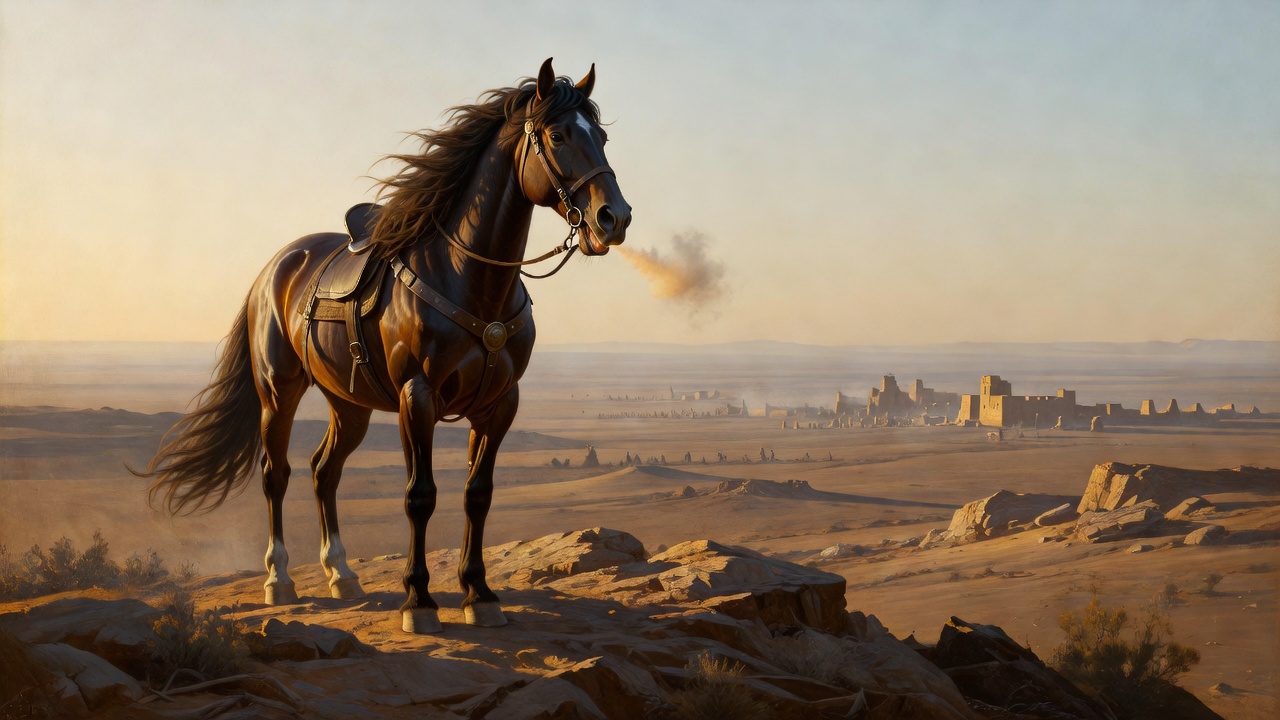
19Whether thou shalt give strength to an horse, either shalt give neighing about his neck?
20Whether thou shalt raise him as locusts? The glory of his nostrils is dreaded.
21He diggeth [the] earth with his foot, he full out joyeth; and he goeth boldly against [the] armed men.
22He despiseth fearedfulness, and he giveth not stead to [the] sword.
23An arrow case shall sound upon him; a spear and a shield shall shine.
24He is hot, or fervent, and gnasheth, and swalloweth the earth; and he areckoneth not that the cry of the trump soundeth.
25When he heareth a clarion, he saith, Joy! he smelleth battle afar; the exciting of dukes, and the yelling of the host.
26Whether an hawk spreading abroad his wings to the south, beginneth to have feathers by thy wisdom?
27Whether an eagle shall be raised up at thy commandment, and shall set [or put] his nest in high places?
28He dwelleth in stones, and he abideth in flints broken before, and in rocks, to which men may not nigh.
29From thence he beholdeth meat and his eyes look from [a] far.
30His young suck blood, and wherever a carrion is, anon he is present.
Did you know?
God’s Care and Design in the Animal Kingdom
- The divine speech challenges Job regarding the untamable nature of wild animals such as the wild donkey and the wild ox. Unlike domesticated livestock used for farming and threshing, these creatures dwell freely in the wilderness and salt flats, completely independent of human authority and labor.Sources: the Bible text itself
- The text highlights the ostrich’s peculiar nesting habits, describing how it leaves its eggs in the sand without the protective care seen in other birds, yet outruns horses when fleeing across open ground.Sources: the Bible text itself
- The vivid portrait of the warhorse describes its fearlessness, strength, and eagerness in the face of weapons and battle horns, emphasizing that its courage and nature are bestowed by God rather than human mastery.Sources: the Bible text itself
Notes written with AI assistance from open sources (Theographic Bible Metadata, CC BY-SA 4.0; Easton’s Bible Dictionary, public domain) and reviewed before publishing.
Credits and license for this translation
Wycliffe's Bible with Modern Spelling
English: Wycliffe's Bible Modern Spelling (with Deuterocanon)
Copyright © 2001,2010,2011,2012,2013,2015 Terry Noble
Language: English
Dialect: Archaic
Translation by: Terry Noble
Wycliffe’s Bible with Modern Spelling, was made in response to requests from readers who wanted my Wycliffe’s Old and New Testaments and Apocrypha in one volume. Printing limitations dictated the number of pages available to me and the letter size. In my previous books, Wycliffe’s Bible, Wycliffe’s Old Testament, Vols. 1 amp 2, Wycliffe’s New Testament, and Wycliffe’s Apocrypha, I have tens of thousands of rewritten verses, presented in parentheses “( )”, to provide help in comprehending the 14th century Middle English vocabulary and grammar. In this present volume, with space at a premium, those “helps” had to be eliminated, to make room for the text of the Apocrypha.
This translation is made available to you under the terms of the
Creative Commons Attribution-Noncommercial-No Derivatives license 4.0.
You may share and redistribute this Bible translation or extracts from it in any format, provided that:
You include the above copyright and source information.
You do not sell this work for a profit.
You do not change any of the words or punctuation of the Scriptures.
Pictures included with Scriptures and other documents on this site are licensed just for use with those Scriptures and documents.
For other uses, please contact the respective copyright owners.
2019-09-26
Section headings adapted from the Berean Standard Bible (public domain); they are not part of this translation’s text.
Source: http://ebible.org/engwyc2017/ · eBible.org