Job 32
Wycliffe's Bible with Modern Spelling · Tap a verse to see its cross-references.
Elihu Rebukes Job’s Friends
1Forsooth these three men left off to answer Job, for he seemed a just [or rightwise] man to them.
2And Elihu, the son of Barachel the Buzite, of the kindred of Ram, was wroth, and had indignation; and he was wroth against Job, for he said himself to be just before God.
3And also Elihu had indignation against the three friends of Job, for they had found no reasonable answer, but only had condemned Job.
4Therefore Elihu abode Job speak-ing, for they, that spake, were elder men.
5But when he had seen, that these three men might not answer Job, he was wroth greatly.
6And Elihu, the son of Barachel the Buzite, answered, and said, I am younger in time, and ye be elder; therefore with head holden down, I dreaded to show to you my sentence.
7For I hoped that [the] longer age should speak, and that the multitude of years should teach wisdom.
8But as I see now, a spirit is in men, and the inspiration, either revelation, of Almighty God giveth understanding.
9Men of long life be not always wise, and eld [or old] men understand not doom.
10Therefore I shall say, Hear ye me, and I also shall show my knowing to you.
11For I abode your words, I heard your prudence, as long as ye disputed in your words.
12And as long as I guessed you to say anything, I beheld; but as I perceive, there is none of you, that may reprove Job, and answer to his words;
13lest peradventure ye say, We have found wisdom; God, and not man, hath cast him away.
14Job spake nothing to me, and I not by your words shall answer him.
15They [much] dreaded, and answer-ed no more, and took away speech from themselves.
16Therefore since I abode, and they spake not, they stood, and answered no more;
17also I shall answer my part, and I shall show my knowing.
18For I am full of words, and the spirit of my womb, that is, my mind, constraineth me.
19Lo! my womb is as must without a spigot or faucet, either a venting, that bursteth new vessels.
20I shall speak, and breathe again a little; I shall open my lips, and I shall answer.
21I shall not take the person of a man, and I shall not make God even to man.
22For I know not how long I shall abide alive, and if my Maker will take me away after a little time.
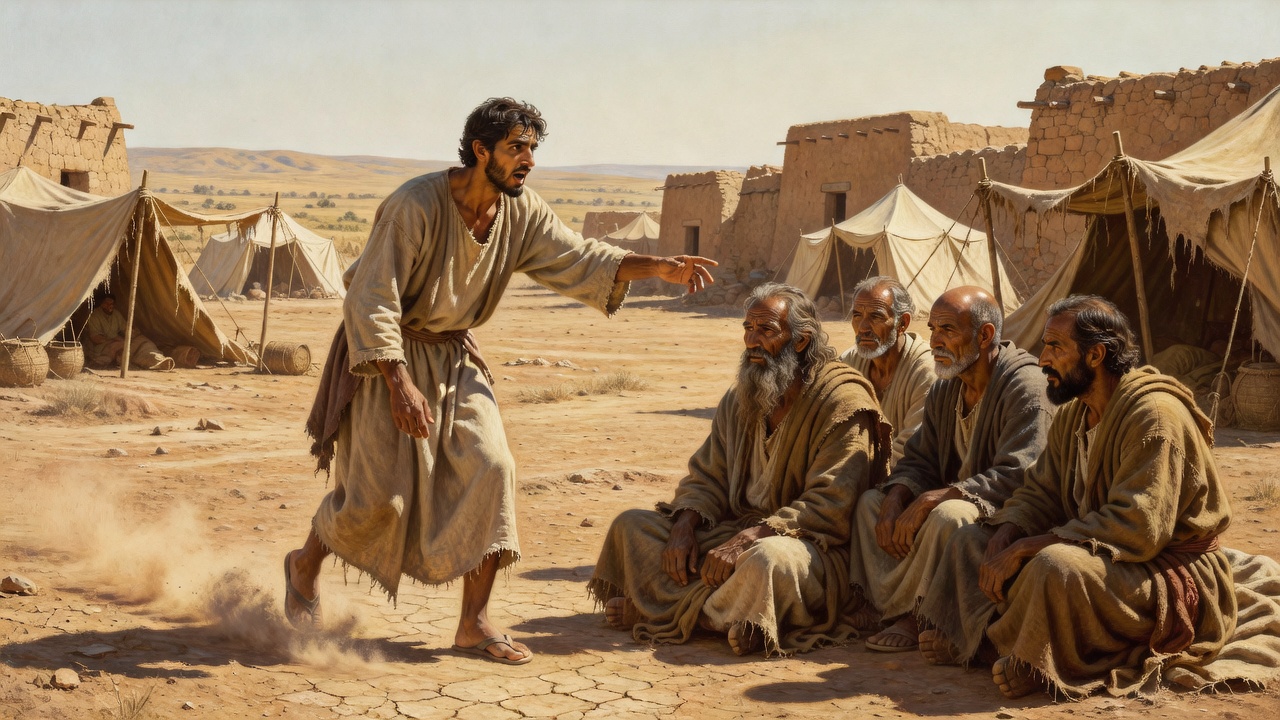
Did you know?
Elihu Enters the Debate
- Elihu son of Barachel the Buzite, from the family of Ram, appears for the first time after Job's three friends cease answering him. His speeches span from chapter 32 through chapter 37.Sources: the Bible text itself · Elihu · Barachel · Ram
- Elihu is angry with both sides of the debate: he is furious with Job for justifying himself rather than God, and angry with the three older companions because they condemned Job without refuting his arguments.Sources: the Bible text itself
- Out of cultural deference to seniority, Elihu remained silent during the earlier debates believing that age taught wisdom. He speaks only when the others have run out of words, arguing that true understanding comes from the breath and spirit of the Almighty rather than age alone.Sources: the Bible text itself
Notes written with AI assistance from open sources (Theographic Bible Metadata, CC BY-SA 4.0; Easton’s Bible Dictionary, public domain) and reviewed before publishing.
Credits and license for this translation
Wycliffe's Bible with Modern Spelling
English: Wycliffe's Bible Modern Spelling (with Deuterocanon)
Copyright © 2001,2010,2011,2012,2013,2015 Terry Noble
Language: English
Dialect: Archaic
Translation by: Terry Noble
Wycliffe’s Bible with Modern Spelling, was made in response to requests from readers who wanted my Wycliffe’s Old and New Testaments and Apocrypha in one volume. Printing limitations dictated the number of pages available to me and the letter size. In my previous books, Wycliffe’s Bible, Wycliffe’s Old Testament, Vols. 1 amp 2, Wycliffe’s New Testament, and Wycliffe’s Apocrypha, I have tens of thousands of rewritten verses, presented in parentheses “( )”, to provide help in comprehending the 14th century Middle English vocabulary and grammar. In this present volume, with space at a premium, those “helps” had to be eliminated, to make room for the text of the Apocrypha.
This translation is made available to you under the terms of the
Creative Commons Attribution-Noncommercial-No Derivatives license 4.0.
You may share and redistribute this Bible translation or extracts from it in any format, provided that:
You include the above copyright and source information.
You do not sell this work for a profit.
You do not change any of the words or punctuation of the Scriptures.
Pictures included with Scriptures and other documents on this site are licensed just for use with those Scriptures and documents.
For other uses, please contact the respective copyright owners.
2019-09-26
Section headings adapted from the Berean Standard Bible (public domain); they are not part of this translation’s text.
Source: http://ebible.org/engwyc2017/ · eBible.org