Job 30
Wycliffe's Bible with Modern Spelling · Tap a verse to see its cross-references.
Job’s Honor Turned to Contempt
1But now younger men in time scorn me, whose fathers I deigned not to set with the dogs of my flock.
2Of which men the strength of their hands was for nought to me, and they were guessed unworthy to that life.
3They were barren for neediness and hunger; they gnawed in wilder-ness, and were pale for poverty and wretchedness;
4and they ate herbs, and the rinds of trees; and the root of junipers was their meat.
5The which men ravished these things from great valleys; and when they had found any of all these things, they ran with a cry to them.
6They dwelled in deserts of strands [or streams], and in caves of [the] earth, either on gravel.
7Which were glad among such things, and they areckoned as delights to be under bushes.
8These were the sons of fools, and of unnoble men, and utterly appearing not on [the] earth.
9But now I am turned into the song of them, and I am made a proverb to them.
10They hold me abominable, and they flee far from me, and dread not to spit on my face.
11For God hath opened his arrow case, and he hath tormented me, and he hath put a bridle into my mouth.
12At the right side of the east my wretchednesses have risen up anon; they turned upside down my feet, and they oppressed me with their paths as with floods.
13They destroyed my ways; they setted treason to me, and they had the mastery; and there was none that helped me.
14They felled in upon me as by a broken wall, and by gate opened, and were stretched forth to my wretched-nesses.
Job’s Prosperity Becomes Calamity
15I am driven into nought; he took away my desire as [the] wind, and mine help passed away as a cloud.
16But now my soul fadeth in myself, and [the] days of torment hold me steadfastly.
17In [the] night my bone is pierced with sorrows; and they, that eat me, sleep not.
18In the multitude of those [or them] my cloth is wasted, and they have girded me as with the collar of a coat.
19I am comparisoned to clay, and I am made like to a dead spark and ashes.
20I shall cry to thee, and thou shalt not hear me; I stand, and thou behold-est not me.
21Thou art changed into cruel to me, and in the hardness of thine hand thou art adversary to me.
22Thou hast raised me, and hast set me as on wind; and hast hurtled me down strongly.
23I know, that thou shalt betake me to death, where an house is ordained to each living man.
24Nevertheless thou sendest not out thine hand to the wasting of them; and if they fall down, thou shalt save them.
25I wept sometime on him that was tormented, and my soul had compas-sion on a poor man.
26I abode goods, and evils be come to me; I abode light, and darknesses brake out.
27Mine inner things boiled out with-out my rest; and [the] days of torment came before me.
28I went mourning, and I rose up without strong vengeance in the company, and I cried.
29I was the brother of dragons, and the fellow of ostriches.
30My skin was made black upon me, and my bones dried for heat.
31Mine harp is turned into mourning, and mine organ into the voice of weepers.
Did you know?
Humiliation, Physical Suffering, and Desert Outcasts
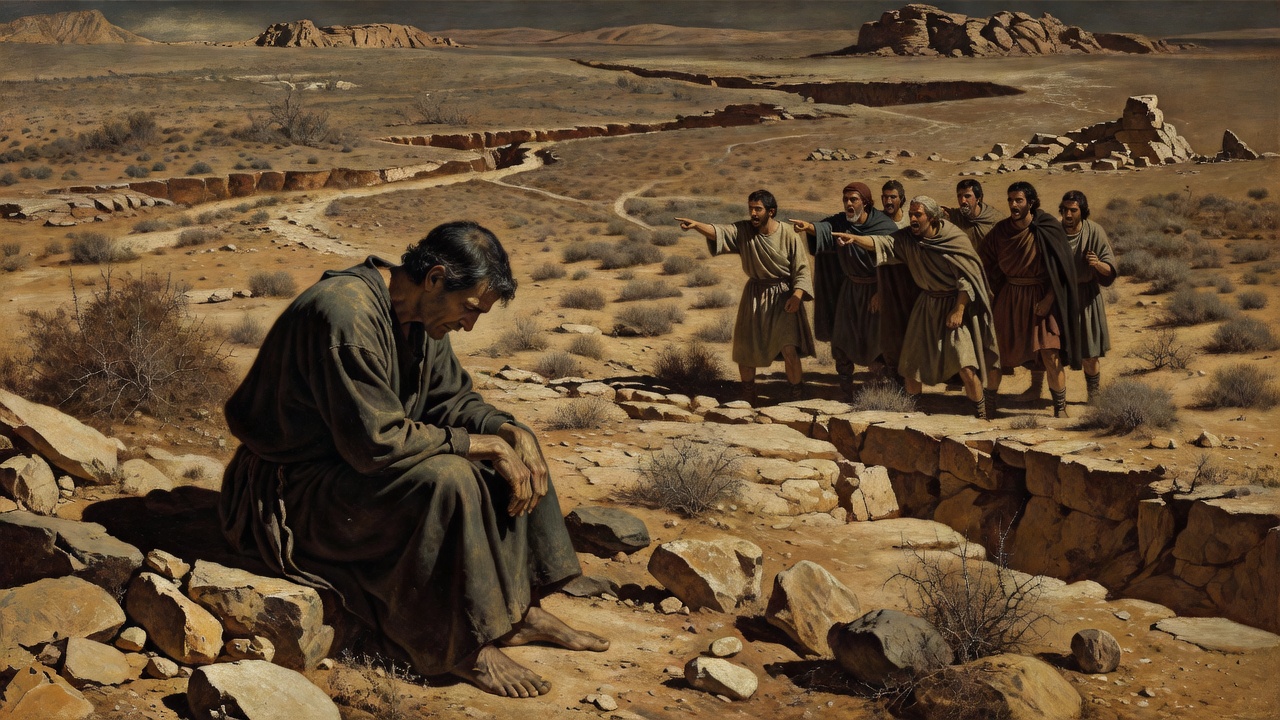
- In this chapter, Job contrasts his previous social standing with his current humiliation at the hands of impoverished outcasts. He describes these men as surviving on the margins of society, foraging for wild mallow and broom tree roots in desolate wadis and rock hollows.Sources: the Bible text itself
- Job uses vivid siege metaphors, picturing his attackers as an advancing army laying ramps and breaking through breaches against him, while he endures severe physical afflictions such as fever, gnawing pain, and blackened, peeling skin.Sources: the Bible text itself
- To convey the isolation and intensity of his grief, Job identifies with the mournful sounds of wilderness creatures, calling himself a companion to jackals and ostriches, while his musical instruments—the harp and flute—are turned entirely to weeping.Sources: the Bible text itself
Notes written with AI assistance from open sources (Theographic Bible Metadata, CC BY-SA 4.0; Easton’s Bible Dictionary, public domain) and reviewed before publishing.
Credits and license for this translation
Wycliffe's Bible with Modern Spelling
English: Wycliffe's Bible Modern Spelling (with Deuterocanon)
Copyright © 2001,2010,2011,2012,2013,2015 Terry Noble
Language: English
Dialect: Archaic
Translation by: Terry Noble
Wycliffe’s Bible with Modern Spelling, was made in response to requests from readers who wanted my Wycliffe’s Old and New Testaments and Apocrypha in one volume. Printing limitations dictated the number of pages available to me and the letter size. In my previous books, Wycliffe’s Bible, Wycliffe’s Old Testament, Vols. 1 amp 2, Wycliffe’s New Testament, and Wycliffe’s Apocrypha, I have tens of thousands of rewritten verses, presented in parentheses “( )”, to provide help in comprehending the 14th century Middle English vocabulary and grammar. In this present volume, with space at a premium, those “helps” had to be eliminated, to make room for the text of the Apocrypha.
This translation is made available to you under the terms of the
Creative Commons Attribution-Noncommercial-No Derivatives license 4.0.
You may share and redistribute this Bible translation or extracts from it in any format, provided that:
You include the above copyright and source information.
You do not sell this work for a profit.
You do not change any of the words or punctuation of the Scriptures.
Pictures included with Scriptures and other documents on this site are licensed just for use with those Scriptures and documents.
For other uses, please contact the respective copyright owners.
2019-09-26
Section headings adapted from the Berean Standard Bible (public domain); they are not part of this translation’s text.
Source: http://ebible.org/engwyc2017/ · eBible.org