Job 21
Wycliffe's Bible with Modern Spelling · Tap a verse to see its cross-references.
Job: God Will Punish the Wicked
1Forsooth Job answered, and said,
2I pray you, hear ye my words, and do ye penance.
3Suffer ye me, that I speak; and laugh ye after my words, if it shall seem to you worthy to do so.
4Whether my disputing is against man, that skillfully I owe not to be [made] sorry?
5Perceive ye me, and be ye astonied; and set ye [or putteth] your finger upon your mouth.
6And when I bethink me, I dread, and trembling shaketh my flesh.
7Why therefore live wicked men? They be enhanced, and comforteth with riches.
8Their seed dwelleth before them; the company of their kinsmen, and of the sons of their sons, dwelleth in their sight.
9Their houses be secure, and peace-able; and the rod, or scourge, of God is not upon them.
10The cow of them conceived, and calved not a dead calf; the cow calved, and is not deprived of her calf.
11Their little children go out as flocks; and their young children full out joy with playings.
12They hold the tympan, and harp; and they joy at the sound of the organ.
13They lead in goods their days; and in a point, they go down to hells, that is, to burials, or the grave.
14Which men said to God, Go thou away from us; we desire not the knowing of thy ways.
15Who is Almighty God, that we serve him? and what profiteth it to us, if we pray him?
16Nevertheless for their goods be not in their hand, or power, the counsel of wicked men be far from me.
17How oft shall the lantern of wicked men be quenched, and flowing shall come upon them, and God shall part with them the sorrows of his strong vengeance?
18They shall be as chaff before the face of the wind; and as a dead spark, that the whirlwind scattereth abroad.
19Ye say, God shall keep the sorrow of the father to his sons; and when he hath yielded to them vengeance, then he shall know it.
20His eyes shall see their slaying; and he shall drink of the strong vengeance of Almighty God.
21For why what pertaineth it to him of his house after him, though the number of his months be half taken away?
22Whether any man shall teach God knowing, which deemeth them that be on high?
23This evil man dieth strong and whole, rich and blessful to the world.
24His entrails be full of fatness; and his bones be moisted with marrow.
25And another man dieth in the bitterness of his soul, and without any riches.
26Nevertheless they shall sleep together in dust, and worms shall cover them.
27Certainly I know your wicked thoughts, and your sentences against me.
28For ye say, Where is the house of the prince? and where be the taber-nacles of wicked men?
29Ask ye this of each way-goer; and ye shall know, that he knoweth these same things,
30that is, that an evil man shall be kept into the day of perdition, and he shall be led to the day of strong vengeance.
31Who shall reprove his ways before him? and who shall yield to him for those things, which he hath done?
32He shall be led to the sepulchres; and he shall wake in the heap of dead men.
33He was sweet to the stones, either filths, of hell; and he draweth each man after him, and unnumber-able men went before him.
34How therefore comfort ye me in vain, since your answers be showed to contrary the truth?
Did you know?
The Prosperity of the Wicked
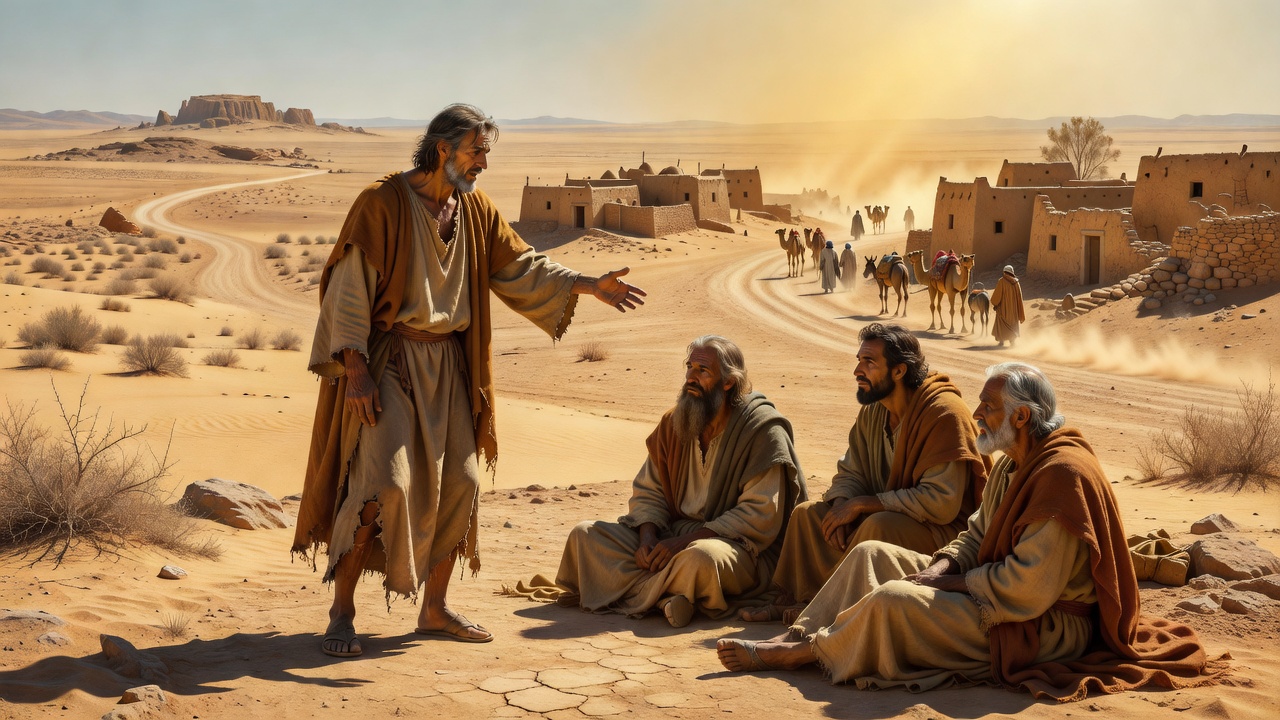
- Job challenges his friends' belief that the wicked always suffer in this life. He points out that many ungodly people grow old, increase in power, see their children flourish to the sound of lyres and flutes, and die in peaceful ease.Sources: the Bible text itself
- Confronting the idea that God reserves punishment for a person's children, Job argues that true accountability requires wrongdoers to experience retribution personally and taste the wrath of the Almighty during their own lives.Sources: the Bible text itself
- Job urges his companions to ask road travelers about common observations. He notes that whether an individual lives in vigorous prosperity or dies in bitter poverty, both ultimately share the same earthly end when they lie down together in the dust.Sources: the Bible text itself
Notes written with AI assistance from open sources (Theographic Bible Metadata, CC BY-SA 4.0; Easton’s Bible Dictionary, public domain) and reviewed before publishing.
Credits and license for this translation
Wycliffe's Bible with Modern Spelling
English: Wycliffe's Bible Modern Spelling (with Deuterocanon)
Copyright © 2001,2010,2011,2012,2013,2015 Terry Noble
Language: English
Dialect: Archaic
Translation by: Terry Noble
Wycliffe’s Bible with Modern Spelling, was made in response to requests from readers who wanted my Wycliffe’s Old and New Testaments and Apocrypha in one volume. Printing limitations dictated the number of pages available to me and the letter size. In my previous books, Wycliffe’s Bible, Wycliffe’s Old Testament, Vols. 1 amp 2, Wycliffe’s New Testament, and Wycliffe’s Apocrypha, I have tens of thousands of rewritten verses, presented in parentheses “( )”, to provide help in comprehending the 14th century Middle English vocabulary and grammar. In this present volume, with space at a premium, those “helps” had to be eliminated, to make room for the text of the Apocrypha.
This translation is made available to you under the terms of the
Creative Commons Attribution-Noncommercial-No Derivatives license 4.0.
You may share and redistribute this Bible translation or extracts from it in any format, provided that:
You include the above copyright and source information.
You do not sell this work for a profit.
You do not change any of the words or punctuation of the Scriptures.
Pictures included with Scriptures and other documents on this site are licensed just for use with those Scriptures and documents.
For other uses, please contact the respective copyright owners.
2019-09-26
Section headings adapted from the Berean Standard Bible (public domain); they are not part of this translation’s text.
Source: http://ebible.org/engwyc2017/ · eBible.org