Job 2
Wycliffe's Bible with Modern Spelling · Tap a verse to see its cross-references.
Job Loses His Health
1And it was done, in a day the sons of God were come to praise him, and they stood before the Lord, and Satan was come among them, and he stood in the sight of the Lord,
2and the Lord said to Satan, From whence comest thou? Which answered, and said, I have compassed the earth, and I have gone through it.
3And the Lord said to Satan, Whether thou hast not considered my servant Job, that none in [the] earth is like him; he is a simple man, and rightful [or right], and dreading God, and going away from evil, and yet holding innocence? But thou hast moved me against him, that I should torment or vex him in vain.
4To whom Satan answered, and said, A man shall give skin for skin, and all things that he hath for his life;
5therefore put to thine hand, and touch his bone and his flesh, and then thou shalt see, that he shall curse thee in thy face.
6Therefore the Lord said to Satan, Lo! he is in thine hand; nevertheless keep thou his life.
7Therefore Satan went out from the face of the Lord, and he smote Job with the worst stinking botch, from the sole of his foot till to his top;
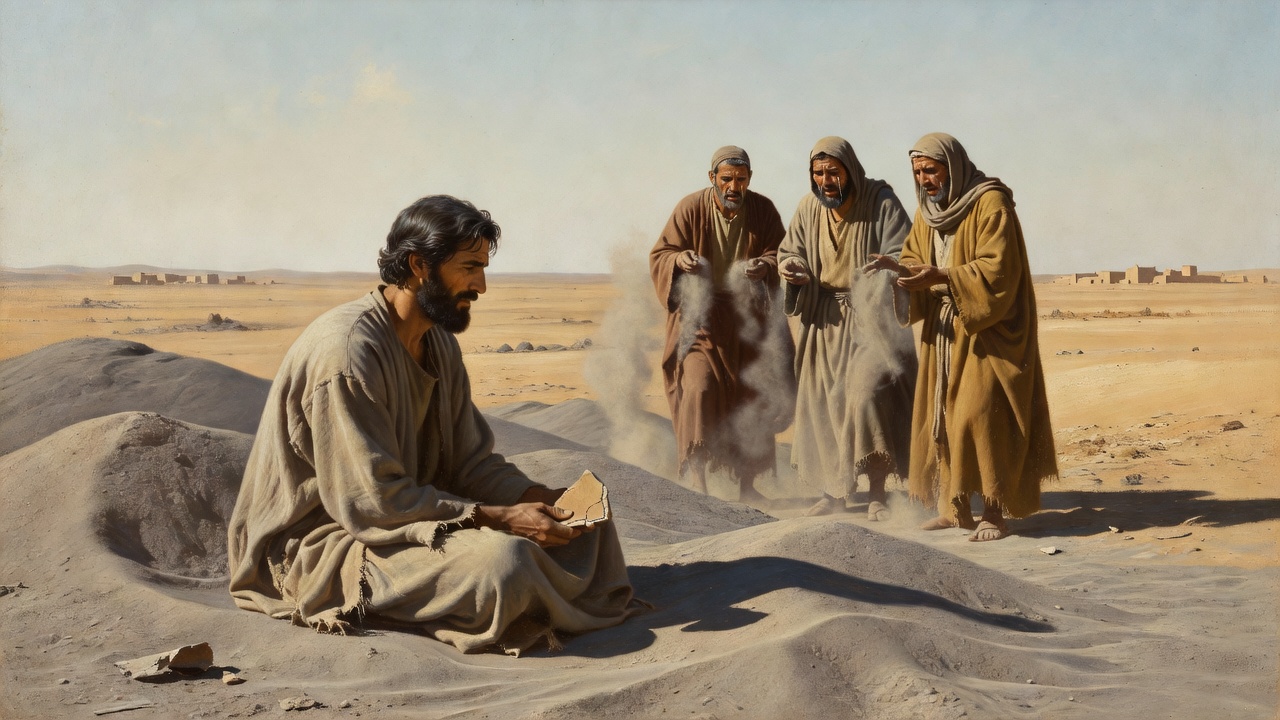
8and Job sat in a dunghill, and he shaved away the quitter or pus of him with a shell.
9Forsooth his wife said to him, Dwellest thou yet in thy simpleness, that is, fondness or foolishness? Curse thou God, and die.
10And Job said to her, Thou hast spoken as one of the fond [or foolish] women; if we have taken goods of the hand of the Lord, why forsooth suffer we not evils? In all these things Job sinned not in his lips.
Job’s Three Friends
11And then three friends of Job heard of all the evil that had befallen to him, and they came to him, each of them from his place, Eliphaz the Temanite, and Bildad the Shuhite, and Zophar the Naamathite; for they had said together to themselves, that they would come together, and visit Job, and comfort him.
12And when they had raised afar their eyes, they knew not him; and they cried [out], and wept, and rent their clothes, and sprinkled dust on their heads into heaven.
13And they sat with him in the earth seven days and seven nights, and no man spake a word to him; for they saw, that his sorrow was great.
Did you know?
Job’s Affliction and the Arrival of His Friends
- In the Hebrew text of Job, the term translated as Satan appears with the definite article as the adversary or accuser. In this second heavenly council, the adversary argues that while Job endured the loss of his wealth and family, striking his physical flesh and bones would cause him to abandon his integrity.Sources: Satan · the Bible text itself
- Job’s companions—Eliphaz the Temanite, Bildad the Shuhite, and Zophar the Naamathite—came from distant regions associated with Arabia. Bildad's background is linked to Shuah, a son of Abraham by Keturah, while the ancient Greek Septuagint translation connects Zophar to the Mineans of southern Arabia.Sources: Bildad · Zophar · the Bible text itself
- Upon seeing Job's severe suffering, his three friends tore their garments, threw dust into the air over their heads, and sat with him on the ground in complete silence for seven days and seven nights. This shared vigil reflected ancient customs of deep mourning when sorrow was too profound for words.Sources: the Bible text itself
Notes written with AI assistance from open sources (Theographic Bible Metadata, CC BY-SA 4.0; Easton’s Bible Dictionary, public domain) and reviewed before publishing.
Credits and license for this translation
Wycliffe's Bible with Modern Spelling
English: Wycliffe's Bible Modern Spelling (with Deuterocanon)
Copyright © 2001,2010,2011,2012,2013,2015 Terry Noble
Language: English
Dialect: Archaic
Translation by: Terry Noble
Wycliffe’s Bible with Modern Spelling, was made in response to requests from readers who wanted my Wycliffe’s Old and New Testaments and Apocrypha in one volume. Printing limitations dictated the number of pages available to me and the letter size. In my previous books, Wycliffe’s Bible, Wycliffe’s Old Testament, Vols. 1 amp 2, Wycliffe’s New Testament, and Wycliffe’s Apocrypha, I have tens of thousands of rewritten verses, presented in parentheses “( )”, to provide help in comprehending the 14th century Middle English vocabulary and grammar. In this present volume, with space at a premium, those “helps” had to be eliminated, to make room for the text of the Apocrypha.
This translation is made available to you under the terms of the
Creative Commons Attribution-Noncommercial-No Derivatives license 4.0.
You may share and redistribute this Bible translation or extracts from it in any format, provided that:
You include the above copyright and source information.
You do not sell this work for a profit.
You do not change any of the words or punctuation of the Scriptures.
Pictures included with Scriptures and other documents on this site are licensed just for use with those Scriptures and documents.
For other uses, please contact the respective copyright owners.
2019-09-26
Section headings adapted from the Berean Standard Bible (public domain); they are not part of this translation’s text.
Source: http://ebible.org/engwyc2017/ · eBible.org