Job 15
Wycliffe's Bible with Modern Spelling · Tap a verse to see its cross-references.
Eliphaz: Job Does Not Fear God
1Then Eliphaz the Temanite answer-ed, and said,
2Whether a wise man shall answer, as speaking against the wind, and shall fill his stomach with burning, that is ire?
3For thou reprovest him by words, which is not like thee, and thou speakest that, that speedeth not to thee.
4As much as is in thee, thou hast avoided dread; and thou hast taken away thy prayers before God.
5For [thy] wickedness hath taught thy mouth, and thou pursuest [or followest] the tongue of blasphemers.
6Thy tongue [or Thy mouth], and not I, shall condemn thee, and thy lips shall answer thee.
7Whether thou art born the first man, and whether thou art formed before little hills?
8Whether thou hast heard the counsel of God, and whether his wisdom is lower than thou?
9What thing knowest thou, which we know not? What thing under-standest thou, which we know not?
10Both wise men and eld, much elder than thy fathers, be among us.
11Whether it is great, that God comfort thee? But thy shrewd words forbid this.
12What raiseth thine heart thee, and thou as thinking great things hast eyes astonied?
13What swelleth thy spirit against God, that thou bring forth of thy mouth such words?
14What is a man, that he be without wem, and that he, born of a woman, appear just [or rightwise]?
15Lo! none among his saints is unchangeable, and heavens be not clean in his sight.
16How much more is a man abominable and unprofitable, that drinketh wickedness as water?
17I shall show to thee, hear thou me; I shall tell to thee that, that I saw.
18Wise men acknowledge, and hide not their fathers.
19To which wise men alone the earth is given, and an alien shall not pass by them.
20A wicked man is proud in all his days; and the number of his years and of his tyranny is uncertain.
21The sound of dread is ever [more] in his ears, and when peace is, he supposeth ever [more] treasons.
22He believeth not that he may turn again from darknesses to light; and he beholdeth about on each side for a sword.
23When he stirreth him [self] to seek bread, he knoweth, that the day of darknesses is made ready in his hand.
24Tribulation shall make him afeared, and anguish shall encompass him, as a king which is made ready to battle.
25For he held forth his hand against God, and he was made strong against Almighty God.
26He ran with his neck raised up against God, and he was armed with a fat noll.
27Fatness, that is, pride of temporal abundance, covered his face, or understanding, and outward fatness, that is, unshamefastness, hangeth down of his sides. [Fatness covered his face, and of his sides grease hangeth.]
28He shall dwell in desolate cities, and in deserted houses, that be turned into burials.
29He shall not be made rich, neither his chattel shall dwell steadfastly; neither he shall send his root into the earth,
30neither he shall go away from darknesses. Flame shall make dry his branches, and he shall be taken away by the spirit of his mouth.
31Believe he not vainly which is deceived by error, that he shall be again-bought by any price.
32Before that his days be [ful] filled, he shall perish, and his hands shall wax dry;
33he shall be hurt as a vine in the first flower of his grape, and as an olive tree casting away his flower.
34For the gathering together of an hypocrite is barren, and fire shall devour the tabernacles of them, that take gifts willfully.
35He conceived sorrow, and childed wickedness, and his womb maketh ready treacheries.
Did you know?
Eliphaz's Second Speech and Ancestral Wisdom
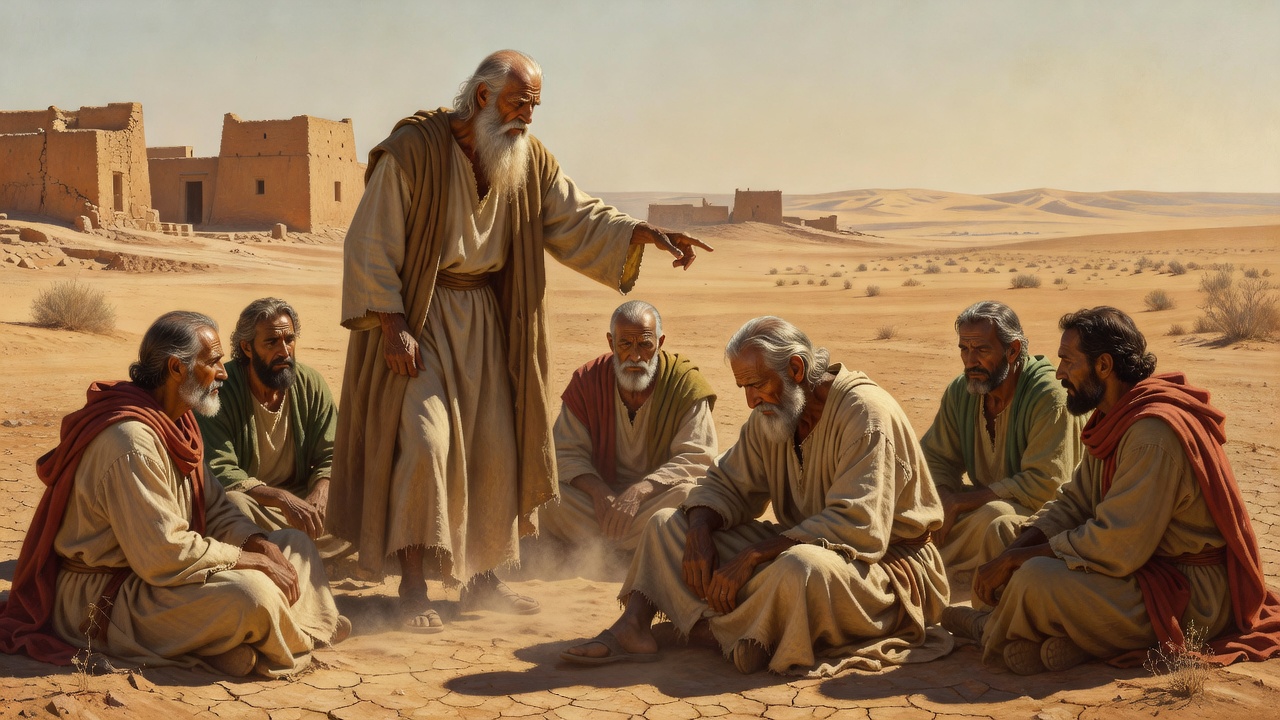
- Eliphaz accuses Job of filling his belly with the hot east wind, invoking a familiar ancient Near Eastern metaphor for the dry, scorching desert wind that blights vegetation and brings destruction instead of sustenance.Sources: the Bible text itself
- To validate his view that the wicked inevitably suffer ruin, Eliphaz appeals to the authority of ancient, gray-haired sages and traditional lore handed down from a time before foreign influences entered the land.Sources: the Bible text itself · Eliphaz
Notes written with AI assistance from open sources (Theographic Bible Metadata, CC BY-SA 4.0; Easton’s Bible Dictionary, public domain) and reviewed before publishing.
Credits and license for this translation
Wycliffe's Bible with Modern Spelling
English: Wycliffe's Bible Modern Spelling (with Deuterocanon)
Copyright © 2001,2010,2011,2012,2013,2015 Terry Noble
Language: English
Dialect: Archaic
Translation by: Terry Noble
Wycliffe’s Bible with Modern Spelling, was made in response to requests from readers who wanted my Wycliffe’s Old and New Testaments and Apocrypha in one volume. Printing limitations dictated the number of pages available to me and the letter size. In my previous books, Wycliffe’s Bible, Wycliffe’s Old Testament, Vols. 1 amp 2, Wycliffe’s New Testament, and Wycliffe’s Apocrypha, I have tens of thousands of rewritten verses, presented in parentheses “( )”, to provide help in comprehending the 14th century Middle English vocabulary and grammar. In this present volume, with space at a premium, those “helps” had to be eliminated, to make room for the text of the Apocrypha.
This translation is made available to you under the terms of the
Creative Commons Attribution-Noncommercial-No Derivatives license 4.0.
You may share and redistribute this Bible translation or extracts from it in any format, provided that:
You include the above copyright and source information.
You do not sell this work for a profit.
You do not change any of the words or punctuation of the Scriptures.
Pictures included with Scriptures and other documents on this site are licensed just for use with those Scriptures and documents.
For other uses, please contact the respective copyright owners.
2019-09-26
Section headings adapted from the Berean Standard Bible (public domain); they are not part of this translation’s text.
Source: http://ebible.org/engwyc2017/ · eBible.org