John 12
Wycliffe's Bible with Modern Spelling · Tap a verse to see its cross-references.
Mary Anoints Jesus
1Therefore Jesus before six days of pask came to Bethany, where Lazarus had been dead, whom Jesus raised.
2And they made to him a supper there, and Martha ministered to him; and Lazarus was one of the men that sat at the meat with him.
3Therefore Mary took a pound of ointment of true nard [or spikenard] precious, and anointed the feet of Jesus, and wiped his feet with her hairs; and the house was full-filled with the savour of the ointment.
4Therefore Judas Iscariot, one of his disciples, that was to betray him, said,
5Why is not this ointment sold for three hundred pence, and given to poor men?
6But he said this thing, not for it pertained to him of needy men, but for he was a thief, and had the purses, and bare those things that were sent.
7Therefore Jesus said, Suffer ye her, that into the day of my burying she keep that;
8for ye shall evermore have poor men with you, but ye shall not ever-more have me.
The Plot to Kill Lazarus
9Therefore much people of the Jews knew, that Jesus was there; and they came, not only for Jesus, but to see Lazarus, whom he had raised from death.
10But the princes of priests thought to slay Lazarus,
11for many of the Jews went away for him, and believed in Jesus.
The Triumphal Entry
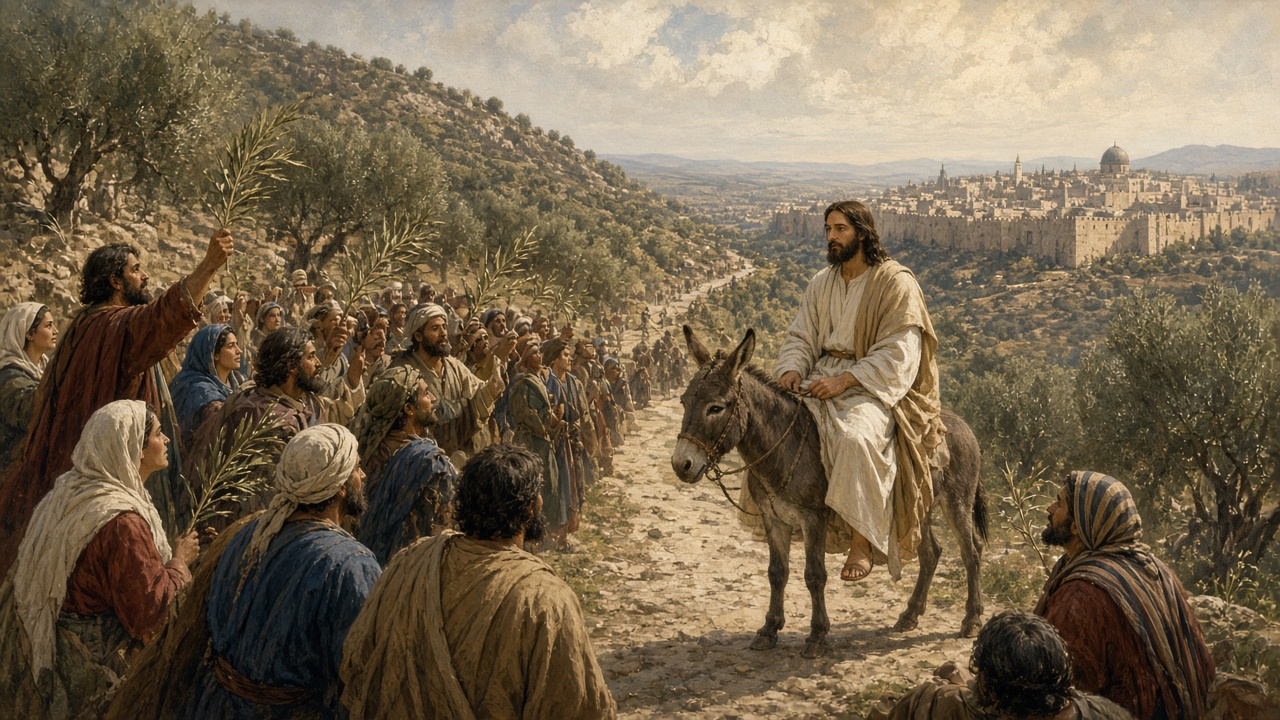
12But on the morrow much people, that came together to the feast day, when they had heard, that Jesus came to Jerusalem,
13took branches of palms, and came forth to meet him, and cried, Hosanna, blessed is the king of Israel, that cometh in the name of the Lord.
14And Jesus found a young ass, and sat on him, as it is written,
15The daughter of Zion, do not thou dread; lo! thy king cometh, sitting on an ass’s foal [or on the colt of a she-ass].
16His disciples knew not first these things, but when Jesus was glorified, then they had mind, that these things were written of him, and these things they did to him.
17Therefore the people bare witness-ing, that was with him, when he called Lazarus from the grave, and raised him from death.
18And therefore the people came, and met with him, for they heard that he had done this sign.
19Therefore the Pharisees said to themselves, Ye see, that we profit nothing; lo! all the world hath gone after him.
Jesus Predicts His Death
20And there were some heathen men, of them that had come up to worship in the feast day.
21And these came to Philip, that was of Bethsaida of Galilee, and prayed him, and said, Sire, we will see Jesus [or we would see Jesus].
22Philip cometh, and saith to Andrew; and again Andrew and Philip said to Jesus.
23And Jesus answered to them, and said, The hour cometh, that man’s Son be clarified.
24Truly, truly, I say to you, but a corn of wheat fall into the earth, and be dead, it dwelleth alone; but if it be dead, it bringeth [forth] much fruit.
25He that loveth his life, shall lose it; and he that hateth his life in this world, keepeth it into everlasting life.
26If any man serve me, pursue he me; and where I am, there my minister [or my servant] shall be. If any man serve me, my Father shall worship him.
27Now my soul is troubled, and what shall I say? Father, save me from this hour; but therefore [or but for that thing] I came into this hour;
28Father, clarify thy name. And a voice came from heaven, and said, And I have clarified, and again I shall clarify.
29Therefore the people that stood, and heard, said, that thunder was made; other men said, an angel spake to him.
30Jesus answered, and said, This voice came not for me, but for you.
31Now is the doom of the world, now the prince of this world shall be cast out.
32And if I shall be enhanced from the earth, I shall draw all things to myself.
33And he said this thing, signifying by what death he was to die.
34And the people answered to him, We have heard of the law, that Christ dwelleth without end; and how sayest thou, It behooveth man’s Son to be areared? Who is this man’s Son?
35And then Jesus saith to them, Yet a little light is in you; walk ye, the while ye have light, that darkness catch you not; he that wandereth in darknesses, knoweth not whither he goeth.
36While ye have light, believe ye in the light, that ye be the children of light. Jesus spake these things, and went, and hid him from them.
Belief and Unbelief
37And when he had done so many miracles [or so many signs] before them, they believed not in him;
38that the word of Isaiah, the prophet, should be fulfilled, which he said, Lord, who hath believed to our hearing, and to whom is the arm of the Lord showed?
39Therefore they might not believe, for again Isaiah said,
40He hath blinded their eyes, and hath made hard the heart of them, that they see not with eyes, and understand [not] with heart; and that they be converted, and I heal them.
41Isaiah said these things, when he saw the glory of him, and spake of him.
42Nevertheless of the princes, many believed in him, but for the Pharisees they acknowledged not, that they should not be put out of the synagogue;
43for they loved the glory of men, more than the glory of God.
44And Jesus cried, and said, He that believeth in me, believeth not in me, but in him that sent me.
45He that seeth me, seeth him that sent me.
46I light came into the world, that each that believeth in me, dwell not in darknesses.
47And if any man heareth my words, and keepeth them not, I deem him not; for I came not, that I deem the world, but that I make the world safe.
48He that despiseth me, and taketh not my words, hath him that shall judge him; that word [or the word] that I have spoken, shall deem him in the last day.
49For I have not spoken of myself, but that Father that sent me, [he] gave to me a commandment, what I shall say, and what I shall speak.
50And I know, that his commandment is everlasting life; therefore those things that I speak, as the Father said to me, so I speak.
Did you know?
The Anointing at Bethany and the Entry into Jerusalem
- Bethany, where Jesus arrived six days before the Passover, lay about two miles east of Jerusalem on the southeastern slope of the Mount of Olives, along the road to Jericho, and took its name from the palm trees that grew there. It was the home of Lazarus, whom Jesus had raised from the dead after four days in the tomb, and of his sisters Martha and Mary; the chief priests planned to kill Lazarus as well, because on his account many people were believing in Jesus.Sources: the Bible text itself · Bethany · Lazarus
- At a dinner where Martha served and Lazarus reclined at the table, Mary anointed Jesus' feet with about a pint of expensive perfume made of pure nard and wiped them with her hair, so the house was filled with the fragrance. Judas Iscariot, son of Simon, whose surname means a man of Kerioth, asked why it was not sold for three hundred denarii for the poor; he was a thief who, as keeper of the money bag, used to take from what was put into it, and he was going to betray Jesus.Sources: the Bible text itself · Judas Iscariot · Simon
- The next day the great crowd that had come for the feast took palm branches and went out to meet Jesus as he came to Jerusalem, seated on a young donkey, shouting praise to the King of Israel, as it is written of the Daughter of Zion. Zion was the southeastern hill of Jerusalem, where David built a citadel and a palace after taking it, so that it became the city of David. At first his disciples did not understand these things, but after Jesus was glorified they remembered that they had also been written about him.Sources: the Bible text itself · Zion
Notes written with AI assistance from open sources (Theographic Bible Metadata, CC BY-SA 4.0; Easton’s Bible Dictionary, public domain) and reviewed before publishing.
Places in this chapter
- Jerusalem · 31.777, 35.234 · verses 11, 12, 20
- Zion · Today: Jerusalem · 31.777, 35.234 · verse 15
- Galilee · 32.760, 35.527 · verse 21
Only places identified with high confidence are shown (90% or more according to the scholarly sources compiled by OpenBible). Period map: DARE (Digital Atlas of the Roman Empire), CC BY 4.0; modern map: © OpenStreetMap contributors; places: OpenBible.info (CC BY 4.0).
Credits and license for this translation
Wycliffe's Bible with Modern Spelling
English: Wycliffe's Bible Modern Spelling (with Deuterocanon)
Copyright © 2001,2010,2011,2012,2013,2015 Terry Noble
Language: English
Dialect: Archaic
Translation by: Terry Noble
Wycliffe’s Bible with Modern Spelling, was made in response to requests from readers who wanted my Wycliffe’s Old and New Testaments and Apocrypha in one volume. Printing limitations dictated the number of pages available to me and the letter size. In my previous books, Wycliffe’s Bible, Wycliffe’s Old Testament, Vols. 1 amp 2, Wycliffe’s New Testament, and Wycliffe’s Apocrypha, I have tens of thousands of rewritten verses, presented in parentheses “( )”, to provide help in comprehending the 14th century Middle English vocabulary and grammar. In this present volume, with space at a premium, those “helps” had to be eliminated, to make room for the text of the Apocrypha.
This translation is made available to you under the terms of the
Creative Commons Attribution-Noncommercial-No Derivatives license 4.0.
You may share and redistribute this Bible translation or extracts from it in any format, provided that:
You include the above copyright and source information.
You do not sell this work for a profit.
You do not change any of the words or punctuation of the Scriptures.
Pictures included with Scriptures and other documents on this site are licensed just for use with those Scriptures and documents.
For other uses, please contact the respective copyright owners.
2019-09-26
Section headings adapted from the Berean Standard Bible (public domain); they are not part of this translation’s text.
Source: http://ebible.org/engwyc2017/ · eBible.org