Judges 15
Wycliffe's Bible with Modern Spelling · Tap a verse to see its cross-references.
Samson’s Revenge
1But a little time after, when the days of wheat harvest nighed, Samson came, and would visit his wife, and he brought to her a goat kid; and when he would enter into her bed by custom, her father forbade him,
2and said, I guessed that thou haddest hated her, and therefore I gave her to thy friend; but she hath a sister, which is younger and fairer than she, be she [a] wife to thee for her.
3To whom Samson answered, From this day forth no blame shall be in me against [the] Philistines, for I shall do evils to you.
4And he went, and took three hundred foxes, and he joined together their tails to tails, and he bound fire brands in middle of the tails,
5which he kindled with fire, and let them go, that they should run about hither and thither; which went anon into the corns of [the] Philistines, by which kindled, both the corns borne now together, and yet standing in the stubble, were burnt, in so much that the flame wasted vineries [or vines], and places of olive trees.
6And the Philistines said, Who did this thing? To whom it was said, Samson, the husband of Timnite’s daughter, for he took away Samson’s wife, and gave her to another man. And the Philistines went up, and burnt both the woman and her father.
7To the which Philistines Samson said, Though ye have done this thing, nevertheless yet I shall ask and take vengeance of you, and then I shall rest.
8And he smote them with great wound, so that they wondered, and putted the hinder part of the hip on the thigh; and he went down, and dwelled in the den of the stone of Etam.
9Then the Philistines went up into the land of Judah, and they setted tents in the place, that was called afterward Lehi, that is, a cheek [bone], where their host was spread abroad.
10And men of the lineage of Judah said to them, Why have ye gone up against us? The which answered, We come that we bind Samson, and yield to him those things the which he [hath] wrought against us.
11Therefore three thousand of men of Judah went down to the den of the flint of Etam; and they said to Samson, Knowest thou not, that [the] Philistines command to us, that is, they have lordship on us? Why wouldest thou do this thing to them? To whom he said, As they did to me, so I did to them.
12They said, We come to bind thee, and to betake thee into the hands of Philistines. To whom Samson answered, Swear ye, and promise ye to me, that ye slay not me.
13And they said, We shall not slay thee, but we shall betake thee bound to them. And they bound him with two new cords, and took him from the stone of Etam.
14And when they had come to the place that is called Cheek [bone], and the Philistines crying high had run to him, the spirit of the Lord felled into him, and as sticks be wont to be wasted at the hot tasting of fire, so and the bonds, with which he was bound, were scattered and loosed.
15And when he had found a cheek- [bone], that is, the nether cheekbone, of an ass, that there lay, he took it, and killed therewith a thousand men;
16and he said, With the cheek [bone] of an ass, that is, with the nether cheek[bone] of a colt of she-asses, I have done away Philistines, and I have killed therewith a thousand men.
17And when he had high cried these words, and had fully ended them, he threw away from his hand the nether cheekbone; and he called the name of that place Ramathlehi, that is to say, the Raising up of a cheekbone.
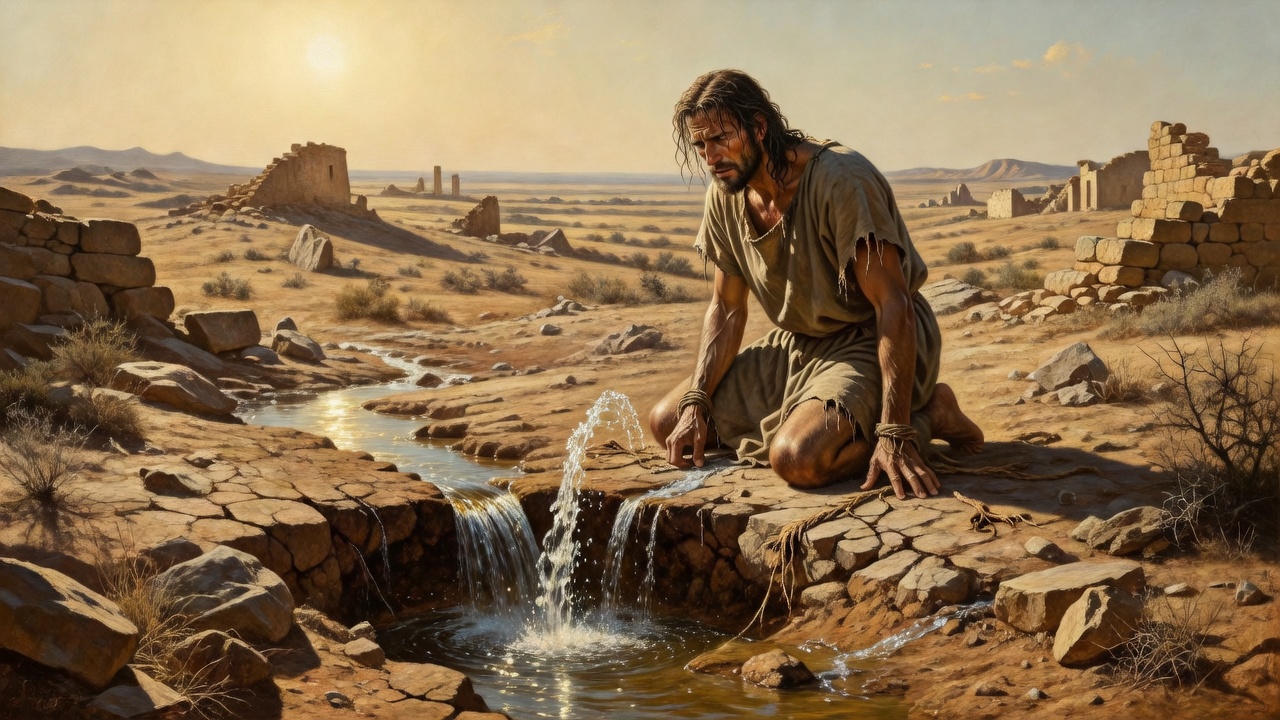
18And he thirsted greatly, and cried to the Lord, and said, Thou, Lord, hast given into the hand of thy servant this greatest health and victory; and lo! I die for thirst, and I shall fall into the hands of uncircumcised men.
19Therefore the Lord opened a wang tooth in the cheekbone of the ass, and waters went out thereof, and when he had drunken he refreshed his spirit, and received strengths; therefore the name of that place was called the Well of the inwardly caller of the cheek-bone, unto this present day.
20And Samson deemed Israel in the days of [the] Philistines twenty years.
Did you know?
Samson's Vengeance and the Spring at Lehi
- The place name Lehi means jawbone in Hebrew. After defeating a thousand Philistines with a fresh donkey jawbone, Samson named the site Ramath-lehi, which means jawbone height or elevation of Lehi.Sources: Lehi · Ramath-lehi · the Bible text itself
- When Samson cried out in extreme thirst and exhaustion after his victory, God opened a hollow place in Lehi to provide water. The resulting spring was named En-hakkore, meaning fountain of the crier.Sources: En-hakkore · the Bible text itself
- During this era of forty years of Philistine dominion, three thousand men of Judah chose to bind Samson rather than defy their Philistine rulers. Samson served as a judge in Israel for twenty years during this period of Philistine rule.Sources: Philistine Dominion · Judgeship of Samson · the Bible text itself
Notes written with AI assistance from open sources (Theographic Bible Metadata, CC BY-SA 4.0; Easton’s Bible Dictionary, public domain) and reviewed before publishing.
Places in this chapter
- Ramath-lehi · Today: Khirbet es Siyyagh · 31.749, 35.001 · verse 17
Only places identified with high confidence are shown (90% or more according to the scholarly sources compiled by OpenBible). Period map: DARE (Digital Atlas of the Roman Empire), CC BY 4.0; modern map: © OpenStreetMap contributors; places: OpenBible.info (CC BY 4.0).
Credits and license for this translation
Wycliffe's Bible with Modern Spelling
English: Wycliffe's Bible Modern Spelling (with Deuterocanon)
Copyright © 2001,2010,2011,2012,2013,2015 Terry Noble
Language: English
Dialect: Archaic
Translation by: Terry Noble
Wycliffe’s Bible with Modern Spelling, was made in response to requests from readers who wanted my Wycliffe’s Old and New Testaments and Apocrypha in one volume. Printing limitations dictated the number of pages available to me and the letter size. In my previous books, Wycliffe’s Bible, Wycliffe’s Old Testament, Vols. 1 amp 2, Wycliffe’s New Testament, and Wycliffe’s Apocrypha, I have tens of thousands of rewritten verses, presented in parentheses “( )”, to provide help in comprehending the 14th century Middle English vocabulary and grammar. In this present volume, with space at a premium, those “helps” had to be eliminated, to make room for the text of the Apocrypha.
This translation is made available to you under the terms of the
Creative Commons Attribution-Noncommercial-No Derivatives license 4.0.
You may share and redistribute this Bible translation or extracts from it in any format, provided that:
You include the above copyright and source information.
You do not sell this work for a profit.
You do not change any of the words or punctuation of the Scriptures.
Pictures included with Scriptures and other documents on this site are licensed just for use with those Scriptures and documents.
For other uses, please contact the respective copyright owners.
2019-09-26
Section headings adapted from the Berean Standard Bible (public domain); they are not part of this translation’s text.
Source: http://ebible.org/engwyc2017/ · eBible.org