Isaiah 64
Wycliffe's Bible with Modern Spelling · Tap a verse to see its cross-references.
A Prayer for God’s Power
1I would that thou brakest heavens, and camest down, that hills floated away from thy face,
2and failed [or vanish away], as the burning of fire, and [waters] burnt in [or with] fire; that thy name were made known to thine enemies, and folks were troubled of thy face.
3When thou shalt do marvels, we shall not abide. Thou camest down, and hills [or mountains] floated away from thy face.
4From the world they heard not, neither perceived with ears; God, none eye saw, without thee, what things thou hast made ready to them that abide thee.
5Thou mettest him that is glad, and doeth rightfulness [or rightwiseness]; in thy ways they shall bethink on thee. Lo! thou art wroth, and we sinned; in those sins we were ever, and we shall be saved.
6And all we be made as an unclean man; all our rightfulnesses [or rightwisenesses] be as the cloth of a woman in menstruation, or unclean blood; and all we fell down as a leaf, and our wickednesses, as wind, have taken away us.
7None is, that calleth thy name to help, that riseth, and holdeth thee; thou hast hid thy face from us, and thou hast hurtled down us in the hand of our wickedness.
8And now, Lord, thou art our father; forsooth we be clay, and thou art our maker, and all we be the works of thine hands.
9Lord, be thou not wroth enough, and have thou no more mind on our wickedness. Lo! Lord, behold thou, all we be thy people.
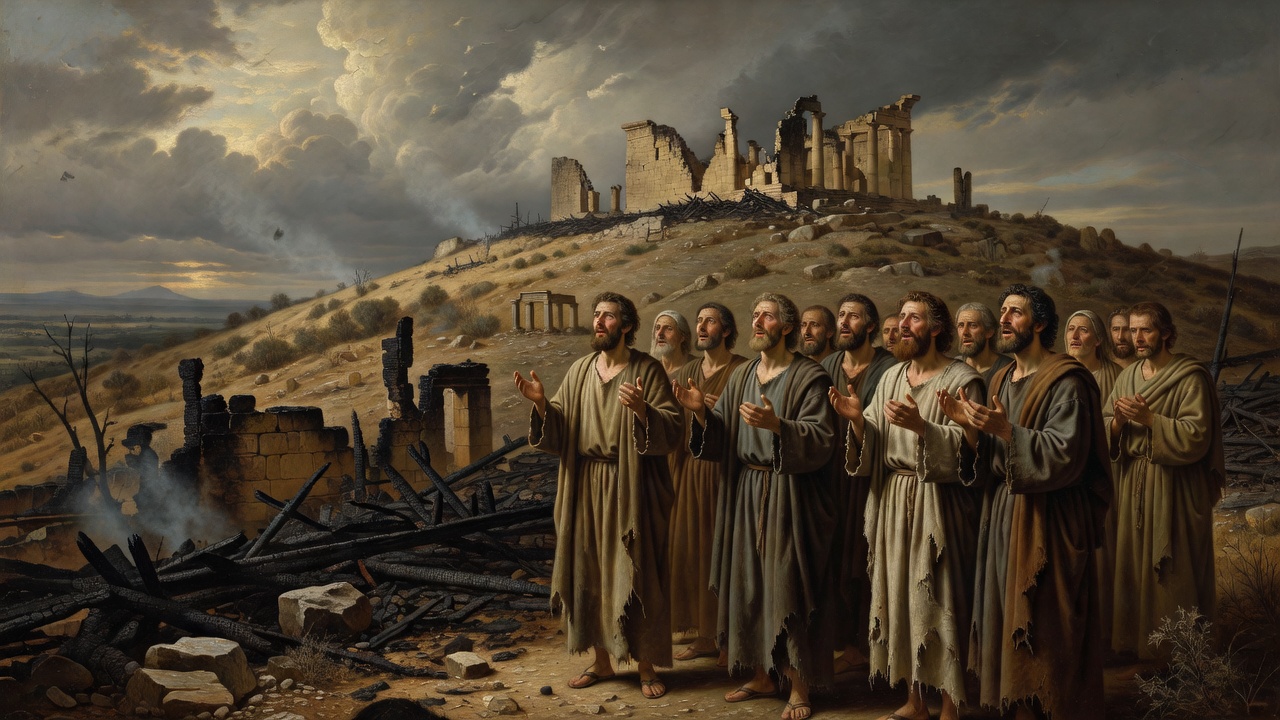
10The city of thy holy, either thy saintuary, is forsaken, Zion is made desert, Jerusalem is made desolate;
11the house of our hallowing and of our glory, where our fathers praised thee, is made into burning of fire; and all our desirable things be turned into fallings.
12Lord, whether on these things thou shalt withhold thee? shalt thou be still, and shalt thou torment us greatly?
Did you know?
A Prayer for Mercy Amid Ruin
- The passage opens with a plea for God to rend the heavens and descend with world-shaking power, like fire that kindles brushwood. Yet it contrasts this desire for divine presence with a confession of human unworthiness, comparing people to withering leaves swept away by their own iniquities.Sources: the Bible text itself
- In Isaiah 64, the community appeals to God as a Father and craftsman, declaring, "we are the clay, and You are the potter." This imagery emphasizes human frailty and total dependence on God, pleading for divine mercy despite their acknowledged guilt.Sources: the Bible text itself
- The chapter laments the destruction of sacred spaces, describing Zion and Jerusalem as desolate wastelands. It specifically mourns the burning and ruin of the holy temple where past generations had offered praise.Sources: the Bible text itself · Zion · Jerusalem
Notes written with AI assistance from open sources (Theographic Bible Metadata, CC BY-SA 4.0; Easton’s Bible Dictionary, public domain) and reviewed before publishing.
Places in this chapter
Only places identified with high confidence are shown (90% or more according to the scholarly sources compiled by OpenBible). Period map: DARE (Digital Atlas of the Roman Empire), CC BY 4.0; modern map: © OpenStreetMap contributors; places: OpenBible.info (CC BY 4.0).
Credits and license for this translation
Wycliffe's Bible with Modern Spelling
English: Wycliffe's Bible Modern Spelling (with Deuterocanon)
Copyright © 2001,2010,2011,2012,2013,2015 Terry Noble
Language: English
Dialect: Archaic
Translation by: Terry Noble
Wycliffe’s Bible with Modern Spelling, was made in response to requests from readers who wanted my Wycliffe’s Old and New Testaments and Apocrypha in one volume. Printing limitations dictated the number of pages available to me and the letter size. In my previous books, Wycliffe’s Bible, Wycliffe’s Old Testament, Vols. 1 amp 2, Wycliffe’s New Testament, and Wycliffe’s Apocrypha, I have tens of thousands of rewritten verses, presented in parentheses “( )”, to provide help in comprehending the 14th century Middle English vocabulary and grammar. In this present volume, with space at a premium, those “helps” had to be eliminated, to make room for the text of the Apocrypha.
This translation is made available to you under the terms of the
Creative Commons Attribution-Noncommercial-No Derivatives license 4.0.
You may share and redistribute this Bible translation or extracts from it in any format, provided that:
You include the above copyright and source information.
You do not sell this work for a profit.
You do not change any of the words or punctuation of the Scriptures.
Pictures included with Scriptures and other documents on this site are licensed just for use with those Scriptures and documents.
For other uses, please contact the respective copyright owners.
2019-09-26
Section headings adapted from the Berean Standard Bible (public domain); they are not part of this translation’s text.
Source: http://ebible.org/engwyc2017/ · eBible.org