Isaiah 62
Wycliffe's Bible with Modern Spelling · Tap a verse to see its cross-references.
Zion’s Salvation and New Name
1For Zion I shall not be still, and for Jerusalem I shall not rest, till the just [or rightwise] man thereof go out as shining, and the saviour thereof be tended as a lamp.
2And heathen men shall see thy just [or rightwise] man, and all kings shall see thy noble man; and a new name, which the mouth of the Lord named, shall be called to thee.
3And thou shalt be a crown of glory in the hand of the Lord, and a diadem of the realm in the hand of thy God.
4Thou shalt no more be called forsaken, and thy land shall no more be called desolate; but thou shalt be called My will in that, and thy land That that shall be inhabited; for it pleased the Lord in thee, and thy land shall be inhabited.
5For a young man shall dwell with a virgin, and thy sons shall dwell in thee; and the spouse shall have joy on the spousess, and thy God shall have joy on thee.
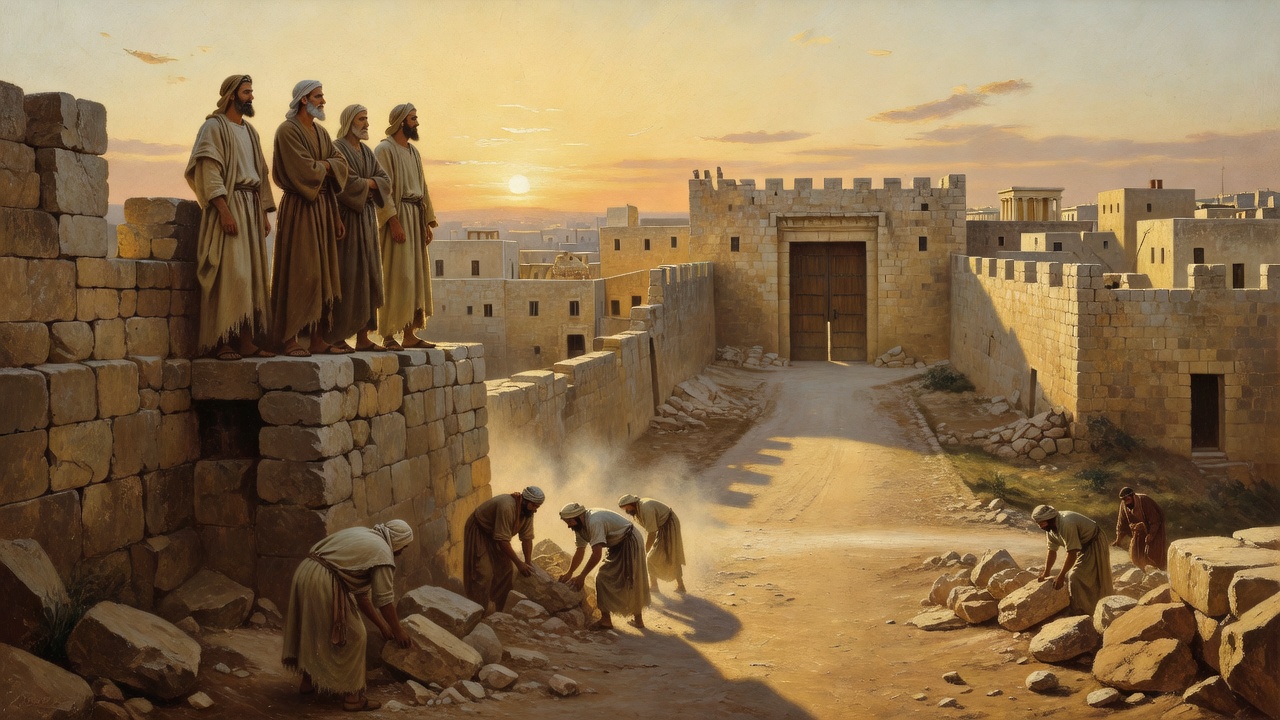
6Jerusalem, I have ordained keepers on thy walls, all day and all night without end they shall not be still. Ye that think on the Lord, be not still,
7and give ye not silence to him, till he stablish, and till he set Jeru-salem praising in [the] earth.
8The Lord swore in his right hand, and in the arm of his strength, I shall no more give thy wheat to be meat to thine enemies, and alien sons shall not drink thy wine, in which thou hast travailed.
9For they that shall gather it together, shall eat it, and shall praise the Lord; and they that bear it together, shall drink in mine holy foreyards.
10Pass ye, pass ye by the gates; make ye ready a way to the people, make ye a plain path; and choose ye [the] stones, and raise ye [up] a sign to peoples.
11Lo! the Lord made heard in the last parts of the earth. Say ye to the daughter of Zion, Lo! thy saviour cometh; lo! his meed is with him, and his work is before him.
12And they shall call them the holy people, again-bought of the Lord. Forsooth thou shalt be called a city sought, and not forsaken.
Did you know?
The Restoration and Renaming of Jerusalem
- In this chapter, Jerusalem and Zion are promised new symbolic names that reflect a dramatic change in status. Rather than being known as Forsaken or Desolate, the city and its land are given names such as Hephzibah (meaning delight is in her) and Beulah (signifying a married land), portraying restoration through the imagery of a joyous wedding feast.Sources: the Bible text itself · Jerusalem · Zion
- The poem depicts continuous watchmen stationed atop the stone walls of Jerusalem who keep unceasing vigil day and night. Their role goes beyond standard military sentry duty, as they are instructed to persistently remind the LORD to establish the mountain city and make it the praise of the earth.Sources: the Bible text itself · Jerusalem
- The command to go through the city gates, clear stones, and build up a raised highway uses the ancient imagery of preparing a royal processional route to welcome returning people and signal salvation to surrounding nations.Sources: the Bible text itself
Notes written with AI assistance from open sources (Theographic Bible Metadata, CC BY-SA 4.0; Easton’s Bible Dictionary, public domain) and reviewed before publishing.
Places in this chapter
- Jerusalem · 31.777, 35.234 · verses 1, 5, 6, 7, 8, 12
- Zion · Today: Jerusalem · 31.777, 35.234 · verses 1, 11
Only places identified with high confidence are shown (90% or more according to the scholarly sources compiled by OpenBible). Period map: DARE (Digital Atlas of the Roman Empire), CC BY 4.0; modern map: © OpenStreetMap contributors; places: OpenBible.info (CC BY 4.0).
Credits and license for this translation
Wycliffe's Bible with Modern Spelling
English: Wycliffe's Bible Modern Spelling (with Deuterocanon)
Copyright © 2001,2010,2011,2012,2013,2015 Terry Noble
Language: English
Dialect: Archaic
Translation by: Terry Noble
Wycliffe’s Bible with Modern Spelling, was made in response to requests from readers who wanted my Wycliffe’s Old and New Testaments and Apocrypha in one volume. Printing limitations dictated the number of pages available to me and the letter size. In my previous books, Wycliffe’s Bible, Wycliffe’s Old Testament, Vols. 1 amp 2, Wycliffe’s New Testament, and Wycliffe’s Apocrypha, I have tens of thousands of rewritten verses, presented in parentheses “( )”, to provide help in comprehending the 14th century Middle English vocabulary and grammar. In this present volume, with space at a premium, those “helps” had to be eliminated, to make room for the text of the Apocrypha.
This translation is made available to you under the terms of the
Creative Commons Attribution-Noncommercial-No Derivatives license 4.0.
You may share and redistribute this Bible translation or extracts from it in any format, provided that:
You include the above copyright and source information.
You do not sell this work for a profit.
You do not change any of the words or punctuation of the Scriptures.
Pictures included with Scriptures and other documents on this site are licensed just for use with those Scriptures and documents.
For other uses, please contact the respective copyright owners.
2019-09-26
Section headings adapted from the Berean Standard Bible (public domain); they are not part of this translation’s text.
Source: http://ebible.org/engwyc2017/ · eBible.org