Ezekiel 6
Wycliffe's Bible with Modern Spelling · Tap a verse to see its cross-references.
Judgment against Idolatry
1And the word of the Lord was made to me, and he said,
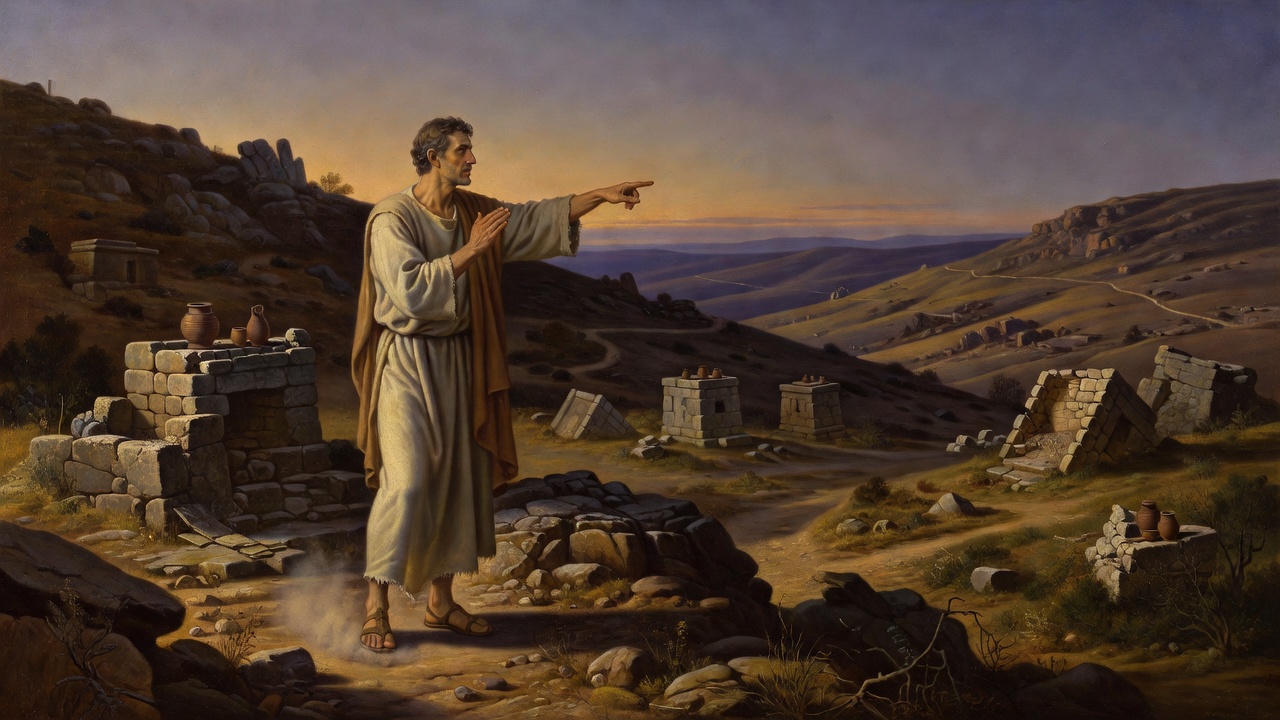
2Thou, son of man, set thy face toward the hills of Israel; and thou shalt prophesy to those hills,
3and shalt say, Hills of Israel, hear ye the word of the Lord God. The Lord God saith these things to mountains, and little hills, to rocks of stone, and to valleys, Lo! I shall bring in on you a sword, and I shall lose your high things or places.
4And I shall destroy your altars, and your simulacra shall be broken; and I shall cast down your slain men before your idols.
5And I shall give the dead bodies of the sons of Israel before the face of your simulacra, and I shall scatter your bones about your altars,
6in all your dwellings. Cities shall be forsaken, and high things shall be destroyed, and shall be scattered; and your altars shall perish, and shall be broken. And your idols shall cease to exist, and your temples of idols shall be all-broken, and your works shall be done away.
7And a slain man shall fall down in the midst of you; and ye shall know, that I am the Lord.
A Remnant to Be Blessed
8And I shall leave in you them that fled [the] sword, to go among heathen men, when I shall scatter you into lands.
9And your delivered men shall have mind on me among heathen men, to which they be led prisoners; for I have all-broken their heart doing fornication, and going away from me, and their eyes doing fornication after their idols. And they shall displease themselves on the evils, which they did in all their abominations.
10And they shall know, that I the Lord spake not in vain, that I should do this evil to them.
11The Lord God saith these things, Smite thine hand, and hurtle thy foot, and say, Alas! to all abominations of the evils of the house of Israel; for they shall fall down by sword, hunger, and pestilence.
12He that is far, shall die by pestilence. Forsooth he that is nigh, shall fall by sword. And he that is left and besieged, shall die by hunger. And I shall [ful] fill mine indignation in them.
13And ye shall know, that I am the Lord, when your slain men shall be in the midst of your idols, in the compass of your altars, in each high little hill, and in all the highnesses of mountains, and under each tree full of wood, and under each oak full of boughs, that is, a place where they burnt incense sweet smelling to all their idols.
14And I shall stretch forth mine hand on them, and I shall make their land desolate and destitute, from desert unto Diblath, in all the dwellings of them; and they shall know, that I am the Lord.
Did you know?
Judgment on Idolatry on the Mountains of Israel
- Ezekiel directs his prophecy specifically against the mountains, hills, ravines, and valleys of Israel because these elevated and secluded natural sites were the primary locations where pagan high places, altars, and incense shrines flourished under leafy oaks and green trees.Sources: the Bible text itself
- The prophet is instructed to accompany his message with expressive physical gestures, including clapping his hands and stomping his feet, to dramatize the shock, grief, and solemnity of the impending judgment by sword, famine, and plague.Sources: the Bible text itself
- Despite announcing widespread desolation across the land, the text promises that a remnant will survive the sword and reflect upon their actions while scattered in captivity among the nations.Sources: the Bible text itself
Notes written with AI assistance from open sources (Theographic Bible Metadata, CC BY-SA 4.0; Easton’s Bible Dictionary, public domain) and reviewed before publishing.
Places in this chapter
- Riblah · Today: Rableh · 34.460, 36.573 · verse 14
Only places identified with high confidence are shown (90% or more according to the scholarly sources compiled by OpenBible). Period map: DARE (Digital Atlas of the Roman Empire), CC BY 4.0; modern map: © OpenStreetMap contributors; places: OpenBible.info (CC BY 4.0).
Credits and license for this translation
Wycliffe's Bible with Modern Spelling
English: Wycliffe's Bible Modern Spelling (with Deuterocanon)
Copyright © 2001,2010,2011,2012,2013,2015 Terry Noble
Language: English
Dialect: Archaic
Translation by: Terry Noble
Wycliffe’s Bible with Modern Spelling, was made in response to requests from readers who wanted my Wycliffe’s Old and New Testaments and Apocrypha in one volume. Printing limitations dictated the number of pages available to me and the letter size. In my previous books, Wycliffe’s Bible, Wycliffe’s Old Testament, Vols. 1 amp 2, Wycliffe’s New Testament, and Wycliffe’s Apocrypha, I have tens of thousands of rewritten verses, presented in parentheses “( )”, to provide help in comprehending the 14th century Middle English vocabulary and grammar. In this present volume, with space at a premium, those “helps” had to be eliminated, to make room for the text of the Apocrypha.
This translation is made available to you under the terms of the
Creative Commons Attribution-Noncommercial-No Derivatives license 4.0.
You may share and redistribute this Bible translation or extracts from it in any format, provided that:
You include the above copyright and source information.
You do not sell this work for a profit.
You do not change any of the words or punctuation of the Scriptures.
Pictures included with Scriptures and other documents on this site are licensed just for use with those Scriptures and documents.
For other uses, please contact the respective copyright owners.
2019-09-26
Section headings adapted from the Berean Standard Bible (public domain); they are not part of this translation’s text.
Source: http://ebible.org/engwyc2017/ · eBible.org