Deuteronomy 24
Wycliffe's Bible with Modern Spelling · Tap a verse to see its cross-references.
Marriage and Divorce Laws
1If a man taketh a wife, and hath her, and she findeth not grace before his eyes for some vileness, or unclean-ness, he shall write a little book of forsaking, and he shall give it in her hand, and he shall deliver her from his house.
2And when she goeth out from him, and weddeth another husband,
3and he also hateth her, and giveth to her a little book of forsaking, and delivereth her from his house, either certainly he is dead,
4the former husband shall not be able to receive her again into wife, for she is defouled, and made abominable before the Lord; lest thou make thy land to do sin, which thy Lord God hath given thee to wield.
5When a man hath taken late a wife, he shall not go forth to battle, neither anything of the common needs shall be enjoined to him, but he shall give attention without blame to his household, that he be glad in one year with his wife.
Additional Laws
6Thou shalt not take instead of a wed the lower and the higher quern-stone of thy brother, for he hath put his life to thee.
7If a man is taken, that is, convicted in doom, busily ambushing to steal his brother of the sons of Israel, and when he hath sold him, taketh price, he shall be slain; and thus thou shalt do away evil from the midst of thee.
8Keep thou diligently, lest thou run into the sickness of leprosy, but thou shalt do whatever things that the priests of the kin of Levi teach thee, by that that I commanded to them, and fulfill thou it diligently.
9Have ye mind what things your Lord God did to Marie, in the way, when ye went out of Egypt.
10When thou shalt ask of thy neighbour anything that he oweth to thee, thou shalt not enter into his house, that thou take away from him a wed;
11but thou shalt stand withoutforth, and he shall bring forth to thee that that he hath.
12And if he is poor, his wed shall not abide by night with thee,
13but anon thou shalt yield his wed to him before the going down of the sun, that he sleep in his cloth, and bless thee, and thou have rightwise-ness before thy Lord God.
14Thou shalt not deny the hire of thy brother needy and poor, either of the comeling that dwelleth with thee in thy land, and is within thy gates;
15but in the same day thou shalt yield to him the price of his travail, before the going down of the sun, for he is poor, and sustaineth thereof his life; lest he cry against thee to the Lord, and it be reckoned to thee into sin.
16The fathers shall not be slain for the sons, neither the sons for the fathers, but each man shall die for his own sin.
17Thou shalt not waywardly turn, or mis-deem, the doom of the comeling, or of the fatherless, either motherless child; neither thou shalt take away instead of a wed the cloth of a widow.
18Have thou mind, that thou servedest in Egypt, and thy Lord God delivered thee from thence; therefore I command to thee that thou do this thing.
19When thou reapest corn in thy field, and forgettest, and leavest a reap, thou shalt not turn again to take it, but thou shalt suffer that a comeling, and a fatherless, either motherless child, and a widow take it away, that thy Lord God bless thee in all the work of thine hands.
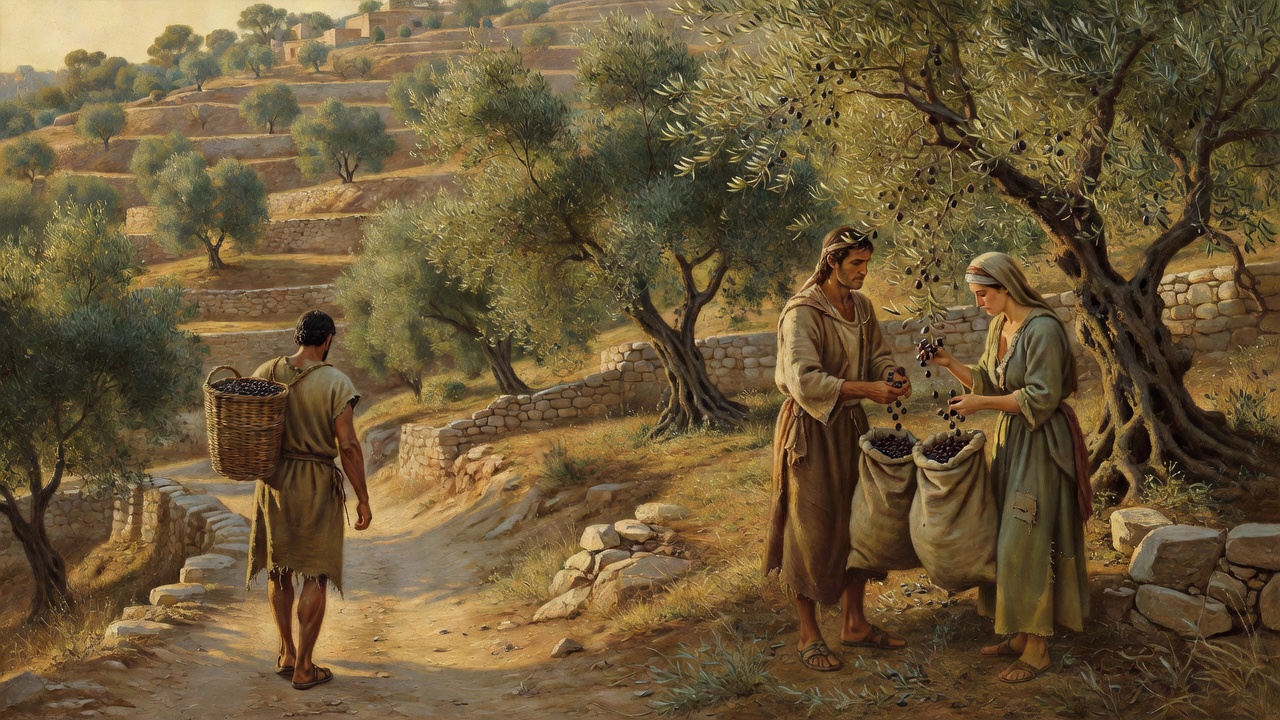
20If thou gatherest the fruits of olives, whatever thing leaveth in the trees, thou shalt not turn again to gather it, but thou shalt leave it to a comeling, a fatherless, either motherless [child], and to a widow.
21If thou gatherest grapes of thy vinery [or vine], thou shalt not gather [the] raisins that leave or be left, but those [or they] shall fall into the uses of the comeling, of the fatherless, either motherless [child], and of the widow.
22Have thou mind, that also thou servedest in Egypt, and therefore I command to thee, that thou do this thing.
Did you know?
Laws of Compassion, Justice, and Social Protection
- Israelite harvesting laws required landowners to leave behind forgotten sheaves of grain, leftover olives, and grape gleanings for vulnerable groups: the resident foreigner, the orphan, and the widow. This social welfare system was grounded in the collective memory that the Israelites had once been oppressed slaves in Egypt.Sources: the Bible text itself · Egypt
- Debtors and hired workers were protected by explicit legal limits. Creditors were forbidden from entering a debtor's house to seize a pledge, taking essential millstones that provided a household's daily bread, or keeping an impoverished person's sleeping cloak past sunset, and day laborers had to be paid before nightfall.Sources: the Bible text itself
- When giving instructions concerning infectious skin diseases and the guidance of Levitical priests, the text points back to the affliction of Miriam, the sister of Moses and Aaron, during the wilderness journey following the Exodus from Egypt.Sources: the Bible text itself · Miriam · Egypt
Notes written with AI assistance from open sources (Theographic Bible Metadata, CC BY-SA 4.0; Easton’s Bible Dictionary, public domain) and reviewed before publishing.
Places in this chapter
Only places identified with high confidence are shown (90% or more according to the scholarly sources compiled by OpenBible). Period map: DARE (Digital Atlas of the Roman Empire), CC BY 4.0; modern map: © OpenStreetMap contributors; places: OpenBible.info (CC BY 4.0).
Credits and license for this translation
Wycliffe's Bible with Modern Spelling
English: Wycliffe's Bible Modern Spelling (with Deuterocanon)
Copyright © 2001,2010,2011,2012,2013,2015 Terry Noble
Language: English
Dialect: Archaic
Translation by: Terry Noble
Wycliffe’s Bible with Modern Spelling, was made in response to requests from readers who wanted my Wycliffe’s Old and New Testaments and Apocrypha in one volume. Printing limitations dictated the number of pages available to me and the letter size. In my previous books, Wycliffe’s Bible, Wycliffe’s Old Testament, Vols. 1 amp 2, Wycliffe’s New Testament, and Wycliffe’s Apocrypha, I have tens of thousands of rewritten verses, presented in parentheses “( )”, to provide help in comprehending the 14th century Middle English vocabulary and grammar. In this present volume, with space at a premium, those “helps” had to be eliminated, to make room for the text of the Apocrypha.
This translation is made available to you under the terms of the
Creative Commons Attribution-Noncommercial-No Derivatives license 4.0.
You may share and redistribute this Bible translation or extracts from it in any format, provided that:
You include the above copyright and source information.
You do not sell this work for a profit.
You do not change any of the words or punctuation of the Scriptures.
Pictures included with Scriptures and other documents on this site are licensed just for use with those Scriptures and documents.
For other uses, please contact the respective copyright owners.
2019-09-26
Section headings adapted from the Berean Standard Bible (public domain); they are not part of this translation’s text.
Source: http://ebible.org/engwyc2017/ · eBible.org