Deuteronomy 16
Wycliffe's Bible with Modern Spelling · Tap a verse to see its cross-references.
Passover and the Feast of Unleavened Bread
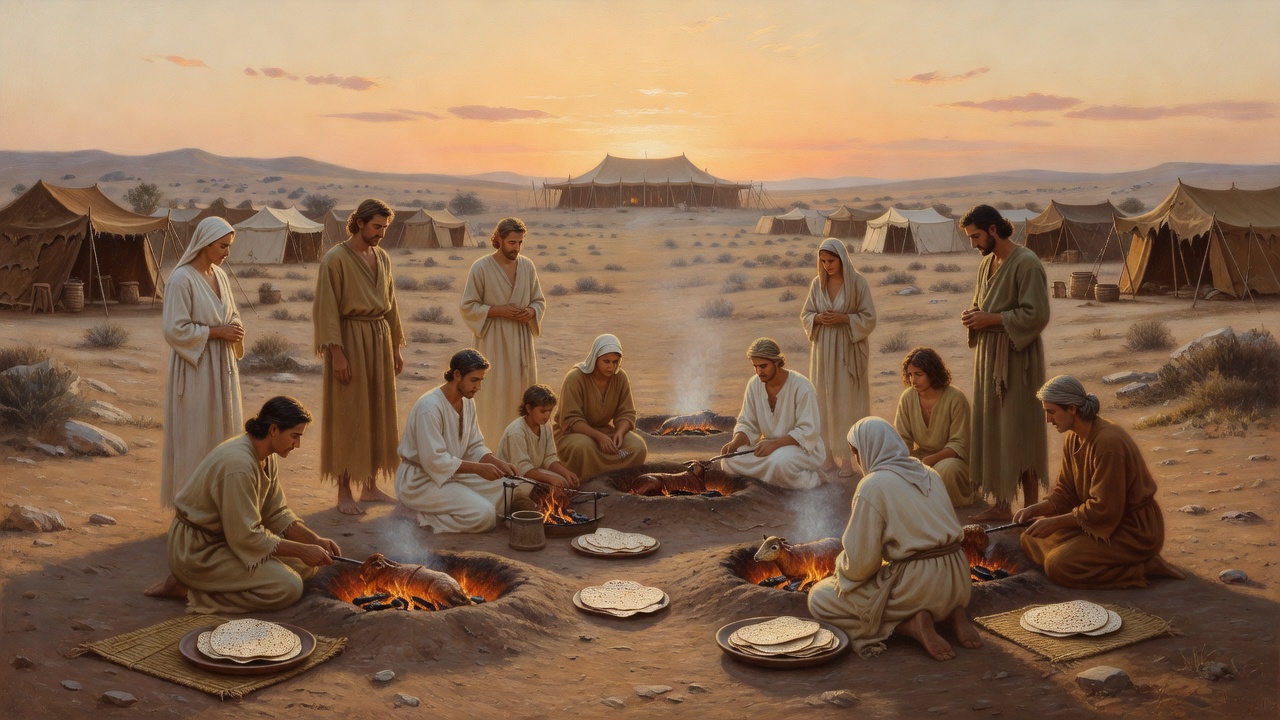
1Keep thou the month of new fruits, and of the beginning of summer, that thou make pask to thy Lord God; for in this month thy Lord God led thee out of Egypt in the night.
2And thou shalt offer pask to thy Lord God, of sheep, and of oxen, in the place which thy Lord God choose, that his name dwell there.
3Thou shalt not eat therein bread dighted with sourdough; in seven days thou shalt eat bread of affliction, with-out sourdough, for suddenly, either hastily, thou wentest out of Egypt, that thou have mind of the day of thy going out of Egypt, in all the days of thy life.
4Nothing dighted with sourdough shall appear in all thy coasts by seven days, and of the flesh of that that is offered in the eventide, shall not dwell in the first day in the morrowtide.
5Thou shalt not be able to offer pask in each of thy cities which thy Lord God shall give to thee,
6but in the place which thy Lord God choose, that his name dwell there; thou shalt offer pask in the eventide, at the going down of the sun, when thou wentest out of Egypt.
7And thou shalt seethe thy offering, and eat it, in the place which thy Lord God hath chosen, and thou shalt rise in the morrowtide of the second day, and thou shalt go into thy tabernacles.
8Six days thou shalt eat therf bread; and in the seventh day, for it is the gathering of thy Lord God, thou shalt not do work.
The Feast of Weeks
9Thou shalt number to thee seven weeks, from that day in which thou settedest a sickle into the corn;
10and thou shalt hallow the feast days of weeks to thy Lord God, a willful offering of thine hand, which thou shalt offer by the blessing of thy Lord God.
11And thou shalt eat before thy Lord God, thou, and thy son, and thy daughter, and thy servant, and thine handmaid, and the deacon or Levite that is within thy gates, and the comeling, and the fatherless, either motherless child, and the widow, that dwell with you, in the place which thy Lord God choose, that his name dwell there.
12And thou shalt have mind for thou were servant in Egypt, and thou shalt keep and do those things that be commanded.
The Feast of Tabernacles
13And thou shalt hallow the solemnity of tabernacles by seven days, when thou hast gathered thy fruits of thy cornfloor, and of the presser [or wine press].
14And thou shalt eat in thy feast, thou, and thy son, and thy daughter, and thy manservant, and thine hand-maid, also the deacon [or Levite], and the comeling, and the fatherless, either motherless child, and the widow, that be within thy gates.
15By seven days thou shalt hallow feasts to thy Lord God, in the place which the Lord choose; and thy Lord God shall bless thee, in all thy fruits, and in all the work of thine hands, and thou shalt be in gladness.
16In three times by the year all thy male kind shall appear in the sight of thy Lord, in the place which he choose, in the solemnity of therf loaves, and in the solemnity of weeks, and in the solemnity of tabernacles. A man shall not appear void before the Lord;
17but each man shall offer after that that he hath, by the blessing of his Lord God, that he gave to him.
Judges and Justice
18Thou shalt ordain judges, and exactors, in all thy gates which thy Lord God shall give to thee, by each of thy lineages, that they deem the people by just [or right] doom,
19and bow they not into the other part for favour, either gift. Thou shalt not take a person, neither gifts, for why gifts blind the eyes of wise men, and change the words of just [or rightwise] men.
20Thou shalt pursue justly [or right-wisely] that that is just [or right], that thou live, and wield the land which thy Lord God shall give to thee.
Forbidden Forms of Worship
21Thou shalt not plant a wood, and each tree, by the altar of thy Lord God;
22neither thou shalt make to thee, and ordain an image; which things thy Lord God hateth.
Did you know?
Appointed Feasts and Righteous Justice
- Deuteronomy mandates three annual pilgrimage festivals—the Feast of Unleavened Bread (Passover), the Feast of Weeks, and the Feast of Tabernacles. For these occasions, the men of Israel were required to travel and appear before God not in their local towns, but at the specific central location chosen as a dwelling for His Name.Sources: the Bible text itself
- The celebrations of the Feast of Weeks and the Feast of Tabernacles explicitly included vulnerable members of society, such as servants, Levites, foreigners, orphans, and widows. These communal rejoicings were tied to the memory of Israel's liberation from slavery in Egypt.Sources: the Bible text itself
- In addition to religious assemblies, the text commands the appointment of local judges and officials across every town. They were forbidden from taking bribes or showing partiality, establishing the standard to pursue justice alone throughout the land.Sources: the Bible text itself
Notes written with AI assistance from open sources (Theographic Bible Metadata, CC BY-SA 4.0; Easton’s Bible Dictionary, public domain) and reviewed before publishing.
Places in this chapter
Only places identified with high confidence are shown (90% or more according to the scholarly sources compiled by OpenBible). Period map: DARE (Digital Atlas of the Roman Empire), CC BY 4.0; modern map: © OpenStreetMap contributors; places: OpenBible.info (CC BY 4.0).
Credits and license for this translation
Wycliffe's Bible with Modern Spelling
English: Wycliffe's Bible Modern Spelling (with Deuterocanon)
Copyright © 2001,2010,2011,2012,2013,2015 Terry Noble
Language: English
Dialect: Archaic
Translation by: Terry Noble
Wycliffe’s Bible with Modern Spelling, was made in response to requests from readers who wanted my Wycliffe’s Old and New Testaments and Apocrypha in one volume. Printing limitations dictated the number of pages available to me and the letter size. In my previous books, Wycliffe’s Bible, Wycliffe’s Old Testament, Vols. 1 amp 2, Wycliffe’s New Testament, and Wycliffe’s Apocrypha, I have tens of thousands of rewritten verses, presented in parentheses “( )”, to provide help in comprehending the 14th century Middle English vocabulary and grammar. In this present volume, with space at a premium, those “helps” had to be eliminated, to make room for the text of the Apocrypha.
This translation is made available to you under the terms of the
Creative Commons Attribution-Noncommercial-No Derivatives license 4.0.
You may share and redistribute this Bible translation or extracts from it in any format, provided that:
You include the above copyright and source information.
You do not sell this work for a profit.
You do not change any of the words or punctuation of the Scriptures.
Pictures included with Scriptures and other documents on this site are licensed just for use with those Scriptures and documents.
For other uses, please contact the respective copyright owners.
2019-09-26
Section headings adapted from the Berean Standard Bible (public domain); they are not part of this translation’s text.
Source: http://ebible.org/engwyc2017/ · eBible.org