2 Samuel 11
Wycliffe's Bible with Modern Spelling · Tap a verse to see its cross-references.
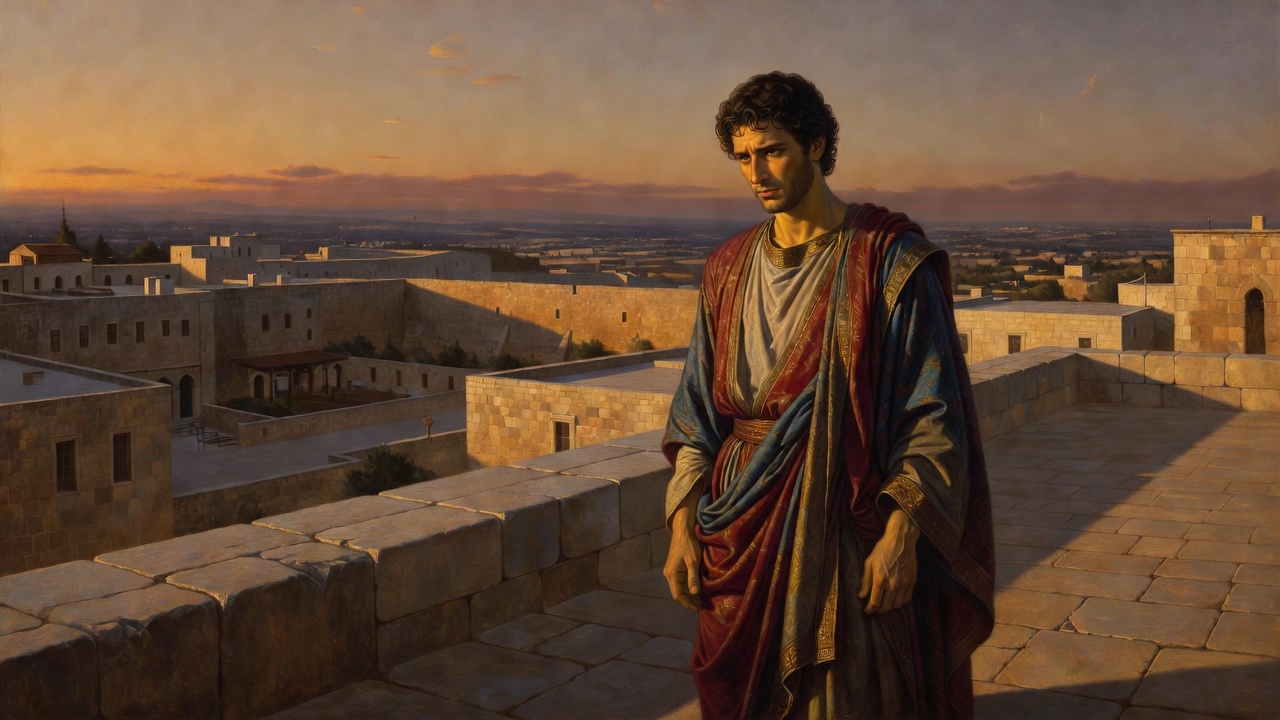
David and Bathsheba
1And it was done, when the year turned again, in that time in which kings be wont to go forth to battles, David sent forth Joab, and with him his servants, and all Israel; and they destroyed the sons of Ammon, and besieged Rabbah; and David dwelled in Jerusalem.
2While these things were done, it befelled, that David rose in a day from his bed after midday, and walked in the solar of the king’s house; and he saw a woman washing herself even against him upon her solar; and the woman was full fair.
3Therefore the king sent, and inquired, what woman it was; and it was told to him that she was Bathsheba, the daughter of Eliam, and she was the wife of Uriah the Hittite.
4Then by messengers sent, David took her; and when she entered to him, he slept with her, and anon she was hallowed from her uncleanness. And she turned again into her house,
5with a child conceived; and she sent, and told to David, and said, I have conceived.
6And David sent to Joab, and said, Send thou Uriah the Hittite to me; and Joab sent Uriah to David.
7And Uriah came to David; and David asked, how rightfully Joab did and the people, and how the battle was administered, or served.
8And David said to Uriah, Go into thine house, and wash thy feet. [And] Uriah went out from the house of the king, and the king’s meat pursued [or followed] him.
9Soothly Uriah slept before the gate of the king’s house with other servants of his lord, and went not down to his house.
10And it was told to David of men, saying, Uriah went not to his house. And David said to Uriah, Whether thou camest not from the way? why wentest thou not down into thine house?
11And Uriah said to David, The ark of God, [and] Israel, and Judah dwell in tents, and my lord Joab, and the servants of my lord dwell upon the face of the earth, and shall I go into mine house, to eat and drink, and sleep with my wife? By thine health, and by the health of thy soul, I shall not do this thing.
12Therefore David said to Uriah, Dwell thou here also today, and tomorrow I shall deliver thee. Uriah dwelled in Jerusalem in that day, and the tother.
13And David called him, that he should eat and drink before him, and David made drunken Uriah; and he went out in the eventide, and slept in his bed with the servants of his lord; and went not down into his house.
David Arranges Uriah’s Death
14Therefore when the morrowtide was made, David wrote [an] epistle to Joab, and sent by the hand of Uriah,
15and wrote in the epistle, Put ye Uriah even against the battle, where the battle is strongest, that is, where the adversaries be strongest, and forsake ye him, that he be smitten and perish.
16Therefore when Joab besieged the city, he setted [or put] Uriah in the place where he knew that strongest men were.
17And [the] men went out of the city, and fought against Joab, and they killed of the people of the servants of David, and also Uriah the Hittite was dead there.
18Therefore Joab sent, and told all the words of the battle;
19and he commanded to the mes-senger, and said, When thou hast fulfilled all the words of the battle to the king,
20if thou seest, that he is wroth, and saith, Why nighed ye to the wall to fight? whether ye knew not, that many darts, or arrows, be sent out from the wall above?
21who smote Abimelech, the son of Jerubbesheth? whether not a woman sent on him a gobbet of a millstone from the wall, and killed him in Thebez? why nighed ye beside the wall? thou shalt say, Also thy servant, Uriah the Hittite, died.
22Therefore the messenger went, [and came], and told to David all things which Joab had commanded to him.
23And the messenger said to David, [The] Men had the mastery against us, and they went out to us into the field; and with great fierceness we pursued them unto the gate of the city.
24And [the] archers sent darts to thy servants from the wall above, and some of the king’s servants be dead; and also thy servant, Uriah the Hittite, is dead.
25And David said to the messenger, Thou shalt say these things to Joab, This thing break not thee; for the hap of battle is diverse, and sword wasteth now this man, [and] now that man; comfort thy fighters against the city, that thou destroy it, and stir or excite thou them.
David Marries Bathsheba
26And the wife of Uriah heard, that Uriah her husband was dead, and she bewailed him.
27And when the mourning was passed, David sent, and brought her into his house; and she was made wife to him, and she childed a son to him. And this word or thing that David had done displeased before the Lord.
Did you know?
David, Bathsheba, and Uriah
- Uriah is identified as a Hittite and was counted among David's elite warriors, the "mighty men." When recalled to Jerusalem from the front line, he refused to enjoy the comfort of his home out of solidarity with his fellow soldiers and the Ark of the Covenant, which were dwelling in tents in the open field.Sources: the Bible text itself · Uriah
- The siege of Rabbah, the chief city of the Ammonites east of the Jordan River, provides the background for this chapter. While spring was the customary time for kings to march out to battle, David remained behind in Jerusalem and entrusted the military campaign to his commander Joab.Sources: the Bible text itself · Rabbah · Joab
- When instructing his messenger about casualties near the city walls, Joab cited the tactical precedent of Abimelech's death at Thebez, where a woman killed him by dropping a millstone from a tower wall. The biblical narrative refers to Abimelech's father Gideon by the name Jerubbesheth.Sources: the Bible text itself · Jerubbesheth · Thebez
Notes written with AI assistance from open sources (Theographic Bible Metadata, CC BY-SA 4.0; Easton’s Bible Dictionary, public domain) and reviewed before publishing.
Places in this chapter
- Ammon · 31.955, 35.934 · verse 1
- Jerusalem · 31.777, 35.234 · verses 1, 12, 22
- Rabbah · Today: Amman · 31.955, 35.934 · verse 1
Only places identified with high confidence are shown (90% or more according to the scholarly sources compiled by OpenBible). Period map: DARE (Digital Atlas of the Roman Empire), CC BY 4.0; modern map: © OpenStreetMap contributors; places: OpenBible.info (CC BY 4.0).
Credits and license for this translation
Wycliffe's Bible with Modern Spelling
English: Wycliffe's Bible Modern Spelling (with Deuterocanon)
Copyright © 2001,2010,2011,2012,2013,2015 Terry Noble
Language: English
Dialect: Archaic
Translation by: Terry Noble
Wycliffe’s Bible with Modern Spelling, was made in response to requests from readers who wanted my Wycliffe’s Old and New Testaments and Apocrypha in one volume. Printing limitations dictated the number of pages available to me and the letter size. In my previous books, Wycliffe’s Bible, Wycliffe’s Old Testament, Vols. 1 amp 2, Wycliffe’s New Testament, and Wycliffe’s Apocrypha, I have tens of thousands of rewritten verses, presented in parentheses “( )”, to provide help in comprehending the 14th century Middle English vocabulary and grammar. In this present volume, with space at a premium, those “helps” had to be eliminated, to make room for the text of the Apocrypha.
This translation is made available to you under the terms of the
Creative Commons Attribution-Noncommercial-No Derivatives license 4.0.
You may share and redistribute this Bible translation or extracts from it in any format, provided that:
You include the above copyright and source information.
You do not sell this work for a profit.
You do not change any of the words or punctuation of the Scriptures.
Pictures included with Scriptures and other documents on this site are licensed just for use with those Scriptures and documents.
For other uses, please contact the respective copyright owners.
2019-09-26
Section headings adapted from the Berean Standard Bible (public domain); they are not part of this translation’s text.
Source: http://ebible.org/engwyc2017/ · eBible.org