1 Samuel 21
Wycliffe's Bible with Modern Spelling · Tap a verse to see its cross-references.
David Takes the Consecrated Bread
1Forsooth David came into Nob to Ahimelech, the priest; and Ahimelech wondered, for David had come; and he said to David, Why art thou alone, and no man is with thee?
2And David said to Ahimelech the priest, The king hath commanded to me a word, and said, No man know this thing, for which thou art sent from me, and what manner behests I have given to thee; for I said also to my children, that they should go into that and that place;
3now therefore if thou hast anything at hand, either five loaves, give thou to me, either whatever thing thou findest.
4And the priest answered to David, and said to him, I have not lay, that is, common, loaves at hand, but only holy bread; whether the children be clean, and mostly of women?
5And David answered to the priest, and said to him, And soothly if it is done of women, we have abstained us from yesterday and the third day ago, when we went out, and the vessels, that is, bodies, of the children were clean; certainly this way is defouled, but and it shall be hallowed today in the vessels.
6Therefore the priest gave to him hallowed bread, for none other bread was there, but only loaves of setting forth, that were taken away from the face of the Lord, that hot loaves shall be set forth.
7And a man of the servants of Saul was there that day, within in the tabernacle of the Lord; and his name was Doeg of Idumea, the mightiest man of the herdsmen of Saul.
David Flees to Gath
8And David said to Ahimelech, If thou hast here at hand spear, either sword, give it to me; for I took not with me my sword, neither mine arms; for why the king’s word constrained me to go in haste.
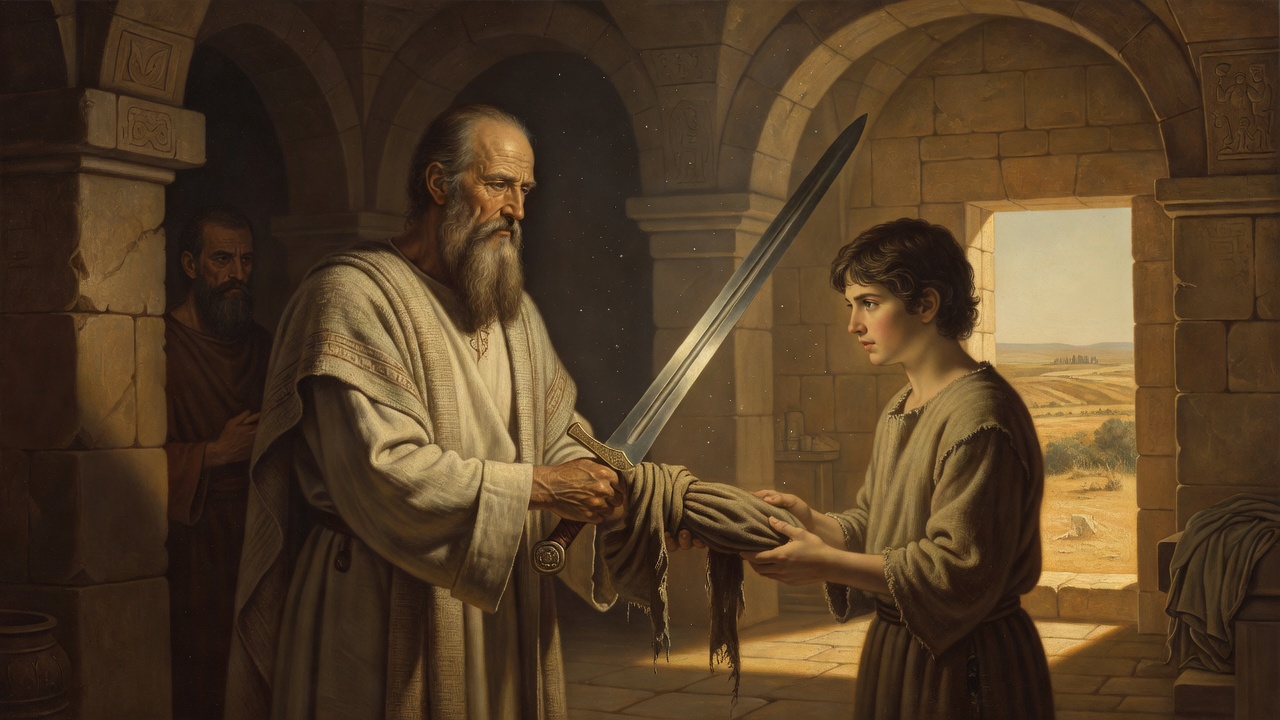
9And the priest said, Lo! the sword of Goliath the Philistine, whom thou killedest in the valley of Terebinth, is wrapped in a cloth next after [the] ephod; if thou wilt take this, take it; for there is none other except that. And David said, None other is like this, give thou it to me.
10And so David rose up, and fled in that day from the face of Saul, and came to Achish, the king of Gath.
11And the servants of Achish said to him, when they had seen David, Whether this is not David, [the] king of the land? Whether they sang not to him by quires [or with dances], and said, Saul smote a thousand, and David smote ten thousand?
12And David took these words in his heart, and he dreaded greatly of the face of Achish, king of Gath.
13And David changed his mouth before Achish, and felled down betwixt their hands, and he painted on the doors of the gate, and his dribbles, that is, spittles, flowed down into his beard.
14And Achish said to his servants, See ye the mad man? why brought ye him to me?
15whether mad men fail to us? why have ye brought in him, that he should be mad, while I am present? Deliver ye him from hence, lest he enter into mine house.
Did you know?
David's Flight to Nob and Gath
- Nob was a priestly town near Jerusalem where the tabernacle was located during Saul's reign. The sword of Goliath, whom David had defeated in the Valley of Elah, was preserved there wrapped in a cloth behind the ephod as a sacred trophy.Sources: the Bible text itself · Nob · Goliath
- While receiving the consecrated bread and weapon from Ahimelech at Nob, David was observed by Doeg the Edomite, the chief overseer of King Saul's flocks, who was detained before the Lord.Sources: the Bible text itself · Doeg
- David fled for refuge to Gath, one of the five royal Philistine cities and the hometown of Goliath. When the servants of King Achish recognized him from songs celebrating his battlefield victories, David protected himself by feigning madness at the city gate.Sources: the Bible text itself · Achish · Gath
Notes written with AI assistance from open sources (Theographic Bible Metadata, CC BY-SA 4.0; Easton’s Bible Dictionary, public domain) and reviewed before publishing.
Places in this chapter
- Valley of Elah · 31.675, 34.998 · verse 9
Only places identified with high confidence are shown (90% or more according to the scholarly sources compiled by OpenBible). Period map: DARE (Digital Atlas of the Roman Empire), CC BY 4.0; modern map: © OpenStreetMap contributors; places: OpenBible.info (CC BY 4.0).
Credits and license for this translation
Wycliffe's Bible with Modern Spelling
English: Wycliffe's Bible Modern Spelling (with Deuterocanon)
Copyright © 2001,2010,2011,2012,2013,2015 Terry Noble
Language: English
Dialect: Archaic
Translation by: Terry Noble
Wycliffe’s Bible with Modern Spelling, was made in response to requests from readers who wanted my Wycliffe’s Old and New Testaments and Apocrypha in one volume. Printing limitations dictated the number of pages available to me and the letter size. In my previous books, Wycliffe’s Bible, Wycliffe’s Old Testament, Vols. 1 amp 2, Wycliffe’s New Testament, and Wycliffe’s Apocrypha, I have tens of thousands of rewritten verses, presented in parentheses “( )”, to provide help in comprehending the 14th century Middle English vocabulary and grammar. In this present volume, with space at a premium, those “helps” had to be eliminated, to make room for the text of the Apocrypha.
This translation is made available to you under the terms of the
Creative Commons Attribution-Noncommercial-No Derivatives license 4.0.
You may share and redistribute this Bible translation or extracts from it in any format, provided that:
You include the above copyright and source information.
You do not sell this work for a profit.
You do not change any of the words or punctuation of the Scriptures.
Pictures included with Scriptures and other documents on this site are licensed just for use with those Scriptures and documents.
For other uses, please contact the respective copyright owners.
2019-09-26
Section headings adapted from the Berean Standard Bible (public domain); they are not part of this translation’s text.
Source: http://ebible.org/engwyc2017/ · eBible.org