1 Chronicles 25
Wycliffe's Bible with Modern Spelling · Tap a verse to see its cross-references.
Twenty-Four Divisions of Musicians
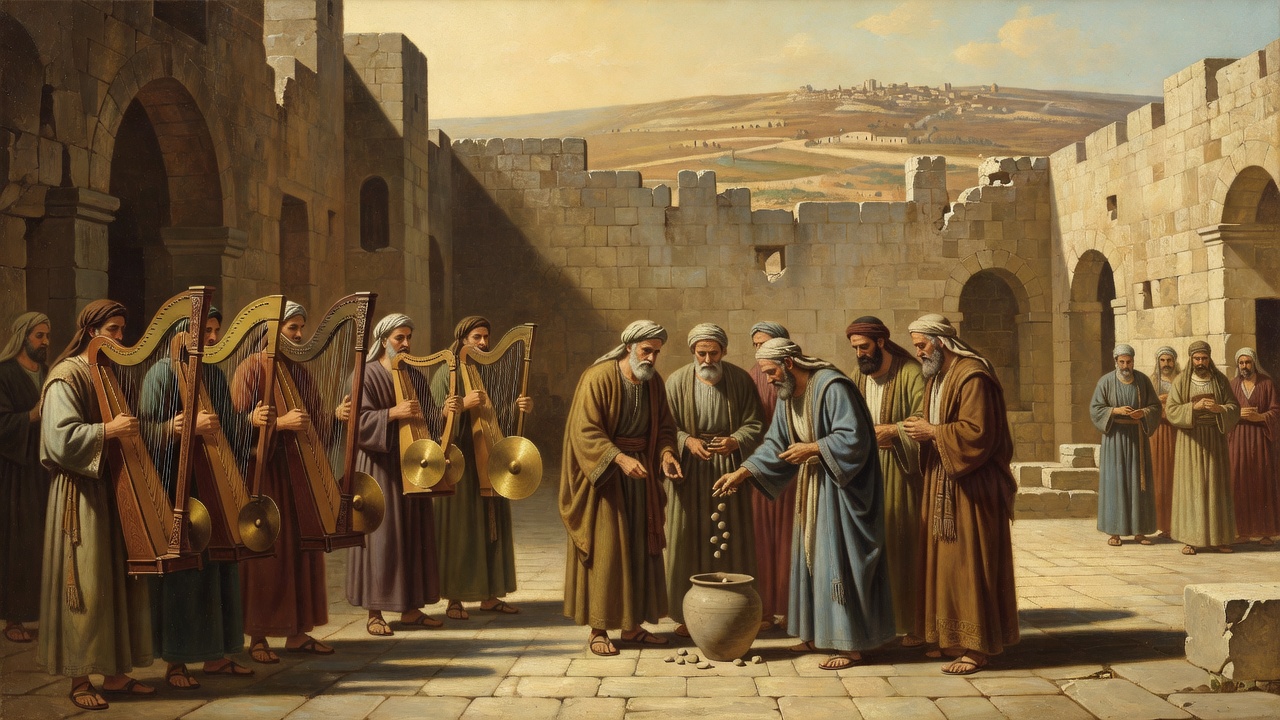
1Therefore David, and the magis-trates of the host, parted or separated to the service of the sons of Asaph, and of Heman, and of Jeduthun, the which should prophesy in harps, and in psalteries, and in cymbals, by their number, and serve the office hallowed, or enjoined, to them.
2Of the sons of Asaph; Zaccur, and Joseph, and Nethaniah, and Asarelah; and the sons of Asaph, under the hand of Asaph, prophesied beside the king.
3And the sons of Jeduthun were these; Gedaliah, Zeri, Jeshaiah, Shimei, and Hashabiah, and Mattithiah, six; under the hand of their father Jeduthun, that prophesied in an harp, upon men acknowledging and praising the Lord.
4Also the sons of Heman were these of Heman; Bukkiah, Mattaniah, Uzziel, Shebuel, and Jerimoth, Hananiah, Hanani, Eliathah, Giddalti, and Romam-tiezer, and Joshbekashah, Mallothi, Hothir, and Mahazioth;
5all these the sons of Heman were prophets of the king in the words of God, that he should enhance the horn, or strength. And God gave to Heman fourteen sons and three daughters.
6All these under the hand of their father were dealed, either assigned, to sing in the temple of the Lord, in cymbals, and psalteries, and harps, into the service of the house of the Lord, nigh the king, that is say, Asaph, and Jeduthun, and Heman.
7And the number of them, with their brethren that taught the song [s] of the Lord, all the teachers, was two hundred fourscore and eight.
8And they sent lots by their whiles evenly, as well the greater as the less, also a wise man and an unwise.
9And the first lot went out to Joseph, that was of Asaph, and to his sons and to his brothers, twelve; the second to Gedaliah, to him, and to his sons and to his brethren, twelve;
10the third to Zaccur, to his sons and to his brethren, twelve;
11the fourth to Izri, to his sons and to his brethren, twelve;
12the fifth to Nethaniah, to his sons and to his brethren, twelve;
13the sixth to Bukkiah, to his sons and to his brethren, twelve;
14the seventh to Jesharelah, to his sons and to his brethren, twelve;
15the eighth to Jeshaiah, to his sons and to his brethren, twelve;
16the ninth to Mattaniah, to his sons and to his brethren, twelve;
17the tenth to Shimei, to his sons and to his brethren, twelve;
18the eleventh to Azareel, to his sons and to his brethren, twelve;
19the twelfth to Hashabiah, to his sons and to his brethren, twelve;
20the thirteenth to Shubael, to his sons and to his brethren, twelve;
21the fourteenth to Mattithiah, to his sons and to his brethren, twelve;
22the fifteenth to Jeremoth, to his sons and to his brethren, twelve;
23the sixteenth to Hananiah, to his sons and to his brethren, twelve;
24the seventeenth to Joshbekashah, to his sons and to his brethren, twelve;
25the eighteenth to Hanani, to his sons and to his brethren, twelve;
26the nineteenth to Mallothi, to his sons and to his brethren, twelve;
27the twentieth to Eliathah, to his sons and to his brethren, twelve;
28the one and twentieth to Hothir, to his sons and to his brethren, twelve;
29the two and twentieth to Giddalti, to his sons and to his brethren, twelve;
30the three and twentieth to Mahaz-ioth, to his sons and to his brethren, twelve;
31the four and twentieth to Romam-tiezer, to his sons and to his brethren, twelve.
Did you know?
Organization of the Temple Musicians
- The ministry of the Levitical musicians under Asaph, Heman, and Jeduthun is described as prophesying with harps, lyres, and cymbals. This reflects a close biblical association between musical performance, thanksgiving, and prophetic inspiration in Israelite worship.Sources: the Bible text itself · Asaph (Levite) · Heman
- The musicians were organized into 24 divisions of 12 skilled members each, totaling 288 trained singers and instrumentalists. Their specific duties and order of service were determined by casting lots, treating young and old, teacher and pupil, on equal terms.Sources: the Bible text itself
- The leaders of these musical families held prominent spiritual roles; Asaph and Heman are identified as seers, and tradition attributes several biblical psalms directly to them or their guilds.Sources: the Bible text itself · Asaph (Levite) · Heman · Jeduthun (Ethan)
Notes written with AI assistance from open sources (Theographic Bible Metadata, CC BY-SA 4.0; Easton’s Bible Dictionary, public domain) and reviewed before publishing.
Credits and license for this translation
Wycliffe's Bible with Modern Spelling
English: Wycliffe's Bible Modern Spelling (with Deuterocanon)
Copyright © 2001,2010,2011,2012,2013,2015 Terry Noble
Language: English
Dialect: Archaic
Translation by: Terry Noble
Wycliffe’s Bible with Modern Spelling, was made in response to requests from readers who wanted my Wycliffe’s Old and New Testaments and Apocrypha in one volume. Printing limitations dictated the number of pages available to me and the letter size. In my previous books, Wycliffe’s Bible, Wycliffe’s Old Testament, Vols. 1 amp 2, Wycliffe’s New Testament, and Wycliffe’s Apocrypha, I have tens of thousands of rewritten verses, presented in parentheses “( )”, to provide help in comprehending the 14th century Middle English vocabulary and grammar. In this present volume, with space at a premium, those “helps” had to be eliminated, to make room for the text of the Apocrypha.
This translation is made available to you under the terms of the
Creative Commons Attribution-Noncommercial-No Derivatives license 4.0.
You may share and redistribute this Bible translation or extracts from it in any format, provided that:
You include the above copyright and source information.
You do not sell this work for a profit.
You do not change any of the words or punctuation of the Scriptures.
Pictures included with Scriptures and other documents on this site are licensed just for use with those Scriptures and documents.
For other uses, please contact the respective copyright owners.
2019-09-26
Section headings adapted from the Berean Standard Bible (public domain); they are not part of this translation’s text.
Source: http://ebible.org/engwyc2017/ · eBible.org