Isaiah 36
World Messianic Bible British Edition · Tap a verse to see its cross-references.
Sennacherib Threatens Jerusalem
1Now in the fourteenth year of King Hezekiah, Sennacherib king of Assyria attacked all of the fortified cities of Judah and captured them. 2The king of Assyria sent Rabshakeh from Lachish to Jerusalem to King Hezekiah with a large army. He stood by the aqueduct from the upper pool in the fuller’s field highway. 3Then Eliakim the son of Hilkiah, who was over the household, and Shebna the scribe, and Joah, the son of Asaph the recorder came out to him.
4Rabshakeh said to them, “Now tell Hezekiah, ‘The great king, the king of Assyria, says, “What confidence is this in which you trust? 5I say that your counsel and strength for the war are only vain words. Now in whom do you trust, that you have rebelled against me? 6Behold, you trust in the staff of this bruised reed, even in Egypt, which if a man leans on it, it will go into his hand and pierce it. So is Pharaoh king of Egypt to all who trust in him. 7But if you tell me, ‘We trust in the LORD our God,’ isn’t that he whose high places and whose altars Hezekiah has taken away, and has said to Judah and to Jerusalem, ‘You shall worship before this altar’?” 8Now therefore, please make a pledge to my master the king of Assyria, and I will give you two thousand horses, if you are able on your part to set riders on them. 9How then can you turn away the face of one captain of the least of my master’s servants, and put your trust in Egypt for chariots and for horsemen? 10Have I come up now without the LORD against this land to destroy it? The LORD said to me, “Go up against this land, and destroy it.”’”
11Then Eliakim, Shebna and Joah said to Rabshakeh, “Please speak to your servants in Aramaic, for we understand it. Don’t speak to us in the Jews’ language in the hearing of the people who are on the wall.”
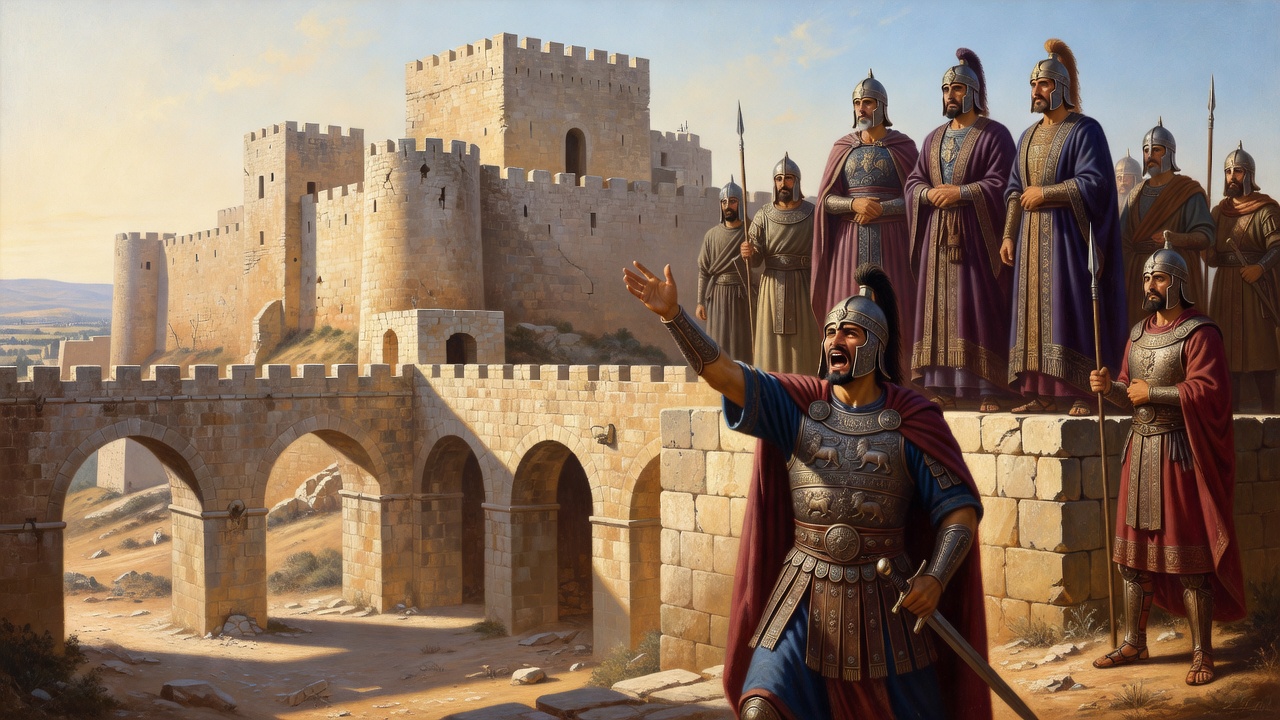
12But Rabshakeh said, “Has my master sent me only to your master and to you, to speak these words, and not to the men who sit on the wall, who will eat their own dung and drink their own urine with you?” 13Then Rabshakeh stood, and called out with a loud voice in the Jews’ language, and said, “Hear the words of the great king, the king of Assyria! 14The king says, ‘Don’t let Hezekiah deceive you; for he will not be able to deliver you. 15Don’t let Hezekiah make you trust in the LORD, saying, “The LORD will surely deliver us. This city won’t be given into the hand of the king of Assyria.”’ 16Don’t listen to Hezekiah, for the king of Assyria says, ‘Make your peace with me, and come out to me; and each of you eat from his vine, and each one from his fig tree, and each one of you drink the waters of his own cistern; 17until I come and take you away to a land like your own land, a land of grain and new wine, a land of bread and vineyards. 18Beware lest Hezekiah persuade you, saying, “The LORD will deliver us.” Have any of the gods of the nations delivered their lands from the hand of the king of Assyria? 19Where are the gods of Hamath and Arpad? Where are the gods of Sepharvaim? Have they delivered Samaria from my hand? 20Who are they amongst all the gods of these countries that have delivered their country out of my hand, that the LORD should deliver Jerusalem out of my hand?’”
21But they remained silent, and said nothing in reply, for the king’s commandment was, “Don’t answer him.”
22Then Eliakim the son of Hilkiah, who was over the household, and Shebna the scribe, and Joah, the son of Asaph the recorder, came to Hezekiah with their clothes torn, and told him the words of Rabshakeh.
Did you know?
Sennacherib's Threat Against Jerusalem
- The term Rabshakeh was not a personal name, but a high-ranking title designating the chief cup-bearer or vizier of the Assyrian royal court. Sennacherib sent this official from Lachish to Jerusalem with a large army to demand the surrender of King Hezekiah.Sources: Rabshakeh · Lachish · the Bible text itself
- Hezekiah's ministers asked the Assyrian envoy to speak in Aramaic, a language used for international diplomacy that the common people would not understand. Rabshakeh refused and intentionally shouted in Hebrew so that the guards and civilians sitting on the city wall would hear his threats directly.Sources: Rabshakeh · the Bible text itself
- The Judean delegation sent out to meet the Assyrian envoy included Eliakim the palace administrator, Shebna the royal scribe, and Joah the recorder. After listening to the envoy's speech defying their God and their king, they returned to Hezekiah in deep mourning with their clothes torn.Sources: Eliakim · Shebna · Joah · the Bible text itself
Notes written with AI assistance from open sources (Theographic Bible Metadata, CC BY-SA 4.0; Easton’s Bible Dictionary, public domain) and reviewed before publishing.
Places in this chapter
- Assyria · 36.359, 43.153 · verses 1, 2, 4, 8, 13, 15, 16, 18
- Jerusalem · 31.777, 35.234 · verses 2, 7, 20
- Lachish · Today: Tell ed Duweir · 31.565, 34.849 · verse 2
- Upper Pool · Today: in Jerusalem · 31.777, 35.234 · verse 2
- Egypt · 30.129, 31.308 · verses 6, 9
- Hamath · Today: Hama · 35.136, 36.750 · verse 19
- Samaria · 32.276, 35.195 · verse 19
Only places identified with high confidence are shown (90% or more according to the scholarly sources compiled by OpenBible). Period map: DARE (Digital Atlas of the Roman Empire), CC BY 4.0; modern map: © OpenStreetMap contributors; places: OpenBible.info (CC BY 4.0).
Credits and license for this translation
The World Messianic Bible British Edition
The World Messianic Bible is not copyrighted, however "World Messianic Bible" is a Trademark.
You may copy, publish, proclaim, distribute, redistribute, sell, give away, quote, memorize, read publicly, broadcast, transmit, share, back up, post on the Internet, print, reproduce, preach, teach from,
and use the World Messianic Bible as much as you want, and others may also do so. All we ask is that if you CHANGE the actual text of the World Messianic Bible in any way, you not call the result the World Messianic Bible
any more. This is to avoid confusion, not to limit your freedom. The Holy Bible is God's Word. It belongs to God. He gave it to us freely, and we who have worked on this translation freely give it to you by dedicating it
to the Public Domain.
Donations to help with the expenses of this project and thus help others have free access to the Word of God may be made to us, but are not required.
Please see https://MLJohnson.org/partner/ for more about partnering with us.
This edition uses British/International spelling.
August 2022 stable text
Section headings adapted from the Berean Standard Bible (public domain); they are not part of this translation’s text.
Source: http://ebible.org/engwmbb/ · eBible.org