Psalms 42
World Messianic Bible · Tap a verse to see its cross-references.
BOOK 2
For the Chief Musician. A contemplation by the sons of Korah.
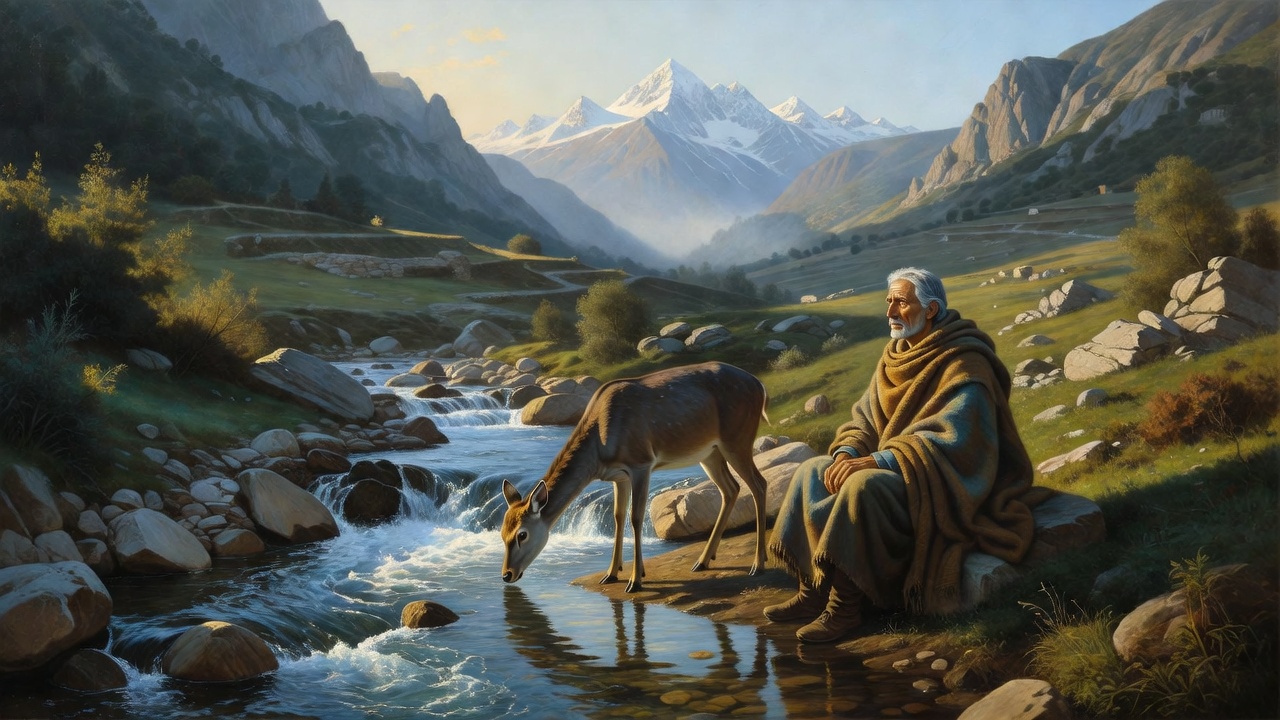
1As the deer pants for the water brooks,
so my soul pants after you, God.
2My soul thirsts for God, for the living God.
When shall I come and appear before God?
3My tears have been my food day and night,
while they continually ask me, “Where is your God?”
4These things I remember, and pour out my soul within me,
how I used to go with the crowd, and led them to God’s house,
with the voice of joy and praise, a multitude keeping a holy day.
5Why are you in despair, my soul?
Why are you disturbed within me?
Hope in God!
For I shall still praise him for the saving help of his presence.
6My God, my soul is in despair within me.
Therefore I remember you from the land of the Jordan,
the heights of Hermon, from the hill Mizar.
7Deep calls to deep at the noise of your waterfalls.
All your waves and your billows have swept over me.
8The LORD will command his loving kindness in the daytime.
In the night his song shall be with me:
a prayer to the God of my life.
9I will ask God, my rock, “Why have you forgotten me?
Why do I go mourning because of the oppression of the enemy?”
10As with a sword in my bones, my adversaries reproach me,
while they continually ask me, “Where is your God?”
11Why are you in despair, my soul?
Why are you disturbed within me?
Hope in God! For I shall still praise him,
the saving help of my countenance, and my God.
Did you know?
Thirsting for God Far from Home
- The psalm is introduced as a song of the sons of Korah, a Levitical family descended from the Levite Korah who took part in temple music and worship.Sources: the Bible text itself · Korah (Levite)
- The speaker longs for God from the northern borderlands, mentioning the Jordan, Mount Hermon, and Mount Mizar. Hermon is a towering range with multiple peaks reaching over 9,000 feet, while Mizar (meaning 'smallness') represents a lesser neighboring summit.Sources: the Bible text itself · Hermon · Hill Mizar
- The poem uses vivid water metaphors, moving from a thirsty deer longing for mountain streams to roaring waterfalls and crashing waves that symbolize overwhelming emotional distress.Sources: the Bible text itself
Notes written with AI assistance from open sources (Theographic Bible Metadata, CC BY-SA 4.0; Easton’s Bible Dictionary, public domain) and reviewed before publishing.
Places in this chapter
Only places identified with high confidence are shown (90% or more according to the scholarly sources compiled by OpenBible). Period map: DARE (Digital Atlas of the Roman Empire), CC BY 4.0; modern map: © OpenStreetMap contributors; places: OpenBible.info (CC BY 4.0).
Credits and license for this translation
The World Messianic Bible
The World Messianic Bible is not copyrighted, however "World Messianic Bible" is a Trademark.
You may copy, publish, proclaim, distribute, redistribute, sell, give away, quote, memorize, read publicly, broadcast, transmit, share, back up, post on the Internet, print, reproduce, preach, teach from,
and use the World Messianic Bible as much as you want, and others may also do so. All we ask is that if you CHANGE the actual text of the World Messianic Bible in any way, you not call the result the World Messianic Bible
any more. This is to avoid confusion, not to limit your freedom. The Holy Bible is God's Word. It belongs to God. He gave it to us freely, and we who have worked on this translation freely give it to you by dedicating it
to the Public Domain.
Donations to help with the expenses of this project and thus help others have free access to the Word of God may be made to us, but are not required.
Please see https://MLJohnson.org/partner/ for more about partnering with us.
This edition uses U. S. A. spelling.
August 2022 stable text
Source: http://ebible.org/engwmb/ · eBible.org