Proverbs 30
World Messianic Bible · Tap a verse to see its cross-references.
The Words of Agur
1The words of Agur the son of Jakeh, the revelation:
the man says to Ithiel,
to Ithiel and Ucal:
2“Surely I am the most ignorant man,
and don’t have a man’s understanding.
3I have not learned wisdom,
neither do I have the knowledge of the Holy One.
4Who has ascended up into heaven, and descended?
Who has gathered the wind in his fists?
Who has bound the waters in his garment?
Who has established all the ends of the earth?
What is his name, and what is his son’s name, if you know?
5“Every word of God is flawless.
He is a shield to those who take refuge in him.
6Don’t you add to his words,
lest he reprove you, and you be found a liar.
7“Two things I have asked of you.
Don’t deny me before I die.
8Remove far from me falsehood and lies.
Give me neither poverty nor riches.
Feed me with the food that is needful for me,
9lest I be full, deny you, and say, ‘Who is the LORD?’
or lest I be poor, and steal,
and so dishonor the name of my God.
10“Don’t slander a servant to his master,
lest he curse you, and you be held guilty.
11There is a generation that curses their father,
and doesn’t bless their mother.
12There is a generation that is pure in their own eyes,
yet are not washed from their filthiness.
13There is a generation, oh how lofty are their eyes!
Their eyelids are lifted up.
14There is a generation whose teeth are like swords,
and their jaws like knives,
to devour the poor from the earth, and the needy from among men.
15“The leech has two daughters:
‘Give, give.’
“There are three things that are never satisfied;
four that don’t say, ‘Enough!’:
16Sheol,
the barren womb,
the earth that is not satisfied with water,
and the fire that doesn’t say, ‘Enough!’
17“The eye that mocks at his father,
and scorns obedience to his mother,
the ravens of the valley shall pick it out,
the young eagles shall eat it.
18“There are three things which are too amazing for me,
four which I don’t understand:
19The way of an eagle in the air,
the way of a serpent on a rock,
the way of a ship in the middle of the sea,
and the way of a man with a maiden.
20“So is the way of an adulterous woman:
She eats and wipes her mouth,
and says, ‘I have done nothing wrong.’
21“For three things the earth trembles,
and under four, it can’t bear up:
22For a servant when he is king,
a fool when he is filled with food,
23for an unloved woman when she is married,
and a servant who is heir to her mistress.
24“There are four things which are little on the earth,
but they are exceedingly wise:
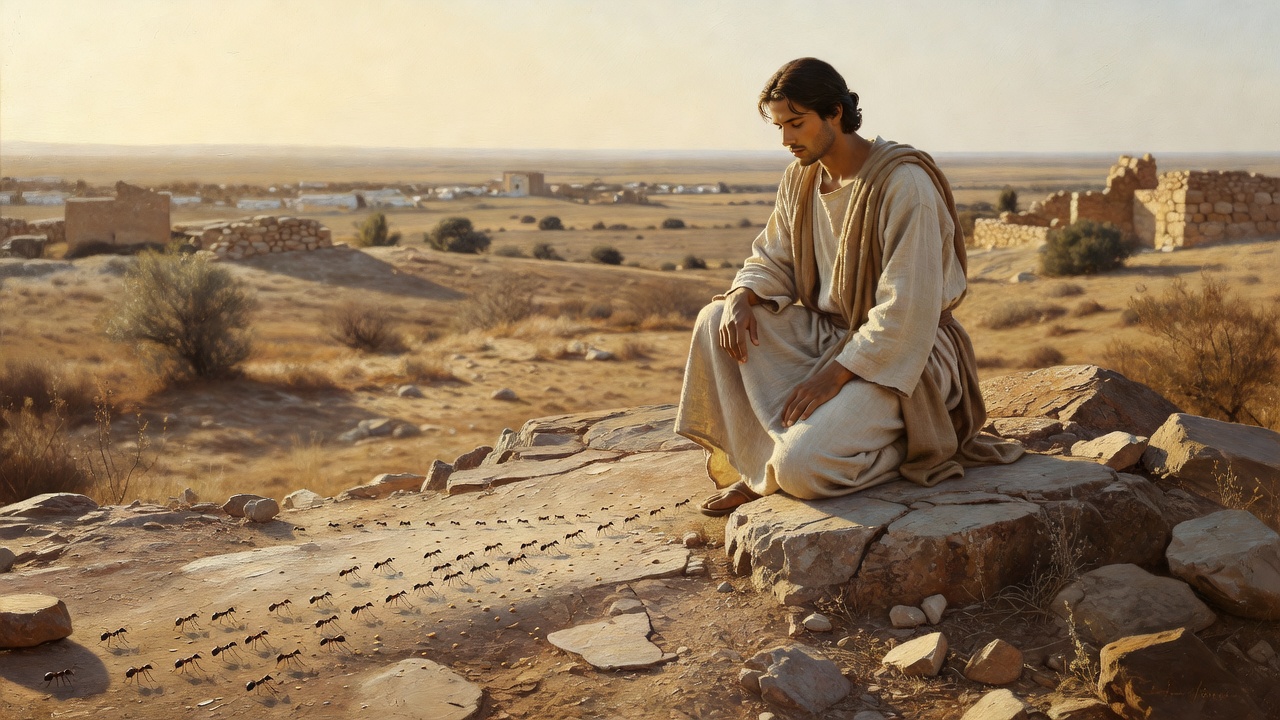
25The ants are not a strong people,
yet they provide their food in the summer.
26The hyraxes are but a feeble folk,
yet make they their houses in the rocks.
27The locusts have no king,
yet they advance in ranks.
28You can catch a lizard with your hands,
yet it is in kings’ palaces.
29“There are three things which are stately in their march,
four which are stately in going:
30The lion, which is mightiest among animals,
and doesn’t turn away for any;
31the greyhound;
the male goat;
and the king against whom there is no rising up.
32“If you have done foolishly in lifting up yourself,
or if you have thought evil,
put your hand over your mouth.
33For as the churning of milk produces butter,
and the wringing of the nose produces blood,
so the forcing of wrath produces strife.”
Did you know?
The Sayings of Agur
- Proverbs 30 is attributed to Agur son of Jakeh, who addressed his sayings to Ithiel and Ucal. Beyond what is recorded in this chapter, nothing further is known about Agur or his father.Sources: Agur · Jakeh · Ucal · the Bible text itself
- The chapter frequently uses a graded numerical pattern ('three things... four that...') to group observations about nature and human behavior. Agur applies this structure to marvels of creation, social disruptions, stately walkers, and four small creatures that display remarkable wisdom: ants, rock badgers, locusts, and lizards.Sources: the Bible text itself
- Agur makes a specific two-part request, asking to be granted neither poverty nor riches, but only his daily portion of food. He explains that having too much might lead someone to disown the Lord, while falling into poverty might tempt a person to steal.Sources: the Bible text itself
Notes written with AI assistance from open sources (Theographic Bible Metadata, CC BY-SA 4.0; Easton’s Bible Dictionary, public domain) and reviewed before publishing.
Credits and license for this translation
The World Messianic Bible
The World Messianic Bible is not copyrighted, however "World Messianic Bible" is a Trademark.
You may copy, publish, proclaim, distribute, redistribute, sell, give away, quote, memorize, read publicly, broadcast, transmit, share, back up, post on the Internet, print, reproduce, preach, teach from,
and use the World Messianic Bible as much as you want, and others may also do so. All we ask is that if you CHANGE the actual text of the World Messianic Bible in any way, you not call the result the World Messianic Bible
any more. This is to avoid confusion, not to limit your freedom. The Holy Bible is God's Word. It belongs to God. He gave it to us freely, and we who have worked on this translation freely give it to you by dedicating it
to the Public Domain.
Donations to help with the expenses of this project and thus help others have free access to the Word of God may be made to us, but are not required.
Please see https://MLJohnson.org/partner/ for more about partnering with us.
This edition uses U. S. A. spelling.
August 2022 stable text
Section headings adapted from the Berean Standard Bible (public domain); they are not part of this translation’s text.
Source: http://ebible.org/engwmb/ · eBible.org