Job 30
Noah Webster Bible · Tap a verse to see its cross-references.
Job’s Honor Turned to Contempt
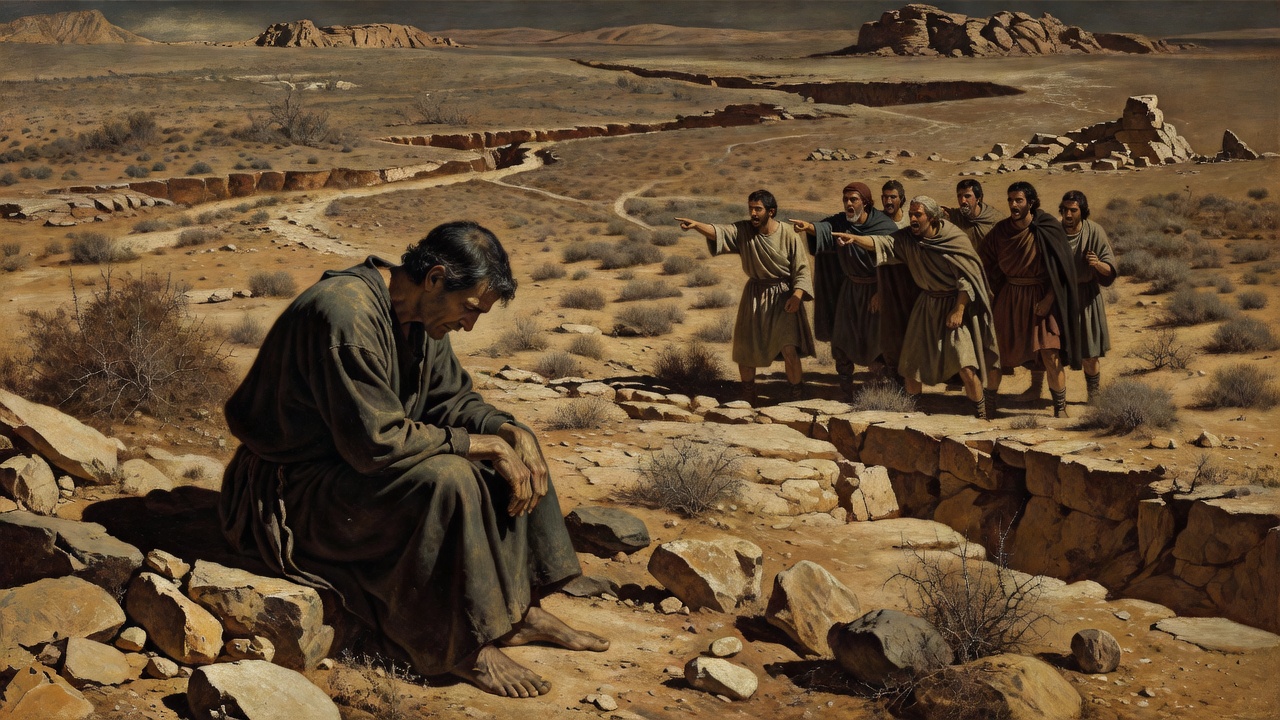
1But now they that are younger than I, have me in derision, whose fathers I would have disdained to set with the dogs of my flock. 2Yes, to what might the strength of their hands profit me, in whom old age had perished? 3For want and famine they were solitary; fleeing into the wilderness in former time desolate and waste. 4Who cut up mallows by the bushes, and juniper roots for their food. 5They were driven forth from among men , (they cried after them, as after a thief;) 6To dwell in the clefts of the valleys, in caves of the earth, and in the rocks. 7Among the bushes they brayed; under the nettles they were collected. 8They were children of fools, yes, children of base men: they were viler than the earth. 9And now I am their song, yes, I am their by-word. 10They abhor me, they flee far from me, and spare not to spit in my face. 11Because he hath loosed my cord, and afflicted me, they have also let loose the bridle before me. 12Upon my right hand rise the youth; they push away my feet, and they raise up against me the ways of their destruction. 13They mar my path, they set forward my calamity, they have no helper. 14They came upon me as a wide breaking in of waters : in the desolation they rolled themselves upon me .
Job’s Prosperity Becomes Calamity
15Terrors are turned upon me: they pursue my soul as the wind: and my welfare passeth away as a cloud. 16And now my soul is poured out upon me; the days of affliction have taken hold upon me. 17My bones are pierced in me in the night season: and my sinews take no rest. 18By the great force of my disease is my garment changed: it bindeth me about as the collar of my coat. 19He hath cast me into the mire, and I have become like dust and ashes. 20I cry to thee, and thou dost not hear me: I stand up, and thou regardest me not . 21Thou hast become cruel to me: with thy strong hand thou opposest thyself against me. 22Thou liftest me up to the wind; thou causest me to ride upon it , and dissolvest my substance. 23For I know that thou wilt bring me to death, and to the house appointed for all living. 24Yet he will not stretch out his hand to the grave, though they cry in his destruction. 25Did not I weep for him that was in trouble? was not my soul grieved for the poor? 26When I looked for good, then evil came: and when I waited for light, there came darkness. 27My bowels boiled, and rested not: the days of affliction came upon me. 28I went mourning without the sun: I stood up, and I cried in the congregation. 29I am a brother to dragons, and a companion to owls. 30My skin is black upon me, and my bones are burned with heat. 31My harp also is turned to mourning, and my organ into the voice of them that weep.
Did you know?
Humiliation, Physical Suffering, and Desert Outcasts
- In this chapter, Job contrasts his previous social standing with his current humiliation at the hands of impoverished outcasts. He describes these men as surviving on the margins of society, foraging for wild mallow and broom tree roots in desolate wadis and rock hollows.Sources: the Bible text itself
- Job uses vivid siege metaphors, picturing his attackers as an advancing army laying ramps and breaking through breaches against him, while he endures severe physical afflictions such as fever, gnawing pain, and blackened, peeling skin.Sources: the Bible text itself
- To convey the isolation and intensity of his grief, Job identifies with the mournful sounds of wilderness creatures, calling himself a companion to jackals and ostriches, while his musical instruments—the harp and flute—are turned entirely to weeping.Sources: the Bible text itself
Notes written with AI assistance from open sources (Theographic Bible Metadata, CC BY-SA 4.0; Easton’s Bible Dictionary, public domain) and reviewed before publishing.
Credits and license for this translation
Noah Webster Bible
The Holy Bible, Containing the Old and New Testaments, in the Common Version, with Amendments of the language by Noah Webster, LL.D.
Public Domain
Language: English
Dialect: archaic American
Translation by: Noah Webster
2024-08-01
Section headings adapted from the Berean Standard Bible (public domain); they are not part of this translation’s text.
Source: http://ebible.org/engwebster/ · eBible.org