Jonah 3
World English Bible British Edition · Tap a verse to see its cross-references.
The Ninevites Repent
1The LORD’s word came to Jonah the second time, saying, 2“Arise, go to Nineveh, that great city, and preach to it the message that I give you.”
3So Jonah arose, and went to Nineveh, according to the LORD’s word. Now Nineveh was an exceedingly great city, three days’ journey across. 4Jonah began to enter into the city a day’s journey, and he cried out, and said, “In forty days, Nineveh will be overthrown!”
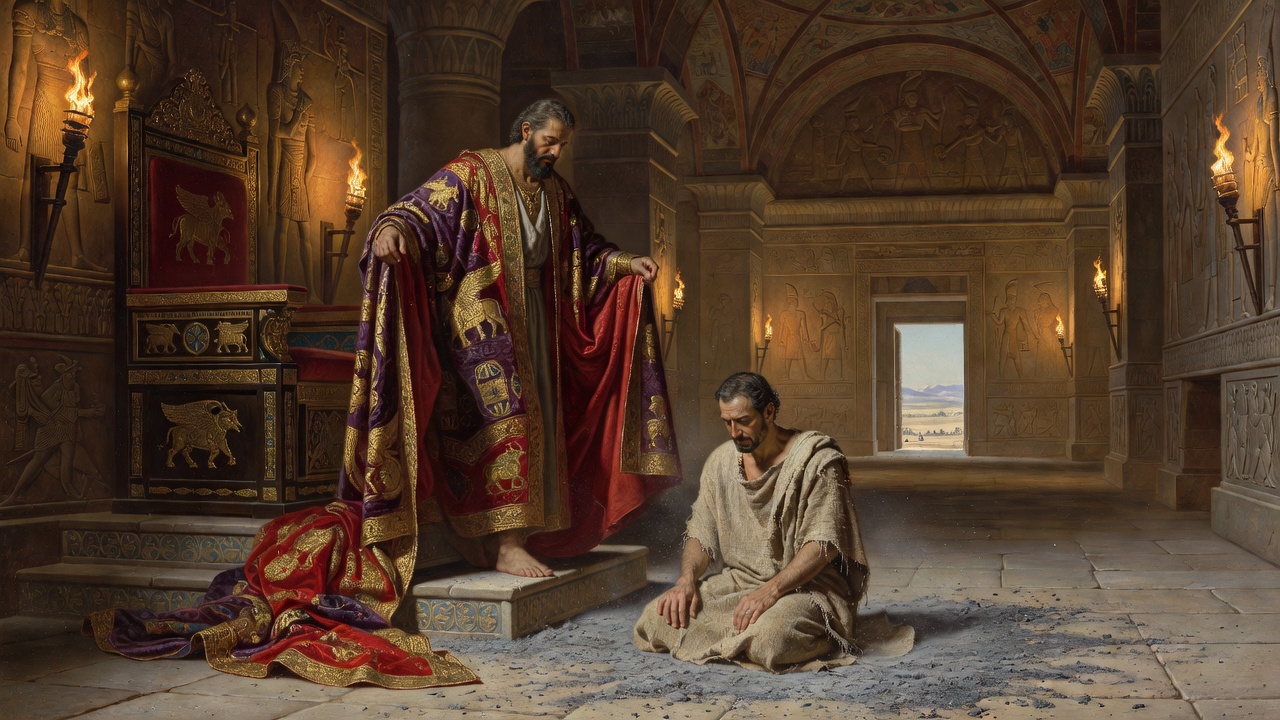
5The people of Nineveh believed God; and they proclaimed a fast and put on sackcloth, from their greatest even to their least. 6The news reached the king of Nineveh, and he arose from his throne, took off his royal robe, covered himself with sackcloth, and sat in ashes. 7He made a proclamation and published through Nineveh by the decree of the king and his nobles, saying, “Let neither man nor animal, herd nor flock, taste anything; let them not feed, nor drink water; 8but let them be covered with sackcloth, both man and animal, and let them cry mightily to God. Yes, let them turn everyone from his evil way and from the violence that is in his hands. 9Who knows whether God will not turn and relent, and turn away from his fierce anger, so that we might not perish?”
10God saw their works, that they turned from their evil way. God relented of the disaster which he said he would do to them, and he didn’t do it.
Did you know?
Jonah's Mission to Nineveh
- Nineveh was the flourishing capital of the ancient Assyrian Empire. The biblical text portrays it as an exceedingly large city, describing it as taking a three-day journey to cross.Sources: Nineveh · the Bible text itself
- Jonah is notable among the prophets of Israel for being sent as a missionary beyond his own nation to preach in a distant, non-Israelite city.Sources: Jonah · the Bible text itself
- The royal proclamation of mourning in Nineveh extended beyond the human population to include livestock, requiring both people and beasts to fast and be covered in sackcloth.Sources: the Bible text itself
Notes written with AI assistance from open sources (Theographic Bible Metadata, CC BY-SA 4.0; Easton’s Bible Dictionary, public domain) and reviewed before publishing.
Places in this chapter
Only places identified with high confidence are shown (90% or more according to the scholarly sources compiled by OpenBible). Period map: DARE (Digital Atlas of the Roman Empire), CC BY 4.0; modern map: © OpenStreetMap contributors; places: OpenBible.info (CC BY 4.0).
Credits and license for this translation
The World English Bible British Edition
The World English Bible British Edition is not copyrighted. It is in the Public Domain. However "World English Bible" is a Trademark.
You may copy, publish, proclaim, distribute, redistribute, sell, give away, quote, memorize, read publicly, broadcast, transmit, share, back up, post on the Internet, print, reproduce, preach, teach from, and use the World English Bible as much as you want, and others may also do so. All we ask is that if you CHANGE the actual text of the World English Bible in any way, you not call the result the World English Bible any more. This is to avoid confusion, not to limit your freedom. The Holy Bible is God's Word. It belongs to God. He gave it to us freely, and we who have worked on this translation freely give it to you by dedicating it to the Public Domain.
Donations to help with the expenses of this project and thus help others have free access to the Word of God may be made to us, but are not required. Please see https://MLJohnson.org/partner/ for more about that.
For a list of what is different between the World English Bible and the World English Bible British Edition, besides the handling of God's Proper Name, see phrasetranslog.txt and phrasetranslist.txt .
2020 stable text edition
Section headings adapted from the Berean Standard Bible (public domain); they are not part of this translation’s text.
Source: http://ebible.org/engwebpb/ · eBible.org