Matthew 11
World English Bible · Tap a verse to see its cross-references.
John’s Inquiry
1When Jesus had finished directing his twelve disciples, he departed from there to teach and preach in their cities.
2Now when John heard in the prison the works of Christ, he sent two of his disciples 3and said to him, “Are you he who comes, or should we look for another?”
4Jesus answered them, “Go and tell John the things which you hear and see: 5the blind receive their sight, the lame walk, the lepers are cleansed, the deaf hear, the dead are raised up, and the poor have good news preached to them. 6Blessed is he who finds no occasion for stumbling in me.”
Jesus Testifies about John
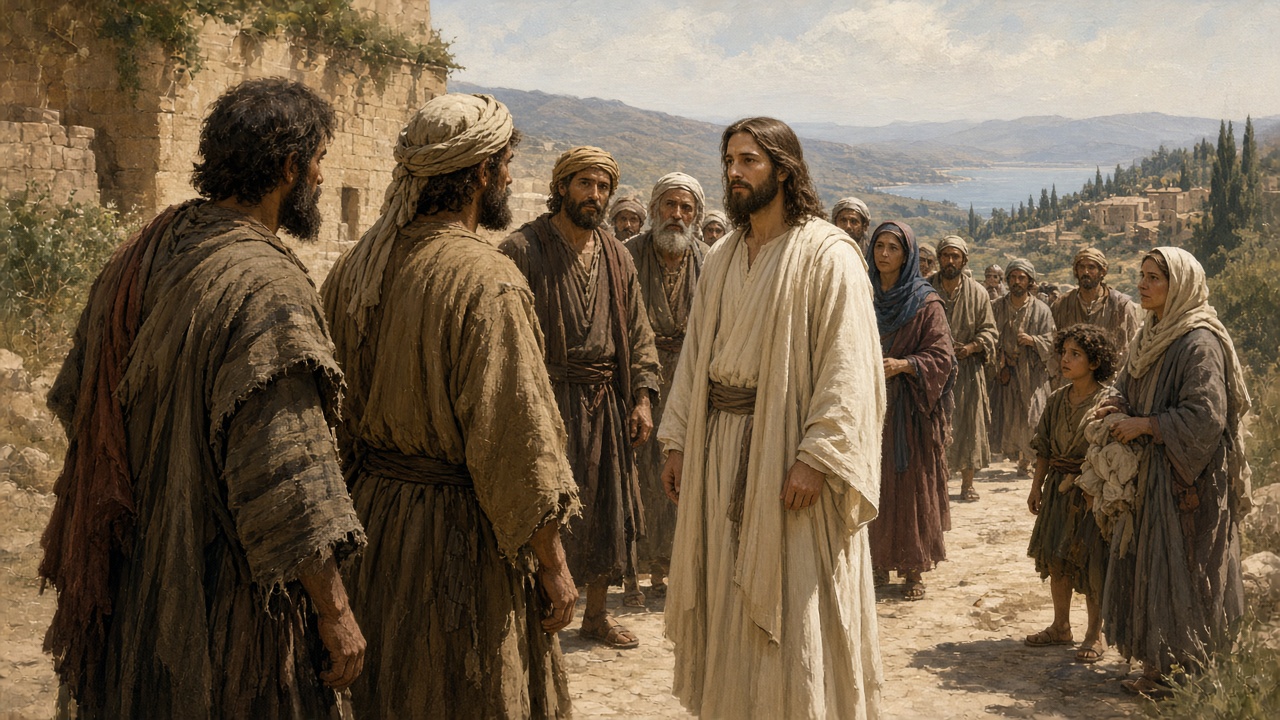
7As these went their way, Jesus began to say to the multitudes concerning John, “What did you go out into the wilderness to see? A reed shaken by the wind? 8But what did you go out to see? A man in soft clothing? Behold, those who wear soft clothing are in kings’ houses. 9But why did you go out? To see a prophet? Yes, I tell you, and much more than a prophet. 10For this is he, of whom it is written, ‘Behold, I send my messenger before your face, who will prepare your way before you.’ 11Most certainly I tell you, among those who are born of women there has not arisen anyone greater than John the Baptizer; yet he who is least in the Kingdom of Heaven is greater than he. 12From the days of John the Baptizer until now, the Kingdom of Heaven suffers violence, and the violent take it by force. 13For all the prophets and the law prophesied until John. 14If you are willing to receive it, this is Elijah, who is to come. 15He who has ears to hear, let him hear.
16“But to what shall I compare this generation? It is like children sitting in the marketplaces, who call to their companions 17and say, ‘We played the flute for you, and you didn’t dance. We mourned for you, and you didn’t lament.’ 18For John came neither eating nor drinking, and they say, ‘He has a demon.’ 19The Son of Man came eating and drinking, and they say, ‘Behold, a gluttonous man and a drunkard, a friend of tax collectors and sinners!’ But wisdom is justified by her children.”
Woe to the Unrepentant
20Then he began to denounce the cities in which most of his mighty works had been done, because they didn’t repent. 21“Woe to you, Chorazin! Woe to you, Bethsaida! For if the mighty works had been done in Tyre and Sidon which were done in you, they would have repented long ago in sackcloth and ashes. 22But I tell you, it will be more tolerable for Tyre and Sidon on the day of judgment than for you. 23You, Capernaum, who are exalted to heaven, you will go down to Hades. For if the mighty works had been done in Sodom which were done in you, it would have remained until today. 24But I tell you that it will be more tolerable for the land of Sodom on the day of judgment, than for you.”
Rest for the Weary
25At that time, Jesus answered, “I thank you, Father, Lord of heaven and earth, that you hid these things from the wise and understanding, and revealed them to infants. 26Yes, Father, for so it was well-pleasing in your sight. 27All things have been delivered to me by my Father. No one knows the Son, except the Father; neither does anyone know the Father, except the Son and he to whom the Son desires to reveal him.
28“Come to me, all you who labor and are heavily burdened, and I will give you rest. 29Take my yoke upon you and learn from me, for I am gentle and humble in heart; and you will find rest for your souls. 30For my yoke is easy, and my burden is light.”
Did you know?
John's question and the cities that did not repent
- From prison, John sent his disciples to ask whether Jesus was the one who was to come. Jesus told the crowds that John was more than a prophet—the messenger sent ahead to prepare the way—and, if they were willing to accept it, the Elijah who was to come. A Bible dictionary calls John the forerunner and says his mission was already the subject of prophecy, citing Isaiah 40:3 and Malachi 3:1; it also introduces Elijah as the Elias of the New Testament.Sources: the Bible text itself · John the Baptist · Elijah
- Jesus then denounced Chorazin, Bethsaida, and Capernaum, where most of his miracles had been performed, because they did not repent. A dictionary identifies Chorazin with modern Kerazeh, about two and a half miles up the Wady Kerazeh from Capernaum, and says that Capernaum, absent from the Old Testament, became Jesus' own city after he left Nazareth. It places Bethsaida on the east side of the lake, two miles up the Jordan in Gaulonitis, enlarged by Philip the tetrarch and named Julias after the emperor's daughter, though some have supposed there was only one Bethsaida, near where the Jordan enters the lake.Sources: the Bible text itself · Chorazin · Capernaum · Bethsaida
- He set those cities against Tyre and Sidon, which he said would have repented long ago in sackcloth and ashes, and against Sodom, which he said would have remained to this day. Sidon, on the Mediterranean coast about twenty-five miles north of Tyre, was the oldest Phoenician city there and the mother city of Tyre. A dictionary says the commerce of the whole world was gathered into Tyre's warehouses, and that Sodom, in the vale of Siddim, was destroyed by fire from heaven so completely that no trace of it has been found.Sources: the Bible text itself · Sidon · Tyre · Sodom
Notes written with AI assistance from open sources (Theographic Bible Metadata, CC BY-SA 4.0; Easton’s Bible Dictionary, public domain) and reviewed before publishing.
Places in this chapter
- Galilee · 32.760, 35.527 · verse 1
- Sidon · Today: Sandikli archaeological site in Sidon · 33.561, 35.372 · verses 21, 22
- Tyre · 33.271, 35.196 · verses 21, 22
Only places identified with high confidence are shown (90% or more according to the scholarly sources compiled by OpenBible). Period map: DARE (Digital Atlas of the Roman Empire), CC BY 4.0; modern map: © OpenStreetMap contributors; places: OpenBible.info (CC BY 4.0).
Credits and license for this translation
The World English Bible
The World English Bible is in the Public Domain. That means that it is not copyrighted. However, "World English Bible" is a Trademark of eBible.org.
You may copy, publish, proclaim, distribute, redistribute, sell, give away, quote, memorize, read publicly, broadcast, transmit, share, back up, post on the Internet, print, reproduce, preach, teach from, and use
the World English Bible as much as you want, and others may also do so. All we ask is that if you CHANGE the actual text of the World English Bible in any way, you not call the result the World English Bible any more.
This is to avoid confusion, not to limit your freedom. The Holy Bible is God's Word. It belongs to God. He gave it to us freely, and we who have worked on this translation freely give it to you by dedicating it to the
Public Domain.
Donations to help with the expenses of this project and thus help others have free access to the Word of God may be made to us, but are not required. Please see
https://MLJohnson.org/partner/ for more about that.
The master copy of this Bible translation is posted on https://eBible.org/web/ and at https://WorldEnglish.Bible .
2020 stable text edition
Section headings adapted from the Berean Standard Bible (public domain); they are not part of this translation’s text.
Source: http://ebible.org/engwebp/ · eBible.org