Deuteronomy 20
World English Bible · Tap a verse to see its cross-references.
Laws of Warfare
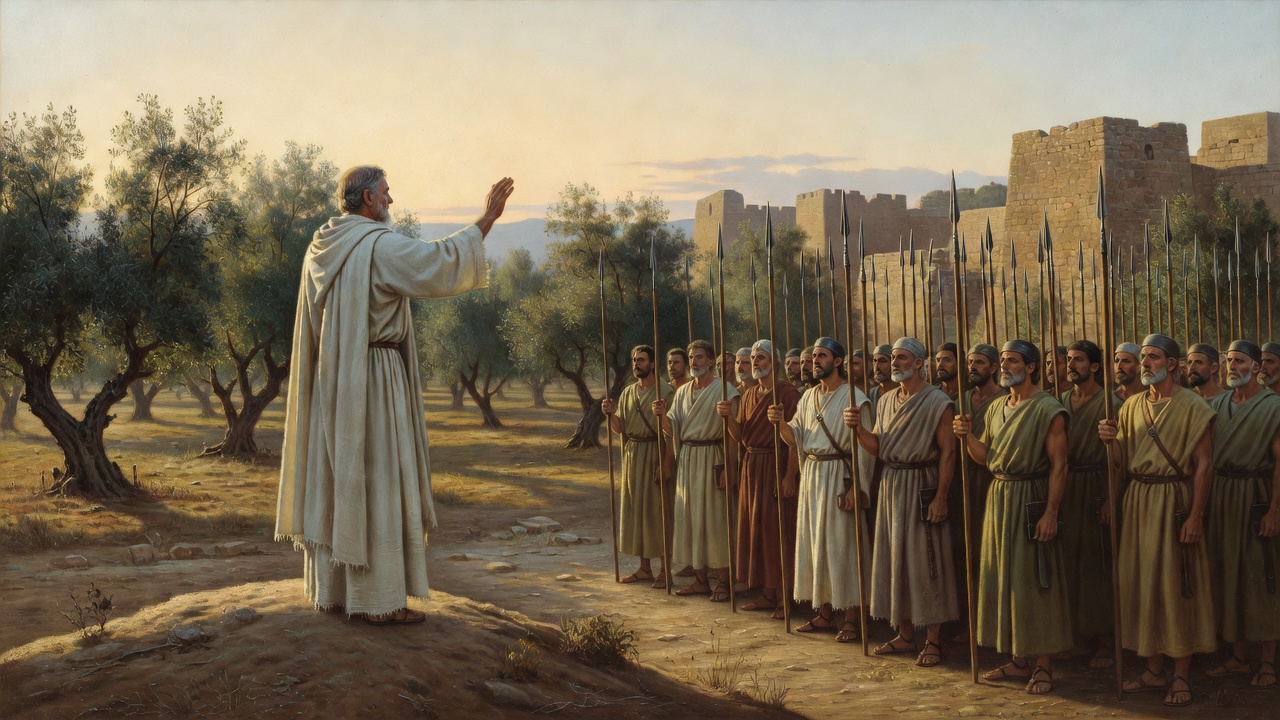
1When you go out to battle against your enemies, and see horses, chariots, and a people more numerous than you, you shall not be afraid of them; for the LORD your God, who brought you up out of the land of Egypt, is with you. 2It shall be, when you draw near to the battle, that the priest shall approach and speak to the people, 3and shall tell them, “Hear, Israel, you draw near today to battle against your enemies. Don’t let your heart faint! Don’t be afraid, nor tremble, neither be scared of them; 4for the LORD your God is he who goes with you, to fight for you against your enemies, to save you.”
5The officers shall speak to the people, saying, “What man is there who has built a new house, and has not dedicated it? Let him go and return to his house, lest he die in the battle, and another man dedicate it. 6What man is there who has planted a vineyard, and has not used its fruit? Let him go and return to his house, lest he die in the battle, and another man use its fruit. 7What man is there who has pledged to be married to a wife, and has not taken her? Let him go and return to his house, lest he die in the battle, and another man take her.” 8The officers shall speak further to the people, and they shall say, “What man is there who is fearful and faint-hearted? Let him go and return to his house, lest his brother’s heart melt as his heart.” 9It shall be, when the officers have finished speaking to the people, that they shall appoint captains of armies at the head of the people.
10When you draw near to a city to fight against it, then proclaim peace to it. 11It shall be, if it gives you answer of peace and opens to you, then it shall be that all the people who are found therein shall become forced laborers to you, and shall serve you. 12If it will make no peace with you, but will make war against you, then you shall besiege it. 13When the LORD your God delivers it into your hand, you shall strike every male of it with the edge of the sword; 14but the women, the little ones, the livestock, and all that is in the city, even all its plunder, you shall take for plunder for yourself. You may use the plunder of your enemies, which the LORD your God has given you. 15Thus you shall do to all the cities which are very far off from you, which are not of the cities of these nations. 16But of the cities of these peoples that the LORD your God gives you for an inheritance, you shall save alive nothing that breathes; 17but you shall utterly destroy them: the Hittite, the Amorite, the Canaanite, the Perizzite, the Hivite, and the Jebusite, as the LORD your God has commanded you; 18that they not teach you to follow all their abominations, which they have done for their gods; so would you sin against the LORD your God. 19When you shall besiege a city a long time, in making war against it to take it, you shall not destroy its trees by wielding an ax against them; for you may eat of them. You shall not cut them down, for is the tree of the field man, that it should be besieged by you? 20Only the trees that you know are not trees for food, you shall destroy and cut them down. You shall build bulwarks against the city that makes war with you, until it falls.
Did you know?
Laws Concerning Warfare
- Before entering combat, Israelite officers announced specific exemptions from military duty, releasing men who had built a house not yet dedicated, planted a vineyard not yet harvested, become engaged to be married, or felt afraid.Sources: the Bible text itself
- The law established different warfare policies for distant cities compared to cities within the Promised Land; distant cities were first offered terms of peace, whereas the inhabitants of nearby nations were marked for complete destruction to avoid idolatry.Sources: the Bible text itself
- During long sieges, Israelite forces were forbidden from cutting down fruit-bearing trees to construct siege works, limiting their timber harvesting only to trees known not to produce food.Sources: the Bible text itself
Notes written with AI assistance from open sources (Theographic Bible Metadata, CC BY-SA 4.0; Easton’s Bible Dictionary, public domain) and reviewed before publishing.
Places in this chapter
- Egypt · 30.129, 31.308 · verse 1
Only places identified with high confidence are shown (90% or more according to the scholarly sources compiled by OpenBible). Period map: DARE (Digital Atlas of the Roman Empire), CC BY 4.0; modern map: © OpenStreetMap contributors; places: OpenBible.info (CC BY 4.0).
Credits and license for this translation
The World English Bible
The World English Bible is in the Public Domain. That means that it is not copyrighted. However, "World English Bible" is a Trademark of eBible.org.
You may copy, publish, proclaim, distribute, redistribute, sell, give away, quote, memorize, read publicly, broadcast, transmit, share, back up, post on the Internet, print, reproduce, preach, teach from, and use
the World English Bible as much as you want, and others may also do so. All we ask is that if you CHANGE the actual text of the World English Bible in any way, you not call the result the World English Bible any more.
This is to avoid confusion, not to limit your freedom. The Holy Bible is God's Word. It belongs to God. He gave it to us freely, and we who have worked on this translation freely give it to you by dedicating it to the
Public Domain.
Donations to help with the expenses of this project and thus help others have free access to the Word of God may be made to us, but are not required. Please see
https://MLJohnson.org/partner/ for more about that.
The master copy of this Bible translation is posted on https://eBible.org/web/ and at https://WorldEnglish.Bible .
2020 stable text edition
Section headings adapted from the Berean Standard Bible (public domain); they are not part of this translation’s text.
Source: http://ebible.org/engwebp/ · eBible.org