1 Kings 1
World English Bible · Tap a verse to see its cross-references.
About this book
About 1 Kings
- Easton's Bible Dictionary (1897) treats the authorship of the books of Kings as uncertain. A tradition that Jeremiah wrote them is, in Easton's view, supported by passages almost identical with parts of Jeremiah and by events Jeremiah knew personally, yet Easton thinks it more probable that Ezra, after the Captivity, compiled the books from earlier documents, perhaps written by David, Solomon, Nathan, Gad, and Iddo. Easton dates the composition between 561 B.C., when Jehoiachin was released from captivity by Evil-merodach, and 538 B.C., the decree of Cyrus.Sources: Easton: Kings, The Books of
- Easton says these books contain the annals of the kingdom from Solomon's accession until Nebuchadnezzar and the Babylonians subdued it, a period he estimates at about 453 years. 1 Kings opens while David is dying: Adonijah, his fourth son, who had become heir-apparent to the throne after the deaths of Amnon and Absalom, has himself proclaimed king, but Nathan and Bathsheba persuade David to enthrone Solomon at once. Solomon, David's son by Bathsheba, whose history is recorded in 1 Kings 1-11, came to the throne, Easton suggests, at about sixteen or eighteen.Sources: Easton: Kings, The Books of · Adonijah · Solomon
- In the Hebrew Scriptures the two books of Kings originally formed one book; the Septuagint first divided them and, with the Vulgate, numbers them as the third and fourth books of Kings, the books of Samuel being the first and second. Easton notes that Chronicles gives greater prominence to the priestly or Levitical office, while Kings gives greater prominence to the royal office, and that in the threefold division of the Scriptures by the Jews these books are ranked among the Prophets. The narrative points to earlier sources: the book of the acts of Solomon and the chronicles of the kings of Judah and of Israel.Sources: Easton: Kings, The Books of
- After Solomon's death the ten tribes revolted and invited Jeroboam, son of Nebat, to be their king; Easton calls him the first king of those tribes and dates his reign from 976 to 945 B.C. He had fled to Egypt under the protection of Shishak I, and later moved his residence from Shechem, his first capital, to Tirzah, which remained the chief residence of Israel's kings until Omri bought the hill of Shomeron from Shemer for two talents of silver and built Samaria. The later narrative includes Ahab, Omri's son and the seventh king of Israel, whose wife was Jezebel: to the calf worship introduced by Jeroboam he added the worship of Baal, and he was severely admonished by the prophet Elijah.Sources: Jeroboam · Tirzah · Samaria · Ahab
Notes written with AI assistance from open sources (Theographic Bible Metadata, CC BY-SA 4.0; Easton’s Bible Dictionary, public domain) and reviewed before publishing.
Abishag Cares for David
1Now King David was old and advanced in years; and they covered him with clothes, but he couldn’t keep warm. 2Therefore his servants said to him, “Let a young virgin be sought for my lord the king. Let her stand before the king, and cherish him; and let her lie in your bosom, that my lord the king may keep warm.” 3So they sought for a beautiful young lady throughout all the borders of Israel, and found Abishag the Shunammite, and brought her to the king. 4The young lady was very beautiful; and she cherished the king, and served him; but the king didn’t know her intimately.
Adonijah Usurps the Kingdom
5Then Adonijah the son of Haggith exalted himself, saying, “I will be king.” Then he prepared him chariots and horsemen, and fifty men to run before him. 6His father had not displeased him at any time in saying, “Why have you done so?” and he was also a very handsome man; and he was born after Absalom. 7He conferred with Joab the son of Zeruiah and with Abiathar the priest; and they followed Adonijah and helped him. 8But Zadok the priest, Benaiah the son of Jehoiada, Nathan the prophet, Shimei, Rei, and the mighty men who belonged to David, were not with Adonijah.
9Adonijah killed sheep, cattle, and fatlings by the stone of Zoheleth, which is beside En Rogel; and he called all his brothers, the king’s sons, and all the men of Judah, the king’s servants; 10but he didn’t call Nathan the prophet, and Benaiah, and the mighty men, and Solomon his brother.
Nathan and Bathsheba before David
11Then Nathan spoke to Bathsheba the mother of Solomon, saying, “Haven’t you heard that Adonijah the son of Haggith reigns, and David our lord doesn’t know it? 12Now therefore come, please let me give you counsel, that you may save your own life and your son Solomon’s life. 13Go in to King David, and tell him, ‘Didn’t you, my lord the king, swear to your servant, saying, “Assuredly Solomon your son shall reign after me, and he shall sit on my throne”? Why then does Adonijah reign?’ 14Behold, while you are still talking there with the king, I will also come in after you and confirm your words.”
15Bathsheba went in to the king in his room. The king was very old; and Abishag the Shunammite was serving the king. 16Bathsheba bowed and showed respect to the king. The king said, “What would you like?”
17She said to him, “My lord, you swore by the LORD your God to your servant, ‘Assuredly Solomon your son shall reign after me, and he shall sit on my throne.’ 18Now, behold, Adonijah reigns; and you, my lord the king, don’t know it. 19He has slain cattle and fatlings and sheep in abundance, and has called all the sons of the king, Abiathar the priest, and Joab the captain of the army; but he hasn’t called Solomon your servant. 20You, my lord the king, the eyes of all Israel are on you, that you should tell them who will sit on the throne of my lord the king after him. 21Otherwise it will happen, when my lord the king sleeps with his fathers, that I and my son Solomon will be considered criminals.”
22Behold, while she was still talking with the king, Nathan the prophet came in. 23They told the king, saying, “Behold, Nathan the prophet!”
When he had come in before the king, he bowed himself before the king with his face to the ground. 24Nathan said, “My lord, King, have you said, ‘Adonijah shall reign after me, and he shall sit on my throne’? 25For he has gone down today, and has slain cattle, fatlings, and sheep in abundance, and has called all the king’s sons, the captains of the army, and Abiathar the priest. Behold, they are eating and drinking before him, and saying, ‘Long live King Adonijah!’ 26But he hasn’t called me, even me your servant, Zadok the priest, Benaiah the son of Jehoiada, and your servant Solomon. 27Was this thing done by my lord the king, and you haven’t shown to your servants who should sit on the throne of my lord the king after him?”
David Renews His Oath to Bathsheba
28Then King David answered, “Call Bathsheba in to me.” She came into the king’s presence and stood before the king. 29The king vowed and said, “As the LORD lives, who has redeemed my soul out of all adversity, 30most certainly as I swore to you by the LORD, the God of Israel, saying, ‘Assuredly Solomon your son shall reign after me, and he shall sit on my throne in my place;’ I will most certainly do this today.”
31Then Bathsheba bowed with her face to the earth and showed respect to the king, and said, “Let my lord King David live forever!”
Solomon Anointed King
32King David said, “Call to me Zadok the priest, Nathan the prophet, and Benaiah the son of Jehoiada.” They came before the king. 33The king said to them, “Take with you the servants of your lord, and cause Solomon my son to ride on my own mule, and bring him down to Gihon. 34Let Zadok the priest and Nathan the prophet anoint him there king over Israel. Blow the trumpet, and say, ‘Long live King Solomon!’ 35Then come up after him, and he shall come and sit on my throne; for he shall be king in my place. I have appointed him to be prince over Israel and over Judah.”
36Benaiah the son of Jehoiada answered the king, and said, “Amen. May the LORD, the God of my lord the king, say so. 37As the LORD has been with my lord the king, even so may he be with Solomon, and make his throne greater than the throne of my lord King David.”
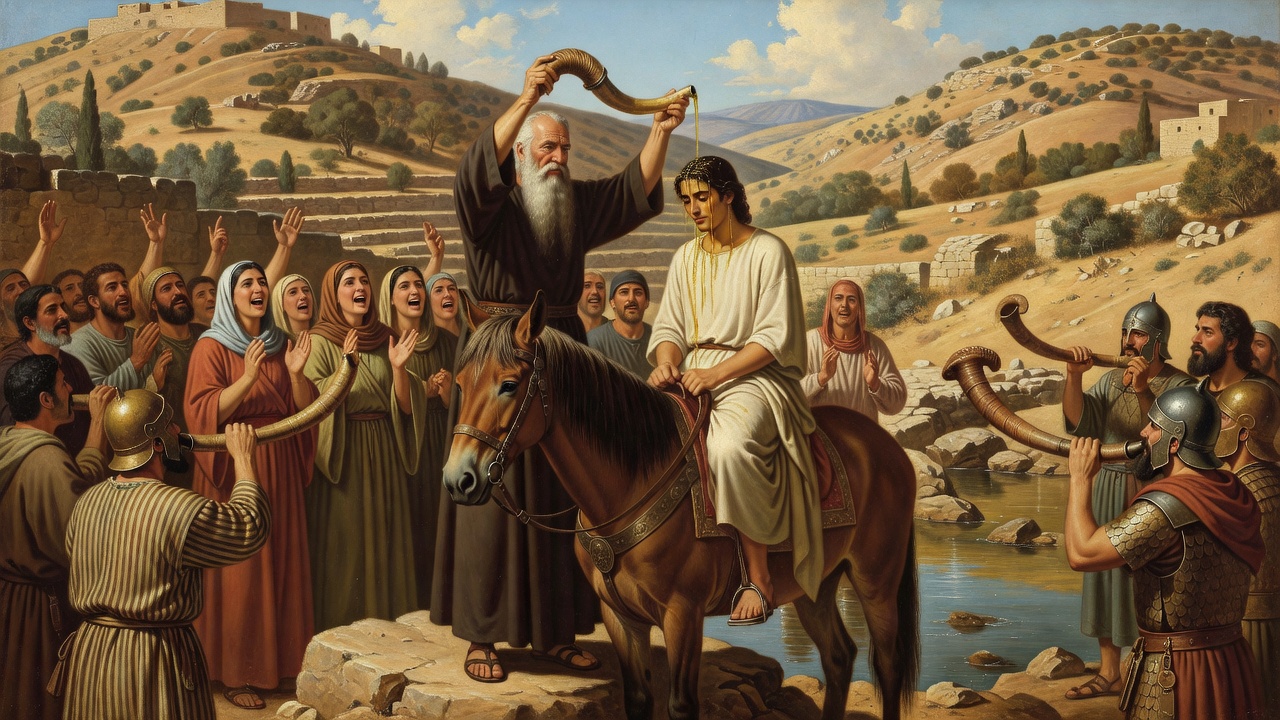
38So Zadok the priest, Nathan the prophet, Benaiah the son of Jehoiada, and the Cherethites and the Pelethites went down and had Solomon ride on King David’s mule, and brought him to Gihon. 39Zadok the priest took the horn of oil from the Tent, and anointed Solomon. They blew the trumpet; and all the people said, “Long live King Solomon!”
40All the people came up after him, and the people piped with pipes, and rejoiced with great joy, so that the earth shook with their sound.
Adonijah Learns of Solomon’s Kingship
41Adonijah and all the guests who were with him heard it as they had finished eating. When Joab heard the sound of the trumpet, he said, “Why is this noise of the city being in an uproar?”
42While he yet spoke, behold, Jonathan the son of Abiathar the priest came; and Adonijah said, “Come in; for you are a worthy man, and bring good news.”
43Jonathan answered Adonijah, “Most certainly our lord King David has made Solomon king. 44The king has sent with him Zadok the priest, Nathan the prophet, Benaiah the son of Jehoiada, and the Cherethites and the Pelethites; and they have caused him to ride on the king’s mule. 45Zadok the priest and Nathan the prophet have anointed him king in Gihon. They have come up from there rejoicing, so that the city rang again. This is the noise that you have heard. 46Also, Solomon sits on the throne of the kingdom. 47Moreover the king’s servants came to bless our lord King David, saying, ‘May your God make the name of Solomon better than your name, and make his throne greater than your throne;’ and the king bowed himself on the bed. 48Also thus said the king, ‘Blessed be the LORD, the God of Israel, who has given one to sit on my throne today, my eyes even seeing it.’”
49All the guests of Adonijah were afraid, and rose up, and each man went his way. 50Adonijah was afraid because of Solomon; and he arose, and went, and hung onto the horns of the altar. 51Solomon was told, “Behold, Adonijah fears King Solomon; for, behold, he is hanging onto the horns of the altar, saying, ‘Let King Solomon swear to me first that he will not kill his servant with the sword.’”
52Solomon said, “If he shows himself a worthy man, not a hair of his shall fall to the earth; but if wickedness is found in him, he shall die.”
53So King Solomon sent, and they brought him down from the altar. He came and bowed down to King Solomon; and Solomon said to him, “Go to your house.”
Did you know?
The Succession to David's Throne
- As David's oldest surviving son after the deaths of Amnon and Absalom, Adonijah claimed the royal succession, backed by the military commander Joab and the high priest Abiathar. However, David chose his younger son Solomon, who was supported by the prophet Nathan, the priest Zadok, and the royal bodyguard under Benaiah.Sources: Adonijah · Solomon · the Bible text itself
- Riding the king's own mule was a decisive public declaration of royal authority. By David's explicit instruction, Solomon was escorted down to the spring of Gihon, where Zadok anointed him king with oil taken from the tabernacle to the sound of ram's horns and popular celebration.Sources: Gihon · Zadok · the Bible text itself
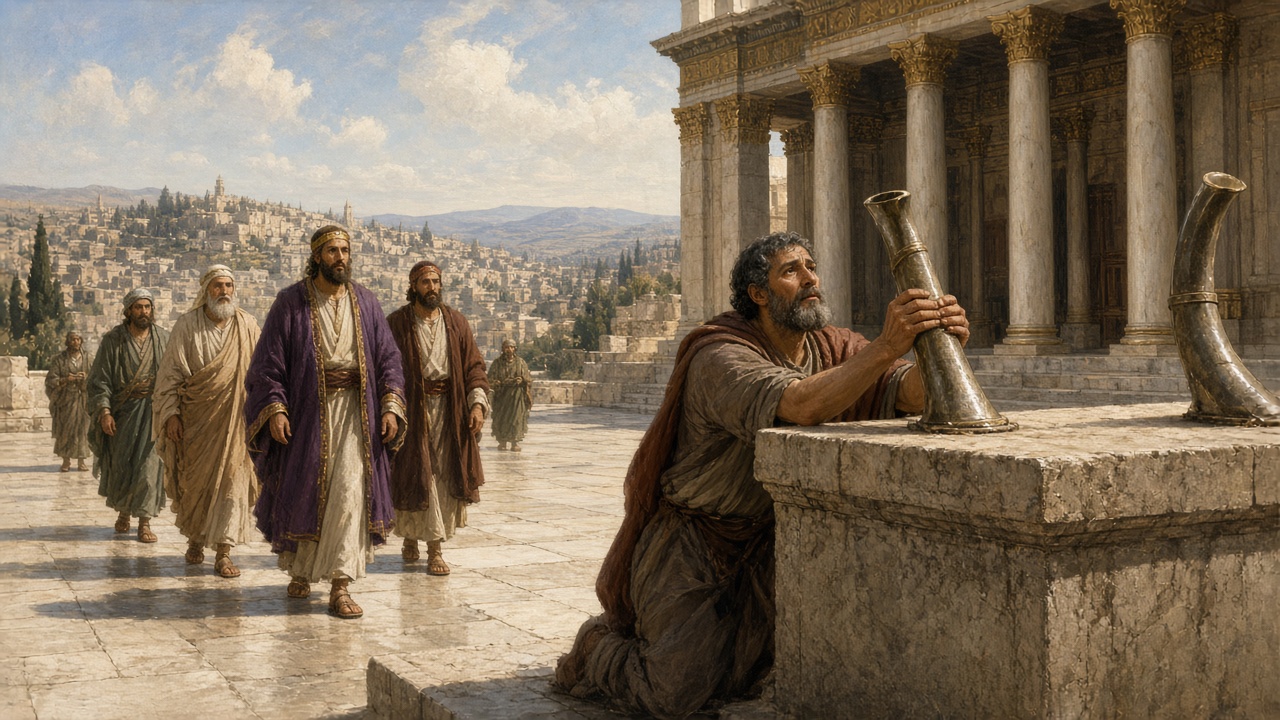
- Upon hearing of Solomon's public coronation, Adonijah fled in terror and sought asylum by taking hold of the horns of the sacrificial altar. Solomon granted him conditional clemency, sparing his life so long as he proved himself a worthy man.Sources: Adonijah · the Bible text itself
Notes written with AI assistance from open sources (Theographic Bible Metadata, CC BY-SA 4.0; Easton’s Bible Dictionary, public domain) and reviewed before publishing.
Places in this chapter
- Shunem · Today: Sulam · 32.606, 35.334 · verse 3
- Serpent’s Stone · Today: within 100 m of Bir Ayub · 31.767, 35.236 · verse 9
- Gihon · Today: Gihon Spring · 31.773, 35.236 · verses 33, 38, 44, 45
- Jerusalem · 31.777, 35.234 · verse 40
Only places identified with high confidence are shown (90% or more according to the scholarly sources compiled by OpenBible). Period map: DARE (Digital Atlas of the Roman Empire), CC BY 4.0; modern map: © OpenStreetMap contributors; places: OpenBible.info (CC BY 4.0).
Credits and license for this translation
The World English Bible
The World English Bible is in the Public Domain. That means that it is not copyrighted. However, "World English Bible" is a Trademark of eBible.org.
You may copy, publish, proclaim, distribute, redistribute, sell, give away, quote, memorize, read publicly, broadcast, transmit, share, back up, post on the Internet, print, reproduce, preach, teach from, and use
the World English Bible as much as you want, and others may also do so. All we ask is that if you CHANGE the actual text of the World English Bible in any way, you not call the result the World English Bible any more.
This is to avoid confusion, not to limit your freedom. The Holy Bible is God's Word. It belongs to God. He gave it to us freely, and we who have worked on this translation freely give it to you by dedicating it to the
Public Domain.
Donations to help with the expenses of this project and thus help others have free access to the Word of God may be made to us, but are not required. Please see
https://MLJohnson.org/partner/ for more about that.
The master copy of this Bible translation is posted on https://eBible.org/web/ and at https://WorldEnglish.Bible .
2020 stable text edition
Section headings adapted from the Berean Standard Bible (public domain); they are not part of this translation’s text.
Source: http://ebible.org/engwebp/ · eBible.org