Matthew 11
Tyndale New Testament · Tap a verse to see its cross-references.
John’s Inquiry
1And it came to passe when Iesus had made an ende of commaundinge his .xii. disciples that he departed thence to teache and to preache in their cities. 2When Ihon beinge in preson hearde the workes of Christ he sent two of his disciples 3and sayde vnto him. Arte thou he that shall come: or shall we loke for another. 4Iesus answered and sayde vnto them. Go and shewe Ihon what ye have hearde and sene. 5The blynd se the halt goo the lepers are clensed: the deef heare the ded ryse ageyne and the glad tidinges is preached to the povre. 6And happy is he that is not offended by me.
Jesus Testifies about John
7And as they departed Iesus begane to speake vnto the people of Ihon. What for to se wet ye out in to the wyldernes? wet ye out to se a rede shake with the wynde? 8other what wet ye out for to se? A man clothed in soofte raymet:? Beholde they that weare soofte clothing are in kynges howses. 9But what wet ye oute for to se? A prophete? Ye I saye to you and more the a prophete. 10For this is he of who it is wrytte. Beholde I sende my messenger before thy face which shall prepare thy waye before the 11Verely I saye vnto you amonge the chyldren of wemen arose there not a gretter then Ihon the baptist. Notwithstondinge he that ys lesse in the kyngdome of heven ys gretter then he. 12From the tyme of Ihon Baptist hytherto the kyngdome of heven suffreth violence and they that go to it with violence pluck it vnto them. 13For all the prophetes and the lawe prophesyed vnto to the tyme of Ihon. 14Also yf ye wyll receave it this is Helyas which shuld come. 15He that hathe eares to heare let him heare. 16But wher vnto shall I lyken this generacion? It ys lyke vnto chyldre which syt in the market and call vnto their felowes 17and saye: we have pyped vnto you and ye have not daunsed? We have morned vnto you and ye have not sorowed. 18For Ihon came nether eatinge nor drinkinge and they saye he hath the devyll. 19The sonne of man came eatinge and drinkinge and they saye beholde a glutton and drynker of wyne and a frend vnto publicans and synners. Never the later wysdome ys iustified of hir children.
Woe to the Unrepentant
20Then began he to vpbrayd the cities in which most of his miracles were done because they meded not. 21Wo be to the Chorasin. Wo be to the Betzaida: for if the miracles which were shewd in you had bene done in Tyre and Sidon they had repented longe agone in sackcloth and asshes. 22Neverthelesse I say to you: it shall be esier for Tyre and Sidon at the day of iudgement then for you. 23And thou Capernaum which art lift vp vnto heven shalt be brought doune to hell. For if the miracles which have bene done in the had bene shewed in zodom: they had remayned to this daye. 24Neverthelesse I saye vnto you: it shalbe easiar for the londe of zodom in the daye of iudgement then for the.
Rest for the Weary
25At that tyme Iesus answered and sayd: I prayse the o father lorde of heven and erth because thou hast hid these thinges from the wyse and prudet and hast opened the vnto babes: 26even so father for so it pleased the. 27All thinges are geve vnto me of my father. And noma knoweth the sonne but the father: nether knoweth eny man the father save the sonne and he to whome the sonne will open him. 28Come vnto me all ye that laboure and are laden and I wyll ease you. 29Take my yoke on you and lerne of me for I am meke and lowly in herte: and ye shall fynd rest vnto youre soules. 30For my yoke is easy and my burden is light.
Did you know?
John's question and the cities that did not repent
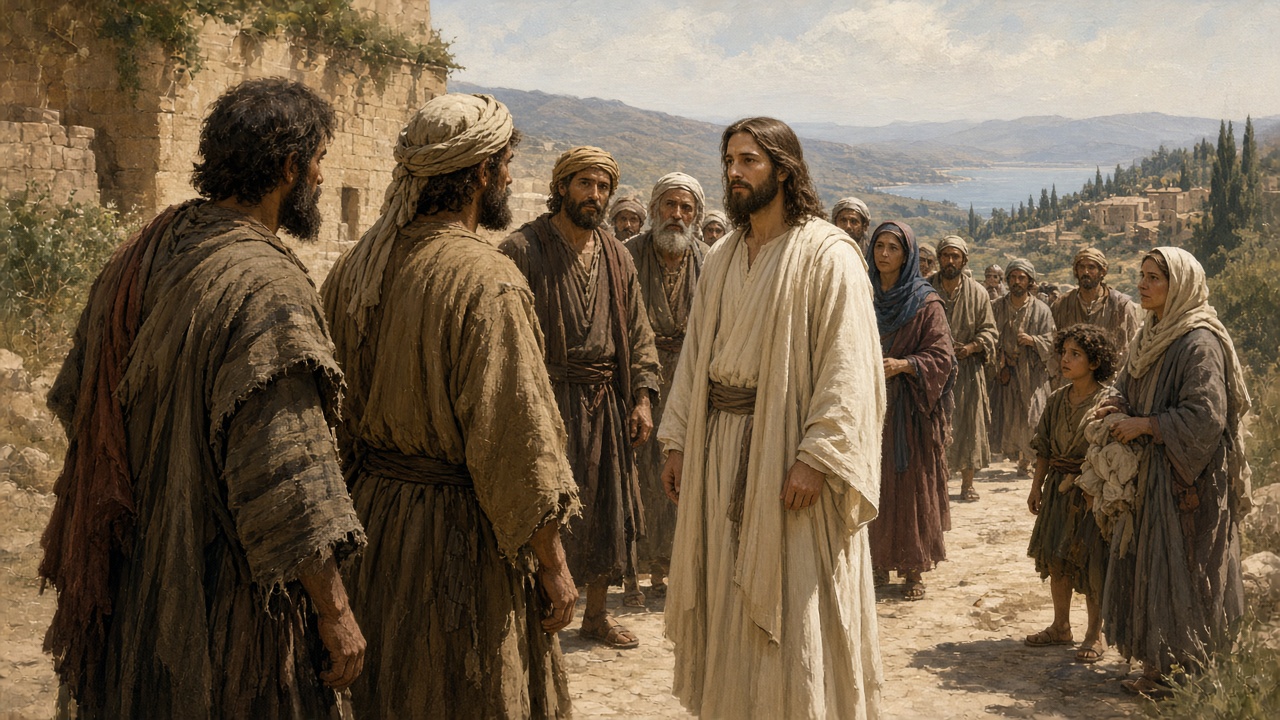
- From prison, John sent his disciples to ask whether Jesus was the one who was to come. Jesus told the crowds that John was more than a prophet—the messenger sent ahead to prepare the way—and, if they were willing to accept it, the Elijah who was to come. A Bible dictionary calls John the forerunner and says his mission was already the subject of prophecy, citing Isaiah 40:3 and Malachi 3:1; it also introduces Elijah as the Elias of the New Testament.Sources: the Bible text itself · John the Baptist · Elijah
- Jesus then denounced Chorazin, Bethsaida, and Capernaum, where most of his miracles had been performed, because they did not repent. A dictionary identifies Chorazin with modern Kerazeh, about two and a half miles up the Wady Kerazeh from Capernaum, and says that Capernaum, absent from the Old Testament, became Jesus' own city after he left Nazareth. It places Bethsaida on the east side of the lake, two miles up the Jordan in Gaulonitis, enlarged by Philip the tetrarch and named Julias after the emperor's daughter, though some have supposed there was only one Bethsaida, near where the Jordan enters the lake.Sources: the Bible text itself · Chorazin · Capernaum · Bethsaida
- He set those cities against Tyre and Sidon, which he said would have repented long ago in sackcloth and ashes, and against Sodom, which he said would have remained to this day. Sidon, on the Mediterranean coast about twenty-five miles north of Tyre, was the oldest Phoenician city there and the mother city of Tyre. A dictionary says the commerce of the whole world was gathered into Tyre's warehouses, and that Sodom, in the vale of Siddim, was destroyed by fire from heaven so completely that no trace of it has been found.Sources: the Bible text itself · Sidon · Tyre · Sodom
Notes written with AI assistance from open sources (Theographic Bible Metadata, CC BY-SA 4.0; Easton’s Bible Dictionary, public domain) and reviewed before publishing.
Places in this chapter
- Galilee · 32.760, 35.527 · verse 1
- Sidon · Today: Sandikli archaeological site in Sidon · 33.561, 35.372 · verses 21, 22
- Tyre · 33.271, 35.196 · verses 21, 22
Only places identified with high confidence are shown (90% or more according to the scholarly sources compiled by OpenBible). Period map: DARE (Digital Atlas of the Roman Empire), CC BY 4.0; modern map: © OpenStreetMap contributors; places: OpenBible.info (CC BY 4.0).
Credits and license for this translation
Tyndale New Testament
The Tyndale New Testament (1534)
Public Domain
Language: English
Dialect: archaic British
Translation by: William Tyndale
2020-12-20
Section headings adapted from the Berean Standard Bible (public domain); they are not part of this translation’s text.
Source: http://ebible.org/engtnt/ · eBible.org