Luke 23
Tyndale New Testament · Tap a verse to see its cross-references.
Jesus before Pilate
1And the whole multitude of them arose and ledde him vnto Pylate. 2And they beganne to accuse him sayinge: We have founde this felowe pervertynge the people and forbiddynge to paye tribute to Cesar: sayinge that he is Christ a kynge. 3And Pylate apposed him sayinge: arte thou the kynge of the iewes? He answered him and sayde: thou sayest it. 4Then sayde Pylate to the hye prestes and to the people: I fynde noo faute in this man. 5And they were the moore fearce sayinge. He moveth the people teachynge thorowout all Iewry and beganne at Galile even to this place.
Jesus before Herod
6When Pilate hearde mencion of Galile he axed whether the man were of Galile. 7And assone as he knewe that he was of Herodes iurisdiccion he sent him to Herode which was also at Ierusalem in those dayes. 8And when Herode sawe Iesus he was excedinglie gladde. For he was desyrous to se him of a longe season because he had hearde many thinges of him and trusted to have sene some myracle done by him. 9Then questeoned he with him of many thinges. But he answered him not one worde. 10The hye prestes and scribes stode forthe and accused him straytly. 11And Herod with his men of warre despysed him and mocked him and arayed him in whyte and sent him agayne to Pylate. 12And the same daye Pylate and Herod were made frendes togeder. For before they were at variaunce.
The Crowd Chooses Barabbas
13And Pylate called to geder the hye prestes and the rulers and the people 14and sayde vnto them: Ye have brought this man vnto me as one that perverted the people. And beholde I have examined him before you and have founde no faute in this man of those thinges where of ye accuse him. 15No nor yet Herode. For I sent you to him: and lo no thinge worthy of deeth is done to him. 16I will therfore chasten him and let him lowsse. 17For of necessite he must have let one lowse vnto them at that feast. 18And all the people cryed at once sayinge: awaye with him and delyvre to vs Barrabas: 19which for insurreccion made in the cite and morther was cast into preson. 20Pylate spake agayne to them willynge to let Iesus lowse. 21And they cryed sayinge: Crucify him Crucify him 22He sayde vnto them the thyrde tyme. What evyll hath he done? I fynde no cause of deeth in him. I will therfore chasten him and let him lowse. 23And they cryed with loude voyce and required that he myght be crucifyed. And the voyce of them and of the hye Prestes prevayled. 24And Pylate gave sentence that it shuld be as they required 25and let lowse vnto them him that for insurreccion and morther was cast into preson whom they desyred: and delyvered Iesus to do with him what they wolde.
The Crucifixion
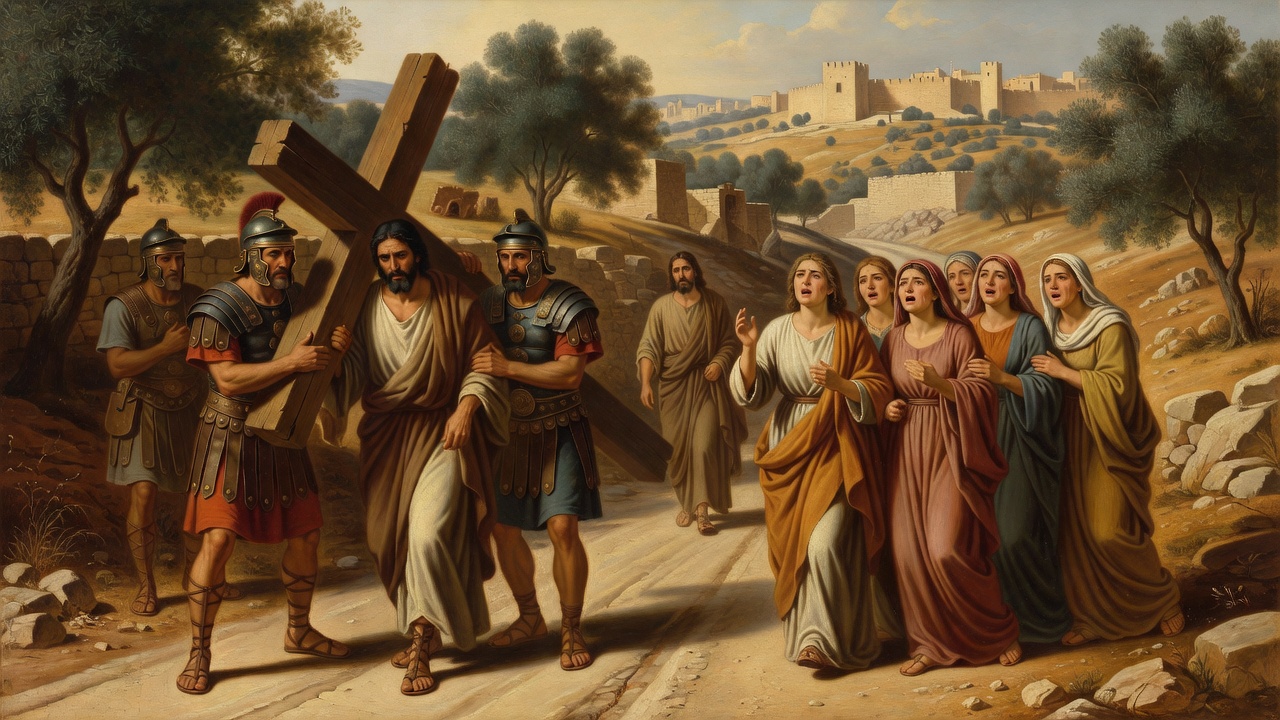
26And as they ledde him awaye they caught one Symon of Syrene commynge out of the felde: and on him layde they the crosse to beare it after Iesus. 27And ther folowed him a greate company of people and of wemen which weme bewayled and lamented him. 28But Iesus turned backe vnto them and sayde: Doughters of Ierusalem, wepe not for me: but wepe for youre selves and for youre chyldren. 29For beholde, the dayes will come, when men shall saye: happy are the baren and the wombes that never bare and the pappes which never gave sucke. 30Then shall they beginne to saye to the mountaynes fall on vs: and to the hilles cover vs. 31For yf they do this to a grene tree what shalbe done to the drye? 32And ther were two evyll doers ledde with him to be slayne. 33And when they were come to the place which is called Calvary there they crucified him and the evyll doers one on ryght honde and the other on the lefte. 34Then sayde Iesus: father forgeve them for they woot not what they do. And they parted his rayment and cast loottes. 35And the people stode and behelde. And the rulers mocked him with thee saying: he holpe other men let him helpe him selfe yf he be Christ the chosen of god. 36The soudiers also mocked him and came and gave him veneger 37and sayde: yf thou be that kynge of the Iewes save thy silfe. 38And his superscripcion was written over him in greke in latine and Ebreu: This is the kynge of the Iewes. 39And one of the evyll doers which hanged rayled on him sayinge: If thou be Christ save thy selfe and vs. 40The other answered and rebuked him sayinge. Net herfearest thou god because thou arte in the same damnacion? 41We are ryghteously punesshed for we receave accordynge to oure dedes: But this man hath done nothinge amysse. 42And he sayde vnto Iesus: Lorde remember me when thou comest into thy kyngdome. 43And Iesus sayde vnto him: Verely I saye vnto the to daye shalt thou be with me in Paradyse.
The Death of Jesus
44And it was about the sixt houre. And ther came a darcknes over all the londe vntyll the nynth houre 45and the sonne was darckened. And the vayle of the temple dyd rent even thorow the myddes. 46And Iesus cryed with a greate voyce and sayd: Father into thy hondes I comende my sprete. And when he thus had sayd he gave vp the goost. 47When the Centurion sawe what had happened he glorified God sayinge: Of a surtie this man was perfecte. 48And all the people that came to geder to that sight beholdynge the thinges which were done: smoote their bestes and returned home. 49And all his acquayntaunce and the wemen that folowed him from Galile stode a farre of beholdynge these thinges.
The Burial of Jesus
50And beholde ther was a man named Ioseph a councelloure and was a good man and a iuste 51and dyd not consent to the counsell and dede of them which was of Aramathia a cite of the Iewes: which same also wayted for the kyngdome of God: 52he went vnto Pilate and begged the boddy of Iesus 53and toke it doune and wrapped it in a lynnen clooth and layed it in an hewen toumbe wherin was never man before layed. 54And that daye was the Saboth even and the Saboth drue on. 55The wemen that folowed after which came with him from Galile behelde the sepulcre and how his body was layed. 56And they returned and prepared odoures and oyntmetes: but rested the Saboth daye accordynge to the commaundement.
Did you know?
Trial, Cross, and Burial
- Pontius Pilate, identified by Easton's Bible Dictionary (1897) as the sixth Roman procurator of Judea (A.D. 26–36), kept his headquarters at Caesarea but often went up to Jerusalem. The council’s accusations in this chapter are political: that Jesus was subverting the nation, forbidding the payment of taxes to Caesar, and proclaiming himself Christ, a king.Sources: Pontius Pilate · the Bible text itself
- When Pilate learned that Jesus was a Galilean and under Herod’s jurisdiction, he sent him to Herod Antipas, a son of Herod by Malthace, who was then in Jerusalem. Herod had long wanted to see Jesus and hoped for a miracle, but Jesus did not answer his questions. After Herod and his soldiers mocked Jesus and dressed him in a fine robe, they sent him back, and that day Herod and Pilate, who had been enemies, became friends.Sources: Herod Antipas · the Bible text itself
- The place of crucifixion is called The Skull; a Latin form, Calvaria, translated the Greek Kranion, which rendered the Hebrew Gulgoleth. It probably took this name from its shape, a low, rounded, bare rise somewhat like a human skull, and Scripture nowhere calls it a hill. The crucifixion took place outside the city walls and near a public road.Sources: Skull · the Bible text itself
Notes written with AI assistance from open sources (Theographic Bible Metadata, CC BY-SA 4.0; Easton’s Bible Dictionary, public domain) and reviewed before publishing.
Places in this chapter
- Galilee · 32.760, 35.527 · verses 5, 6, 7, 49, 55
- Jerusalem · 31.777, 35.234 · verses 5, 7, 19, 28
- Judea · Today: Judea 1 · 31.777, 35.234 · verses 5, 51
- Cyrene · 32.821, 21.851 · verse 26
Only places identified with high confidence are shown (90% or more according to the scholarly sources compiled by OpenBible). Period map: DARE (Digital Atlas of the Roman Empire), CC BY 4.0; modern map: © OpenStreetMap contributors; places: OpenBible.info (CC BY 4.0).
Credits and license for this translation
Tyndale New Testament
The Tyndale New Testament (1534)
Public Domain
Language: English
Dialect: archaic British
Translation by: William Tyndale
2020-12-20
Section headings adapted from the Berean Standard Bible (public domain); they are not part of this translation’s text.
Source: http://ebible.org/engtnt/ · eBible.org