John 10
Tyndale New Testament · Tap a verse to see its cross-references.
Jesus the Good Shepherd
1Verely verely I saye vnto you: he that entreth not in by the dore into the shepefolde but clymeth vp some other waye: the same is a thefe and a robber. 2He that goeth in by the dore is the shepeherde of the shepe: 3to him the porter openeth and the shepe heare his voyce and he calleth his awne shepe by name and leadeth them out. 4And when he hath sent forthe his awne shepe he goeth before them and the shepe folowe him: for they knowe his voyce. 5A straunger they will not folowe but will flye from him: for they knowe not the voyce of straungers. 6This similitude spake Iesus vnto them. But they vnderstode not what thinges they were which he spake vnto them. 7Then sayde Iesus vnto them agayne. Verely verely I saye vnto you: I am the dore of the shepe. 8All even as many as came before me are theves and robbers: but the shepe dyd not heare them. 9I am the dore: by me yf eny man enter in he shalbe safe and shall goo in and out and fynde pasture. 10The thefe cometh not but forto steale kyll and destroye. I am come that they myght have lyfe and have it more aboundantly. 11I am the good shepeheerd. The good shepeheerd geveth his lyfe for the shepe. 12An heyred servaut which is not the shepeherd nether the shepe are his awne seith the wolfe comynge and leveth the shepe and flyeth and the wolfe catcheth them and scattereth the shepe. 13The heyred servaut flyeth because he is an heyred servaunt and careth not for the shepe. 14I am that good shepeheerd and knowe myne and am knowe of myne. 15As my father knoweth me: even so knowe I my father. And I geve my lyfe for the shepe: 16and other shepe I have which are not of this folde. Them also must I bringe that they maye heare my voyce and that ther maye be one flocke and one shepeherde. 17Therfore doth my father love me because I put my lyfe from me that I myght take it agayne. 18No man taketh it from me: but I put it awaye of my selfe. I have power to put it from me and have power to take it agayne: This commaundment have I receaved of my father. 19And ther was a dissencion agayne amonge the Iewes for these sayinges 20and many of them sayd. He hath the devyll and is mad: why heare ye him? 21Other sayde these are not the wordes of him that hath the devyll. Can the devyll open the eyes of the blynde?
Jesus at the Feast of Dedication
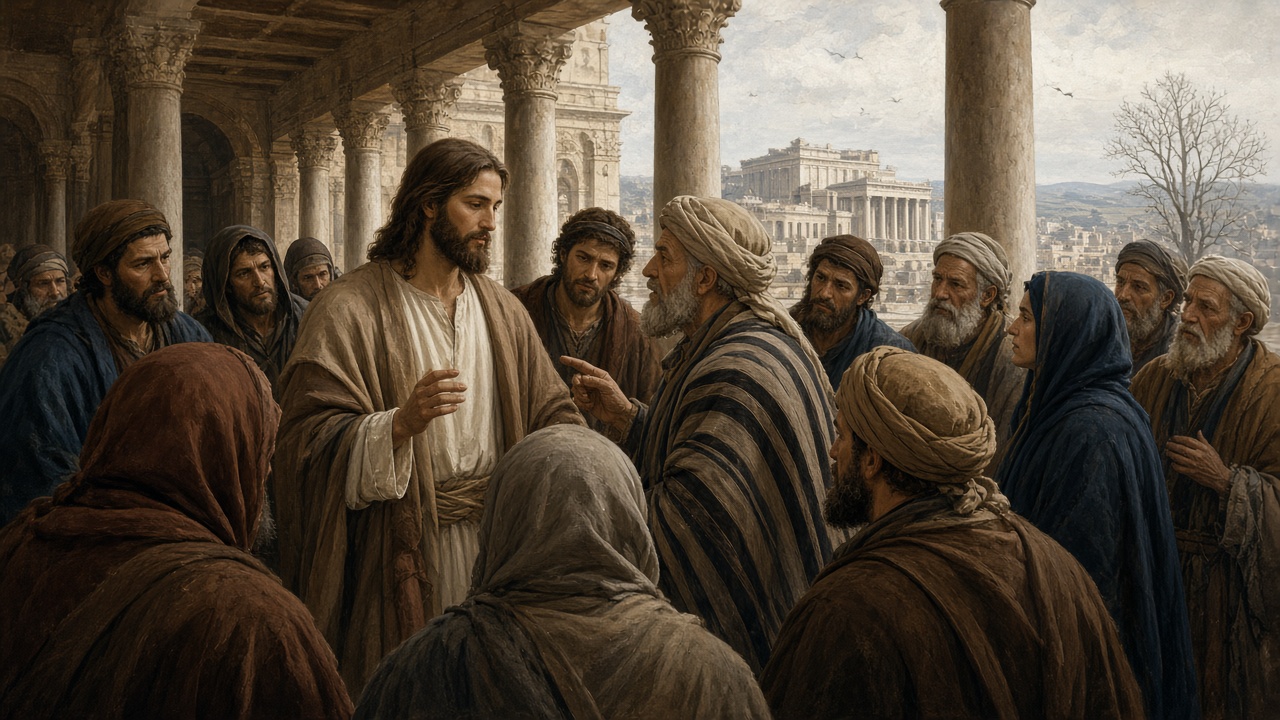
22And it was at Ierusalem the feaste of the dedicacion and it was wynter: 23and Iesus walked in Salomons porche. 24Then came the Iewes rounde aboute him and sayde vnto him: How longe dost thou make vs doute? Yf thou be Christ tell vs playnly. 25Iesus answered them: I tolde you and ye beleve not. The workes that I do in my fathers name they beare witnes of me. 26But ye beleve not because ye are not of my shepe. As I sayde vnto you: 27my shepe heare my voyce and I knowe them and they folowe me and 28I geve vnto the eternall lyfe and they shall never perisshe nether shall eny man plucke the oute of my honde. 29My father which gave the me is greatter then all and no man is able to take them out of my fathers honde. 30And I and my father are one. 31Then the Iewes agayne toke up stones to stone him with all. 32Iesus answered them: many good workes have I shewed you from my father: for which of them will ye stone me? 33The Iewes answered him sayinge. For thy good workes sake we stone ye not: but for thy blasphemy and because that thou beinge a man makest thy selfe God. 34Iesus answered them: Is it not written in youre lawe: I saye ye are goddes? 35If he called the goddes vnto whom the worde of God was spoken (and the scripture can not be broken) 36saye ye then to him whom the father hath sainctified and sent into the worlde thou blasphemest because I sayd I am the sonne of God? 37If I do not the workes of my father beleve me not. 38But if I do though ye beleve not me yet beleve the workes that ye maye knowe and beleve that the father is in me and I in him. 39Agayne they went aboute to take him: but he escaped out of their hondes
John’s Testimony Confirmed
40and went awaye agayne beyonde Iordan into the place where Iohn before had baptised and there aboode. 41And many resorted vnto him and sayd. Iohn dyd no miracle: but all thinges that Iohn spake of this man are true. 42And many beleved on him theare.
Did you know?
The Good Shepherd
- During the Feast of Dedication in Jerusalem it was winter, and Jesus was walking in the temple courts in Solomon's Colonnade. The name Jerusalem, in a dual form, means "possession of peace" or "foundation of peace"; that form probably refers to the mountains of Zion and Moriah, or, as some suppose, to the upper and lower city. Solomon's Hebrew name, Shelomoh, means "peaceful."Sources: the Bible text itself · Jerusalem · Solomon
- A chronology of Gospel events dates the Good Shepherd teaching to AD 29, and dates a time of teaching and healing from Perea to Jerusalem to AD 30.Sources: The Good Shepherd Teaching · Teaching and Healing in Perea to Jerusalem
- Jesus then went back across the Jordan to the place where John had first been baptizing, and many people there believed in him. John was of priestly descent: his father, Zacharias, was a priest of the course of Abia, and his mother, Elisabeth, was of the daughters of Aaron. His birth, six months before that of Jesus, was foretold by an angel; those who came said that John never performed a sign, yet everything he had said about Jesus was true.Sources: the Bible text itself · John the Baptist
Notes written with AI assistance from open sources (Theographic Bible Metadata, CC BY-SA 4.0; Easton’s Bible Dictionary, public domain) and reviewed before publishing.
Places in this chapter
- Jerusalem · 31.777, 35.234 · verse 22
- Solomon’s Portico · Today: in Jerusalem · 31.777, 35.234 · verse 23
- Jordan · Today: Jordan River · 31.761, 35.558 · verse 40
Only places identified with high confidence are shown (90% or more according to the scholarly sources compiled by OpenBible). Period map: DARE (Digital Atlas of the Roman Empire), CC BY 4.0; modern map: © OpenStreetMap contributors; places: OpenBible.info (CC BY 4.0).
Credits and license for this translation
Tyndale New Testament
The Tyndale New Testament (1534)
Public Domain
Language: English
Dialect: archaic British
Translation by: William Tyndale
2020-12-20
Section headings adapted from the Berean Standard Bible (public domain); they are not part of this translation’s text.
Source: http://ebible.org/engtnt/ · eBible.org