John 4
Text-Critical English New Testament · Tap a verse to see its cross-references.
Jesus Speaks with a Samaritan Woman
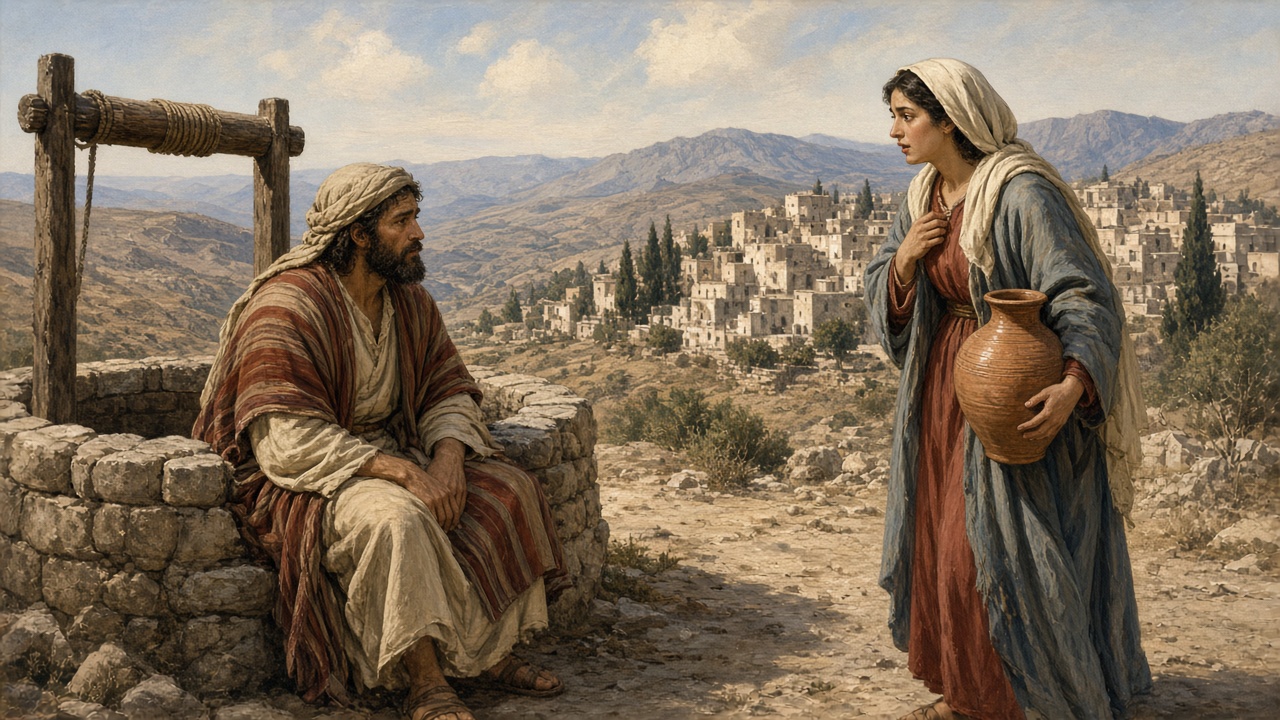
1Now when the Lord learned that the Pharisees heard he was making and baptizing more disciples than John 2(although it was not Jesus himself who baptized them, but his disciples), 3he left Judea and went away to Galilee. 4But he had to pass through Samaria. 5So he came to a town of Samaria called Sychar, near the plot of land that Jacob had given to his son Joseph. 6Jacob's well was there, so Jesus, wearied as he was from the journey, sat by the well. It was about the sixth hour.
7When a woman from Samaria came to draw water, Jesus said to her, “Give me some water to drink.” 8(For his disciples had gone into the city to buy food.) 9So the Samaritan woman said to him, “How is it that yoʋ, a Jew, ask for water to drink from me, a Samaritan woman?” (For Jews have no dealings with Samaritans.) 10Jesus answered her, “If yoʋ knew the gift of God and who it is that is saying to yoʋ, ‘Give me some water to drink,’ yoʋ would have asked him, and he would have given yoʋ living water.” 11The woman said to him, “Sir, yoʋ do not even have a bucket to draw with, and the well is deep. Where then can yoʋ get this living water? 12Are yoʋ greater than our father Jacob, who gave us this well and drank from it himself, as did his sons and livestock?” 13Jesus answered her, “Everyone who drinks this water will thirst again, 14but whoever drinks the water I give him will certainly never thirst again. On the contrary, the water I give him will become in him a spring of water welling up to eternal life.” 15The woman said to him, “Sir, give me this water so that I will not get thirsty again and have to come here to draw water.” “Everyone who drinks this water will thirst again, but whoever drinks the water I give him will certainly never thirst again.|src="04 John 04_13-14 (Heinrich Hofmann).png" size="span" copy="Public Domain (Heinrich Hofmann)" ref="4:13–14"
16Jesus said to her, “Go call yoʋr husband and come back here.” 17The woman said in response, “I have no husband.” Jesus said to her, “Yoʋ have rightly said, ‘I have no husband,’ 18for yoʋ have had five husbands, and the man yoʋ now have is not yoʋr husband; what yoʋ have said is true.” 19The woman said to him, “Sir, I see that yoʋ are a prophet. 20Our fathers worshiped on this mountain, but you say that the place where people must worship is in Jerusalem.” 21Jesus said to her, “Woman, believe me, an hour is coming when neither on this mountain nor in Jerusalem will you worship the Father. 22You worship what you do not know; we worship what we know, because salvation is from the Jews. 23But an hour is coming, and is now here, when the true worshipers will worship the Father in spirit and truth, for the Father seeks such people to worship him. 24God is spirit, and those who worship him must worship in spirit and truth.” 25The woman said to him, “I know that Messiah is coming” (who is called Christ). “When he comes, he will explain everything to us.” 26Jesus said to her, “I who speak to yoʋ am he.”
27Just then his disciples came back, and they were amazed that he was speaking with a woman. However, no one said, “What do yoʋ want?” or, “Why are yoʋ speaking with her?” 28Then the woman left her water jar, went into the town, and said to the people, 29“Come see a man who told me everything I have ever done. Could this be the Christ?” 30So they left the town and began coming to him.
31In the meantime the disciples were urging him, “Rabbi, eat.” 32But he said to them, “I have food to eat that you do not know about.” 33So the disciples said to one another, “Could someone have brought him something to eat?” 34Jesus said to them, “My food is to do the will of him who sent me and to complete his work. 35Do you not say, ‘There are still four months and then comes the harvest’? I tell you, lift up your eyes and see that the fields are already ripe for harvest. 36He who reaps receives wages and gathers fruit for eternal life, so that both he who sows and he who reaps may rejoice together. 37For in this the true saying is verified: ‘One sows and another reaps.’ 38I sent you to reap what you have not labored for; others have labored, and you have entered into their labor.”
39Many of the Samaritans from that town believed in Jesus because of the woman's testimony: “He told me everything I have ever done.” 40So when the Samaritans came to him, they asked him to stay with them, and he stayed there for two days. 41And many more believed because of his word. 42So they said to the woman, “It is no longer because of yoʋr report that we believe, for we ourselves have heard, and we know that this is truly the Christ, the Savior of the world.”
Jesus Heals an Official's Son
43After two days, he departed from there and went to Galilee. 44(For Jesus himself had testified that a prophet has no honor in his own hometown.) 45When he came to Galilee, the Galileans received him because they had seen all that he had done in Jerusalem at the feast, for they also had gone to the feast.
46Once more Jesus went to Cana of Galilee, where he had turned the water into wine. Now there was a certain royal official whose son was sick in Capernaum. 47When he heard that Jesus had come from Judea to Galilee, he went to him and asked him to come down and heal his son, for his son was about to die. 48Then Jesus said to him, “Unless you see signs and wonders, you will certainly not believe.” 49The royal official said to him, “Sir, come down before my boy dies.” 50Jesus said to him, “Go; yoʋr son will live.” And the man believed what Jesus said to him and went on his way. 51As he was going back down to his house, his servants met him and told him, “Yoʋr son is alive.” 52So he asked them the hour when he began to get better. They said to him, “Yesterday at the seventh hour the fever left him.” 53Then the father realized that this was the hour when Jesus had said to him, “Yoʋr son will live.” So he believed, along with his entire household. 54This was the second sign that Jesus did after coming from Judea to Galilee.
Did you know?
Living Water in Samaria
- Jesus left Judea to return to Galilee, and the Gospel says he had to pass through Samaria. Under the Romans in Jesus' time, Judea was the southernmost of Palestine's three divisions, distinguished from Samaria and Galilee, and the narrative notes that Jews did not associate with Samaritans.Sources: the Bible text itself · Judea
- He came to Sychar, near the plot of ground that Jacob had given his son Joseph, and, weary from the journey, sat down by Jacob's well. Easton's Bible Dictionary (1897) records that from the time of the Crusaders Sychar was usually identified with Shechem, but that explorations had identified it with 'Askar, a small Samaritan town on the southern base of Ebal, about a mile north of the well.Sources: the Bible text itself · Sychar
- The woman contrasted worship on this mountain with the Jewish claim that one must worship in Jerusalem, and she spoke of a coming Messiah, called Christ. When the disciples returned from buying food in the town, they were surprised that Jesus was speaking with a woman.Sources: the Bible text itself
Notes written with AI assistance from open sources (Theographic Bible Metadata, CC BY-SA 4.0; Easton’s Bible Dictionary, public domain) and reviewed before publishing.
Places in this chapter
- Galilee · 32.760, 35.527 · verses 3, 43, 45, 46, 47, 54
- Judea · Today: Judea 1 · 31.777, 35.234 · verses 3, 47, 54
- Samaria · Today: Samaria 2 · 32.276, 35.195 · verses 4, 5, 7, 9
- Jerusalem · 31.777, 35.234 · verses 20, 21, 45
- Mount Gerizim · 32.199, 35.273 · verse 20
Only places identified with high confidence are shown (90% or more according to the scholarly sources compiled by OpenBible). Period map: DARE (Digital Atlas of the Roman Empire), CC BY 4.0; modern map: © OpenStreetMap contributors; places: OpenBible.info (CC BY 4.0).
Credits and license for this translation
Text-Critical English New Testament
The New Testament based on the Byzantine Text with extensive text-critical footnotes
Copyright © 2022 Robert Adam Boyd
Language: English
"The Text-Critical English New Testament" and "Byzantine Text Version" are trademarks of Robert Adam Boyd. If you adapt, remix, transform, or in any other way change the translation or footnotes, you may not call it "The Text-Critical English New Testament" or "Byzantine Text Version".
This translation is made available to you under the terms of the
Creative Commons Attribution license 4.0.
You may share and redistribute this Bible translation or extracts from it in any format, provided that:
You include the above copyright and source information.
If you make any changes to the text, you must indicate that you did so in a way that makes it clear that the original licensor is not necessarily endorsing your changes.
Pictures included with Scriptures and other documents on this site are licensed just for use with those Scriptures and documents.
For other uses, please contact the respective copyright owners.
Note that in addition to the rules above, revising and adapting God's Word involves a great responsibility to be true to God's Word. See Revelation 22:18-19.
2026-10-02
Source: http://ebible.org/engtcent/ · eBible.org