James 2
Text-Critical English New Testament · Tap a verse to see its cross-references.
Warning Against Partiality
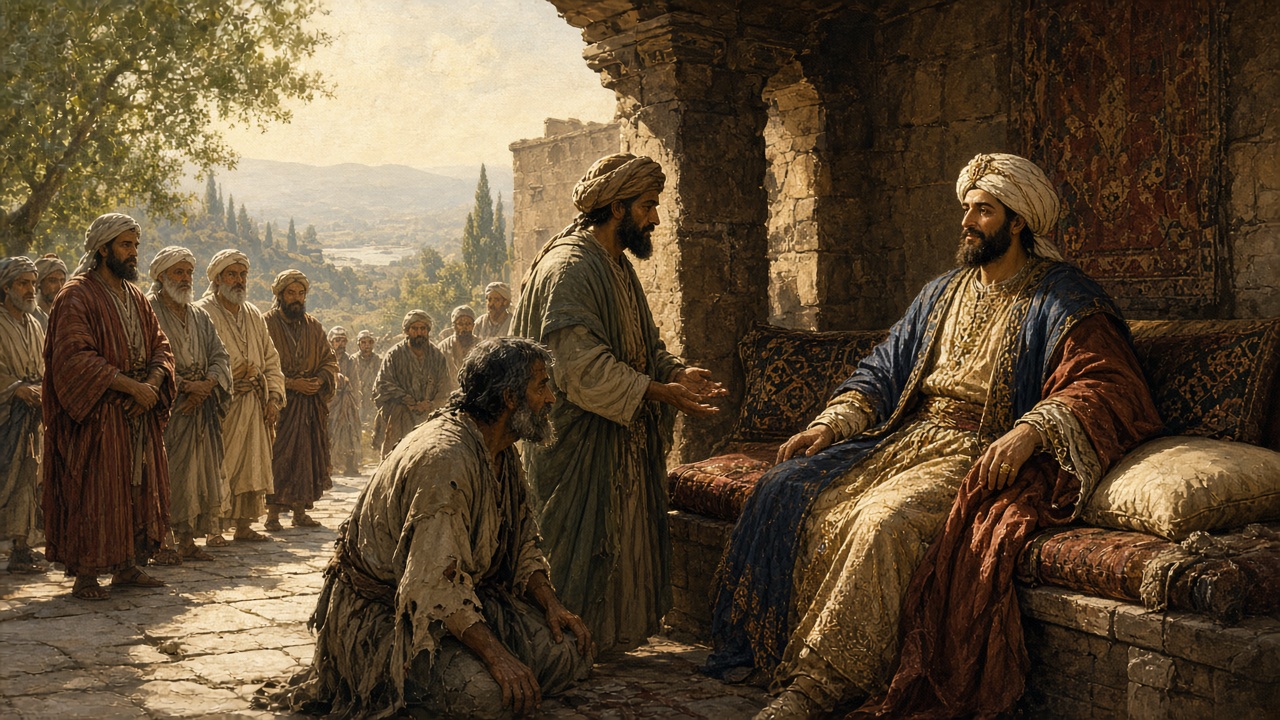
1My brothers, practice your faith in our Lord Jesus Christ, the Lord of glory, without showing partiality. 2Suppose a man in fine clothing comes into your assembly wearing a gold ring, and a poor man in filthy clothing also comes in. 3If you pay attention to the man who is wearing fine clothing and say to him, “Yoʋ sit here in a good place,” but you say to the poor man, “Yoʋ stand there, or sit here under my footstool,” 4have you not made distinctions among yourselves and become judges with evil thoughts?
5Listen, my beloved brothers, has not God chosen the poor of the world to be rich in faith and heirs of the kingdom that he has promised to those who love him? 6But you have dishonored the poor man. Is it not the rich who oppress you? Are they not the ones who drag you into court? 7Do they not blaspheme the good name by which you are called? 8If you really fulfill the royal law according to the Scripture, “Yoʋ shall love yoʋr neighbor as yoʋrself,” you do well. 9But if you show partiality, you commit sin and are convicted by the law as transgressors. 10For whoever keeps the entire law but stumbles in one point has become guilty of it all. 11For he who said, “Do not commit adultery,” also said, “Do not murder.” Now if yoʋ do not commit adultery but do commit murder, yoʋ have become a transgressor of the law. 12Speak and act as people who will be judged by the law of liberty. 13For judgment is without mercy to anyone who has not shown mercy; mercy is exalted over judgment.
Faith and Works
14What is the benefit, my brothers, if someone claims to have faith but does not have works? Can that faith save him? 15If a brother or sister is poorly clothed and lacks daily food, 16and one of you says to them, “Go in peace, be warmed and filled,” without giving them anything to address their physical needs, what is the benefit? 17In the same way faith by itself, if it does not have works, is dead.
18But someone will say, “Yoʋ have faith, and I have works.” Show me yoʋr faith by yoʋr works, and I, by my works, will show yoʋ my faith. 19Do yoʋ believe that God is one? Yoʋ do well; even the demons believe—and shudder! 20Do yoʋ want to be shown, O foolish man, that faith without works is dead? 21Was not our father Abraham justified by works when he offered his son Isaac on the altar? 22Do yoʋ see how faith was active along with his works, and by works his faith was brought to completion? 23And the Scripture was fulfilled that says, “Abraham believed God, and it was counted to him as righteousness,” and he was called a friend of God. 24You see then that a person is justified by works, and not by faith alone. 25In the same way, was not Rahab the prostitute also justified by works when she received the messengers and sent them out by another way? 26For just as the body without the spirit is dead, so faith without works is also dead. Was not our father Abraham justified by works when he offered his son Isaac on the altar?|src="20 James 02_21.png" size="span" copy="Public Domain (Gustave Doré)" ref="2:21"
Did you know?
Impartiality and Living Faith
- James recalls that Abraham was justified by offering his son Isaac on the altar, his faith working with his actions and perfected by what he did. Isaac, the only son of Abraham by Sarah, was the one God commanded Abraham to offer as a sacrifice on a mountain in the land of Moriah.Sources: the Bible text itself · Isaac
- James also cites Rahab the prostitute, justified by welcoming the spies and sending them off on another route. The two spies, sent by Joshua while the Hebrews were encamped at Shittim opposite Jericho, had gone to her house, faced danger in the city, and were saved by her fidelity.Sources: the Bible text itself · Rahab
Notes written with AI assistance from open sources (Theographic Bible Metadata, CC BY-SA 4.0; Easton’s Bible Dictionary, public domain) and reviewed before publishing.
Credits and license for this translation
Text-Critical English New Testament
The New Testament based on the Byzantine Text with extensive text-critical footnotes
Copyright © 2022 Robert Adam Boyd
Language: English
"The Text-Critical English New Testament" and "Byzantine Text Version" are trademarks of Robert Adam Boyd. If you adapt, remix, transform, or in any other way change the translation or footnotes, you may not call it "The Text-Critical English New Testament" or "Byzantine Text Version".
This translation is made available to you under the terms of the
Creative Commons Attribution license 4.0.
You may share and redistribute this Bible translation or extracts from it in any format, provided that:
You include the above copyright and source information.
If you make any changes to the text, you must indicate that you did so in a way that makes it clear that the original licensor is not necessarily endorsing your changes.
Pictures included with Scriptures and other documents on this site are licensed just for use with those Scriptures and documents.
For other uses, please contact the respective copyright owners.
Note that in addition to the rules above, revising and adapting God's Word involves a great responsibility to be true to God's Word. See Revelation 22:18-19.
2026-10-02
Source: http://ebible.org/engtcent/ · eBible.org