Exodus 3
One Unity Resource Bible · Tap a verse to see its cross-references.
(4)
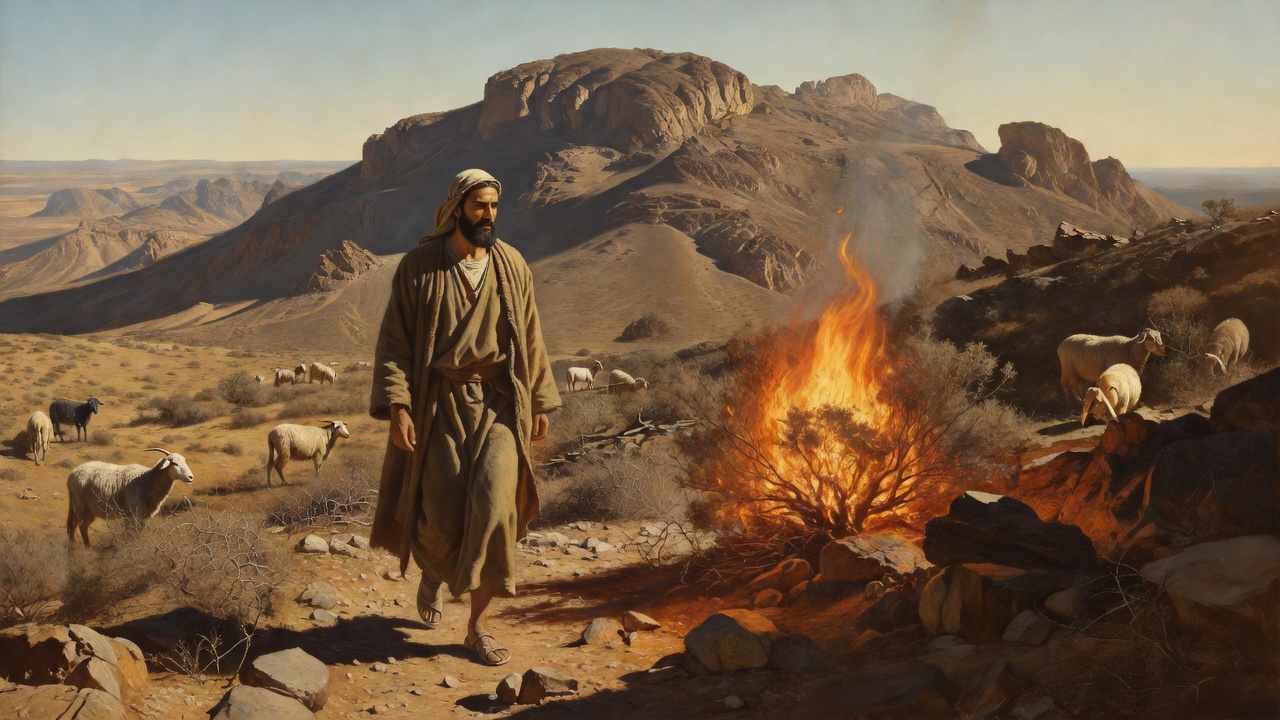
Moses at the Burning Bush
1Now Moses [Drawn out] was keeping the flock of Jethro [Abundance], his father-in-law, the priest of Midian [Strife], and he led the flock to the back of the wilderness, and came to God’s mountain, to Horeb [Desert]. 2Ha mal'ak Yahweh [The Angel of He sustains breathing] appeared to him in a flame of fire out of the middle of a bush. He looked, and behold, the bush burned with fire, and the bush was not consumed. 3Moses [Drawn out] said, “I will turn aside now and see this great sight; why the bush is not being burned up?”
4When Adonai saw that he turned aside to see, God called to him out of the middle of the bush, and said, “Moses [Drawn out]! Moses [Drawn out]!”
He said, “Here I am.”
5He said, “Don’t come close. Take your sandals off of your feet, for the place you are standing on is holy ground.” 6Moreover he said, “I am the God of your father, the God of Abraham [Father of a multitude], the God of Isaac [Laughter], and the God of Jacob [Supplanter].”
Moses [Drawn out] hid his face; for he was afraid to look at God.
7Adonai said, “I have surely seen the affliction of my people who are in Egypt [Abode of slavery], and have sh'ma ·heard obeyed· their cry because of their taskmasters, for I know their sorrows. 8I have come down to deliver them out of the hand of the Egyptians [people from Abode of slavery], and to bring them up out of that land to a good and large land, to a land flowing with milk and honey; to the place of the Canaanite [Descendant of Humbled], the Hittite [Descendant of Trembling fear], the Amorite [Descendants of Talkers], the Perizzite [Descendant of Belonging to village], the Hivite [Wicked], and the Jebusite [Descendants of Thresher]. 9Now, behold, the cry of the children of Israel [God prevails] has come to me. Moreover I have seen the oppression with which the Egyptians [people from Abode of slavery] oppress them. 10Come now therefore, and I will send you to Pharaoh, that you may bring my people, the children of Israel [God prevails], out of Egypt [Abode of slavery].”
11Moses [Drawn out] said to God, “Who am I, that I should go to Pharaoh, and that I should bring the children of Israel [God prevails] out of Egypt [Abode of slavery]?”
12He said, “Certainly I will be with you. This will be the token to you, that I have sent you: when you have brought the people out of Egypt [Abode of slavery], you shall abad ·serve· God on this mountain.”
13Moses [Drawn out] said to God, “Behold, when I come to the children of Israel [God prevails], and tell them, ‘The God of your fathers has sent me to you;’ and they ask me, ‘What is his name?’ What should I tell them?”
14God said to Moses [Drawn out], “ I Am Who I Am ,” and he said, “You shall tell the children of Israel [God prevails] this: ‘I AM has sent me to you.’” 15God said moreover to Moses [Drawn out], “You shall tell the children of Israel [God prevails] this, ‘Yahweh, the God of your fathers, the God of Abraham [Father of a multitude], the God of Isaac [Laughter], and the God of Jacob [Supplanter], has sent me to you.’ This is my name forever, and this is my memorial to all generations. (5) 16Go, and gather the elders of Israel [God prevails] together, and tell them, ‘Yahweh, the God of your fathers, the God of Abraham [Father of a multitude], of Isaac [Laughter], and of Jacob [Supplanter], has appeared to me, saying, “I have surely visited you, and seen that which is done to you in Egypt [Abode of slavery]; 17and I have said, I will bring you up out of the affliction of Egypt [Abode of slavery] to the land of the Canaanite [Descendant of Humbled], the Hittite [Descendant of Trembling fear], the Amorite [Descendants of Talkers], the Perizzite [Descendant of Belonging to village], the Hivite [Wicked], and the Jebusite [Descendants of Thresher], to a land flowing with milk and honey.”’ 18They will sh'ma ·hear obey· your voice, and you shall come, you and the elders of Israel [God prevails], to the king of Egypt [Abode of slavery], and you shall tell him, ‘ Adonai, the God of the Hebrews [Immigrants], has met with us. Now please let us go three days’ journey into the wilderness, that we may sacrifice to Adonai, our God.’ 19I know that the king of Egypt [Abode of slavery] won’t give you permission to go, no, not by a mighty hand. 20I will reach out my hand and strike Egypt [Abode of slavery] with all my wonders which I will do among them, and after that he will let you go. 21I will give this people chen ·grace· in the sight of the Egyptians [people from Abode of slavery], and it will happen that when you go, you shall not go empty handed. 22But every woman shall ask of her neighbor, and of her who visits her house, jewels of silver, jewels of gold, and clothing; and you shall put them on your sons, and on your daughters. You shall plunder the Egyptians [people from Abode of slavery].”
Did you know?
The Call of Moses at the Burning Bush
- Moses is shepherding in Midian when this chapter begins. The Midianites were a nomadic Arabian tribe descended from Midian, Abraham's fourth son by Keturah, whose name is explained as strife. They lived chiefly in the desert north of Arabia, and the Sinai peninsula was grazing land for their flocks; it was there, after fleeing Egypt, that Moses became a servant and then the priest's son-in-law.Sources: the Bible text itself · Midian · Midian
- His father-in-law is Jethro, called the priest of Midian. Easton's Bible Dictionary (1897) equates that priest with Raguel and says that, if the two names belong to one man, Raguel may be regarded as his personal name and Jethro, meaning excellency, as an official title.Sources: the Bible text itself · Jethro
- Moses leads the flock to Horeb, the mountain of God. The name is explained as desert, or mountain, of the dried-up ground, a general term for the whole range of which Sinai was one summit; Easton's Bible Dictionary (1897) gives the modern name of the range as Jebel Musa and describes a huge block about two miles long and about one mile wide, with a very spacious plain called Er Rahah at its north-east end, where the Israelites later camped for nearly a year.Sources: the Bible text itself · Horeb
Notes written with AI assistance from open sources (Theographic Bible Metadata, CC BY-SA 4.0; Easton’s Bible Dictionary, public domain) and reviewed before publishing.
Places in this chapter
- Midian · 28.495, 35.012 · verse 1
- Mount Horeb · Today: Jebel Musa · 28.540, 33.973 · verse 1
- Egypt · 30.129, 31.308 · verses 7, 8, 10, 11, 12, 16, 17, 18, 19, 20, 22
Only places identified with high confidence are shown (90% or more according to the scholarly sources compiled by OpenBible). Period map: DARE (Digital Atlas of the Roman Empire), CC BY 4.0; modern map: © OpenStreetMap contributors; places: OpenBible.info (CC BY 4.0).
Credits and license for this translation
One Unity Resource Bible
The One Unity Resource Bible translation of the Holy Bible into American English with some transliterated Hebrew notations
Copyright © 2016,2019 Thomas Robinson
Language: English
Dialect: American
Translation by: Thomas Robinson
This translation is made available to you under the terms of the
Creative Commons Attribution Share-Alike license 4.0.
You have permission to share and redistribute this Bible translation in any format and to make reasonable revisions and adaptations of this translation, provided that:
You include the above copyright and source information.
If you make any changes to the text, you must indicate that you did so in a way that makes it clear that the original licensor is not necessarily endorsing your changes.
If you redistribute this text, you must distribute your contributions under the same license as the original.
Pictures included with Scriptures and other documents on this site are licensed just for use with those Scriptures and documents.
For other uses, please contact the respective copyright owners.
Note that in addition to the rules above, revising and adapting God's Word involves a great responsibility to be true to God's Word. See Revelation 22:18-19.
2024-12-05
Section headings adapted from the Berean Standard Bible (public domain); they are not part of this translation’s text.
Source: http://ebible.org/engourb/ · eBible.org