Exodus 21
One Unity Resource Bible · Tap a verse to see its cross-references.
Parashah 18: Mishpatim ·Judgments, Rulings· 21:1-24:18
1“Now these are the judgments which you shall set before them.
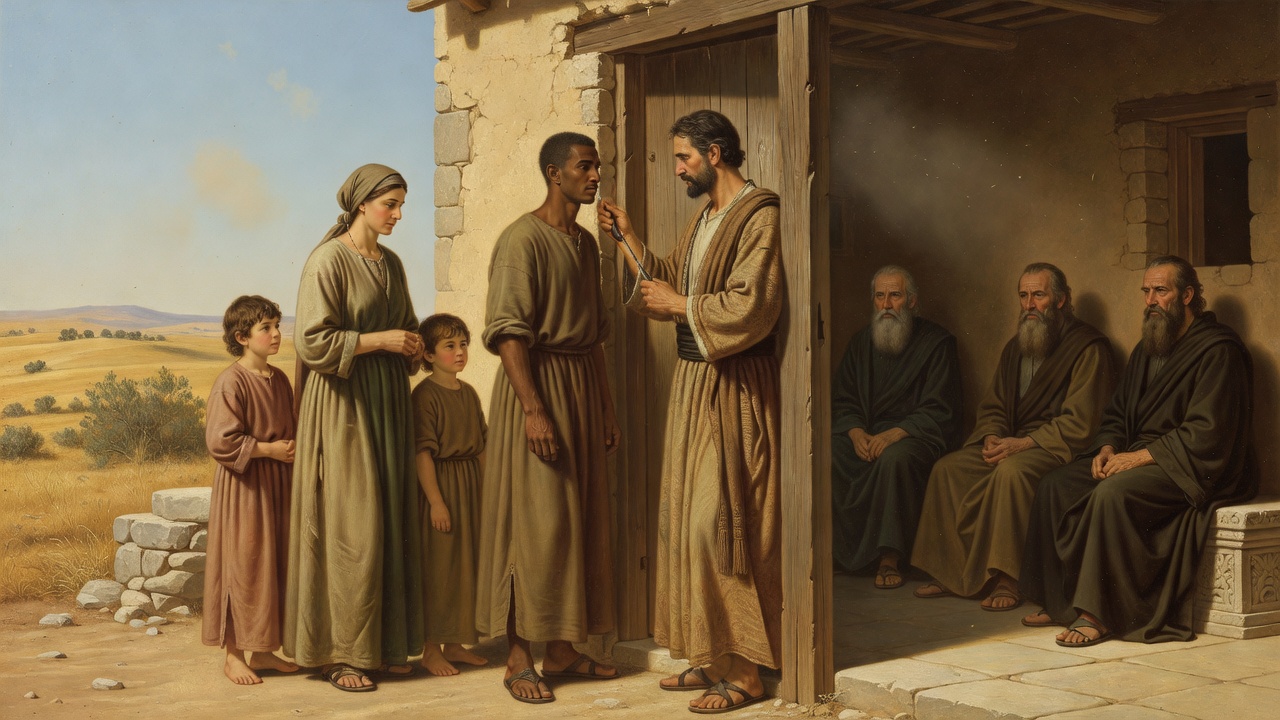
2“If you buy a Hebrew [Immigrant] servant, he shall serve six years and in the seventh he shall go out free without paying anything. 3If he comes in by himself, he shall go out by himself. If he is married, then his wife shall go out with him. 4If his master gives him a wife and she bears him sons or daughters, the wife and her children shall be her master’s, and he shall go out by himself. 5But if the servant shall plainly say, ‘I 'ahav ·affectionately love· my master, my wife, and my children. I will not go out free;’ 6then his master shall bring him to God, and shall bring him to the door or to the doorpost, and his master shall bore his ear through with an awl, and he shall serve him forever.
7“If a man sells his daughter to be a female servant, she shall not go out as the male servants do. 8If she does not please her master, who has married her to himself, then he shall let her be redeemed. He shall have no right to sell her to a foreign people, since he has dealt deceitfully with her. 9If he marries her to his son, he shall deal with her in the mishpat ·manner· of a daughter. 10If he takes another wife to himself, he shall not diminish her food, her clothing, and her marital rights. 11If he does not do these three things for her, she may go free without paying any money.
12“One who strikes a man so that he dies shall surely be put to death, 13but not if it is unintentional, but God allows it to happen: then I will appoint you a place where he shall flee. 14If a man schemes and comes presumptuously on his neighbor to kill him, you shall take him from my altar, that he may die.
15“Anyone who attacks his father or his mother shall be surely put to death.
16“Anyone who kidnaps someone and sells him, or if he is found in his hand, he shall surely be put to death.
17“Anyone who curses his father or his mother shall surely be put to death.
18“If men quarrel and one strikes the other with a stone, or with his fist, and he does not die, but is confined to bed; 19if he rises again and walks around with his staff, then he who struck him shall be cleared: only he shall pay for the loss of his time, and shall provide for his healing until he is thoroughly healed.
(2) 20“If a man strikes his servant or his maid with a rod, and he dies under his hand, he shall surely be punished. 21Notwithstanding, if he gets up after a day or two, he shall not be punished, for he is his property.
22“If men fight and hurt a pregnant woman so that she gives birth prematurely, and yet no harm follows, he shall be surely fined as much as the woman’s husband demands and the judges allow. 23But if any harm follows, then you must take life for life, 24eye for eye, tooth for tooth, hand for hand, foot for foot, 25burning for burning, wound for wound, and bruise for bruise.
26“If a man strikes his servant’s eye, or his maid’s eye, and destroys it, he shall let him go free for his eye’s sake. 27If he strikes out his male servant’s tooth, or his female servant’s tooth, he shall let him go free for his tooth’s sake.
28“If a bull gores a man or a woman to death, the bull shall surely be stoned, and its meat shall not be eaten; but the owner of the bull shall not be held responsible. 29But if the bull had a habit of goring in the past, and it has been testified to its owner, and he has not kept it in, but it has killed a man or a woman, the bull shall be stoned, and its owner shall also be put to death. 30If a ransom is laid on him, then he shall give for the redemption of his life whatever is laid on him. 31Whether it has gored a son or has gored a daughter, according to this judgment it shall be done to him. 32If the bull gores a male servant or a female servant, thirty shekels [12 oz; 3/4 lb; 340.2 g] of silver shall be given to their master, and the ox shall be stoned.
33“If a man opens a pit, or if a man digs a pit and does not cover it, and a bull or a donkey falls into it, 34the owner of the pit shall make it good. He shall give money to its owner, and the dead animal shall be his.
35“If one man’s bull injures another’s, so that it dies, then they shall sell the live bull, and divide its price; and they shall also divide the dead animal. 36Or if it is known that the bull was in the habit of goring in the past, and its owner has not kept it in, he shall surely pay bull for bull, and the dead animal shall be his own.
Did you know?
Ordinances on Servants and Injuries
- A bought Hebrew servant served six years and went free in the seventh year without payment. He left alone if he had arrived alone, or with his wife if he had arrived with her, but a wife given by the master and any children she bore remained with the master. If the servant declared that he loved his master, his wife, and his children and did not wish to go free, the master brought him before the judges, pierced his ear with an awl at the door or doorpost, and he served for life.Sources: the Bible text itself
- Whoever struck and killed a man was to be put to death. If he had not lain in wait, but God had allowed it to happen, a place was appointed where he might flee; yet if he schemed and acted willfully to kill his neighbor, he was taken even from the altar to be put to death. Whoever struck or cursed his father or mother, and whoever kidnapped another man whether he sold him or the man was found in his possession, was also to be put to death.Sources: the Bible text itself
- If men quarreled and one struck the other with a stone or a fist so that he was confined to bed but did not die, the striker went unpunished once the injured man could walk outside with his staff, but he had to compensate for lost work and see that he was completely healed. If a serious injury resulted, the requirement was a life for a life, an eye for an eye, a tooth for a tooth, a hand for a hand, a foot for a foot, a burn for a burn, a wound for a wound, and a stripe for a stripe. If a man struck and blinded the eye or knocked out the tooth of his manservant or maidservant, he had to let the servant go free as compensation.Sources: the Bible text itself
Notes written with AI assistance from open sources (Theographic Bible Metadata, CC BY-SA 4.0; Easton’s Bible Dictionary, public domain) and reviewed before publishing.
Credits and license for this translation
One Unity Resource Bible
The One Unity Resource Bible translation of the Holy Bible into American English with some transliterated Hebrew notations
Copyright © 2016,2019 Thomas Robinson
Language: English
Dialect: American
Translation by: Thomas Robinson
This translation is made available to you under the terms of the
Creative Commons Attribution Share-Alike license 4.0.
You have permission to share and redistribute this Bible translation in any format and to make reasonable revisions and adaptations of this translation, provided that:
You include the above copyright and source information.
If you make any changes to the text, you must indicate that you did so in a way that makes it clear that the original licensor is not necessarily endorsing your changes.
If you redistribute this text, you must distribute your contributions under the same license as the original.
Pictures included with Scriptures and other documents on this site are licensed just for use with those Scriptures and documents.
For other uses, please contact the respective copyright owners.
Note that in addition to the rules above, revising and adapting God's Word involves a great responsibility to be true to God's Word. See Revelation 22:18-19.
2024-12-05
Source: http://ebible.org/engourb/ · eBible.org