Deuteronomy 5
One Unity Resource Bible · Tap a verse to see its cross-references.
(A:4, S:3)
The Covenant at Horeb
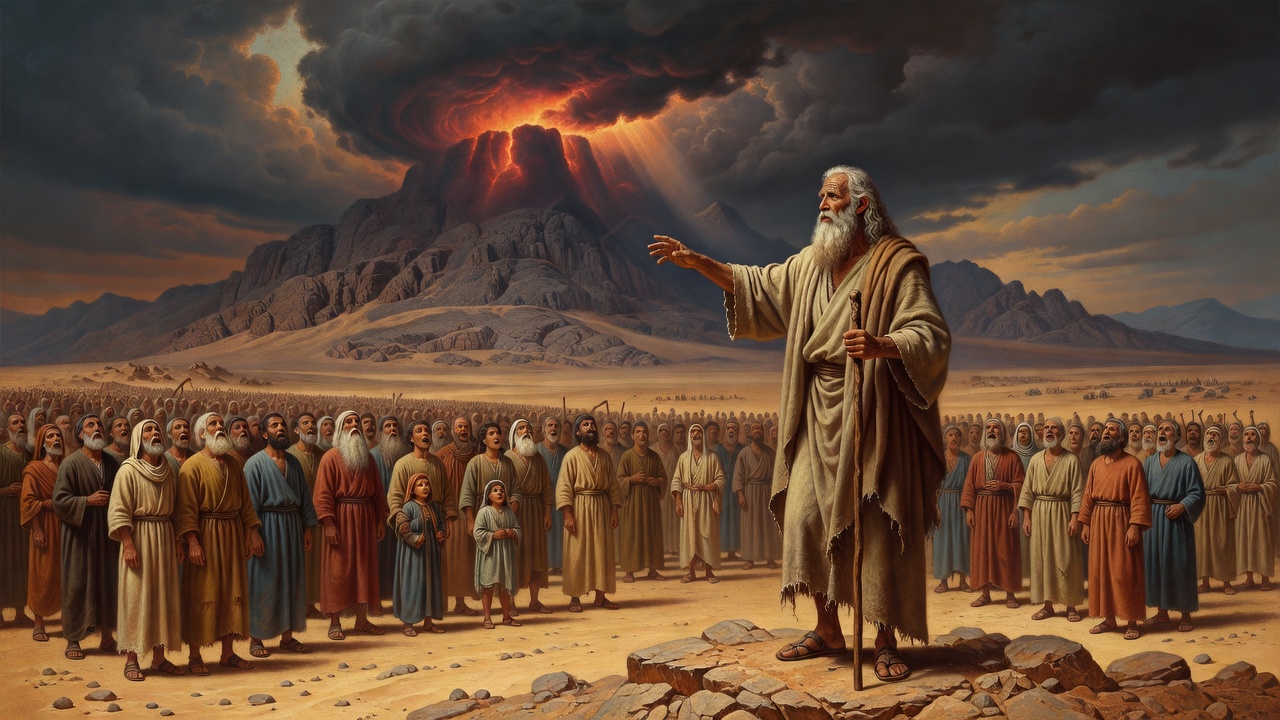
1Moses [Drawn out] called to all Israel [God prevails], and said to them, “ Sh'ma ·Hear obey·, Israel [God prevails], the statutes and the judgments which I speak in your ears today, that you may learn them, and observe to do them.” 2Yahweh Eloheikhem [Yahweh our God] made a covenant with us in Horeb [Desert]. 3Adonai didn’t make this covenant with our fathers, but with us, even us, who are all of us here alive today. 4Adonai spoke with you face to face on the mountain out of the middle of the fire,
The Ten Commandments
5(I stood between Adonai and you at that time, to show you Adonai’s word; for you were afraid because of the fire, and didn’t go up onto the mountain) saying,
6“I am Yahweh [He sustains breathing] your God, who brought you out of the land of Egypt [Abode of slavery], out of the house of bondage.
7“You shall have no other deities before me.
8“You shall not make an engraved image for yourself, any likeness of what is in heaven above, or what is in the earth beneath, or that is in the water under the earth. 9You shall not hawa ·bow low, prostrate· yourself down to them, nor abad ·serve· them; for I, Yahweh [He sustains breathing], your God, am El Kana' [Jealous God], visiting the depravity (moral evil) of the fathers on the children, and on the third and on the fourth generation of those who hate me; 10and showing chesed ·loving-kindness· to thousands of those who 'ahav ·affectionately love· me and keep my mitzvot ·instructions·.
11“You shall not use את the name of Adonai your God worthlessly: for Adonai את will not hold him guiltless who takes את his name in vain.
12“Observe the Shabath ·Intermission· day, to keep it holy, as Adonai your God enjoined you. 13You shall labor six days, and do all your work; 14but the seventh day is a Shabath ·Intermission· to Adonai your God, in which you shall not do any work, you, nor your son, nor your daughter, nor your male servant, nor your female servant, nor your ox, nor your donkey, nor any of your livestock, nor your stranger who is within your gates; that your male servant and your female servant may rest as well as you. 15You shall remember that you were a servant in the land of Egypt [Abode of slavery], and Adonai your God brought you out of there by a mighty hand and by an outstretched arm. Therefore Adonai your God enjoined you to keep the Shabath ·Intermission· day.
16“Honor your father and your mother, as Adonai your God enjoined you; that your days may be long, and that it may go well with you, in the land which Adonai your God gives you.
17“You shall not murder.
18“You shall not commit adultery.
19“You shall not steal.
20“You shall not give false witness against your neighbor.
21“You shall not covet your neighbor’s wife. Neither shall you desire your neighbor’s house, his field, or his male servant, or his female servant, his ox, or his donkey, or anything that is your wrote neighbor’s.”
(A:5, S:4)
Moses Intercedes for the People
22Adonai spoke these words to all your assembly on the mountain out of the middle of the fire, of the cloud, and of the thick darkness, with a great voice. He added no more. He them on two stone tablets, and gave them to me. 23When you sh'ma ·heard obeyed· the voice out of the middle of the darkness, while the mountain was burning with fire, you came near to me, even all the heads of your tribes, and your elders; 24and you said, “Behold, Yahweh Eloheikhem [Yahweh our God] has shown us his kavod ·weighty glory· and his greatness, and we have sh'ma ·heard obeyed· his voice out of the middle of the fire. We have seen today that God does speak with man, and he lives. 25Now therefore why should we die? For this great fire will consume us. If we sh'ma ·hear obey· Yahweh Eloheikhem [Yahweh our God]’s voice any more, then we shall die. 26For who is there of all flesh, that has sh'ma ·heard obeyed· the voice of the Elohim Chayim [Living God] speaking out of the middle of the fire, as we have, and lived? 27Go near, and sh'ma ·hear obey· all that Yahweh Eloheikhem [Yahweh our God] shall say, and tell us all that Yahweh Eloheikhem [Yahweh our God] tells you; and we will sh'ma ·hear obey· it, and do it.”
28Adonai sh'ma ·heard obeyed· the voice of your words, when you spoke to me; and Adonai said to me, “I have sh'ma ·heard obeyed· the voice of the words of this people, which they have spoken to you. They have well said all that they have spoken. 29Oh that there were such a heart in them, that they would fear me, and keep all my mitzvot ·instructions· always, that it might be well with them, and with their children forever!
30“Go tell them, ‘ Teshuvah ·Completely return· to your tents.’ 31But as for you, stand here by me, and I will tell you all the mitzvot ·instructions·, and the statutes, and the judgments, which you shall teach them, that they may do them in the land which I give them to possess it.”
32You shall observe to do therefore as Adonai your God has enjoined you. You shall not turn aside to the right hand or to the left. 33You shall walk in all the way which Adonai your God has enjoined you, that you may live, and that it may be well with you, and that you may prolong your days in the land which you shall possess.
Did you know?
The Covenant and the Ten Commandments
- In Deuteronomy, the mountain where the covenant and commandments were given is called Horeb. Horeb refers to the broader mountain range of which Sinai was a peak, situated beside a spacious plain where the Israelites could camp.Sources: Horeb · the Bible text itself
- In Deuteronomy's account of the Sabbath commandment, the requirement of rest is explicitly tied to Israel's history of slavery in Egypt. Because the Israelites had been liberated from forced labor, their servants, foreigners, and working animals were also granted complete rest on the seventh day.Sources: the Bible text itself
- Moses served as an intermediary between God and the people because the tribal heads and elders feared they would die if they continued hearing the divine voice from the fire and deep darkness. They asked Moses to go near, receive the remaining statutes, and report them to the assembly.Sources: the Bible text itself
Notes written with AI assistance from open sources (Theographic Bible Metadata, CC BY-SA 4.0; Easton’s Bible Dictionary, public domain) and reviewed before publishing.
Places in this chapter
Only places identified with high confidence are shown (90% or more according to the scholarly sources compiled by OpenBible). Period map: DARE (Digital Atlas of the Roman Empire), CC BY 4.0; modern map: © OpenStreetMap contributors; places: OpenBible.info (CC BY 4.0).
Credits and license for this translation
One Unity Resource Bible
The One Unity Resource Bible translation of the Holy Bible into American English with some transliterated Hebrew notations
Copyright © 2016,2019 Thomas Robinson
Language: English
Dialect: American
Translation by: Thomas Robinson
This translation is made available to you under the terms of the
Creative Commons Attribution Share-Alike license 4.0.
You have permission to share and redistribute this Bible translation in any format and to make reasonable revisions and adaptations of this translation, provided that:
You include the above copyright and source information.
If you make any changes to the text, you must indicate that you did so in a way that makes it clear that the original licensor is not necessarily endorsing your changes.
If you redistribute this text, you must distribute your contributions under the same license as the original.
Pictures included with Scriptures and other documents on this site are licensed just for use with those Scriptures and documents.
For other uses, please contact the respective copyright owners.
Note that in addition to the rules above, revising and adapting God's Word involves a great responsibility to be true to God's Word. See Revelation 22:18-19.
2024-12-05
Section headings adapted from the Berean Standard Bible (public domain); they are not part of this translation’s text.
Source: http://ebible.org/engourb/ · eBible.org