Deuteronomy 24
One Unity Resource Bible · Tap a verse to see its cross-references.
Marriage and Divorce Laws
1When a man takes a wife and marries her, then it shall be, if she finds no chen ·grace· in his eyes, because he has found some unseemly thing in her, that he shall write her a get ·bill of divorce·, and put it in her hand, and send her out of his house. 2When she has departed out of his house, she may go and be another man’s wife. 3If the latter husband hates her, and write her a bill of divorce, and puts it in her hand, and sends her out of his house; or if the latter husband die, who took her to be his wife; 4her former husband, who sent her away, may not take her again to be his wife, after that she is defiled; for that is detestable to Adonai. You shall not cause the land to sin ·err (from the standard goal)·, which Adonai your God gives you for an inheritance. (6) 5When a man takes a new wife, he shall not go out in the army, neither shall he be assigned any business. He shall be free at home one year, and shall cheer his wife whom he has taken.
Additional Laws
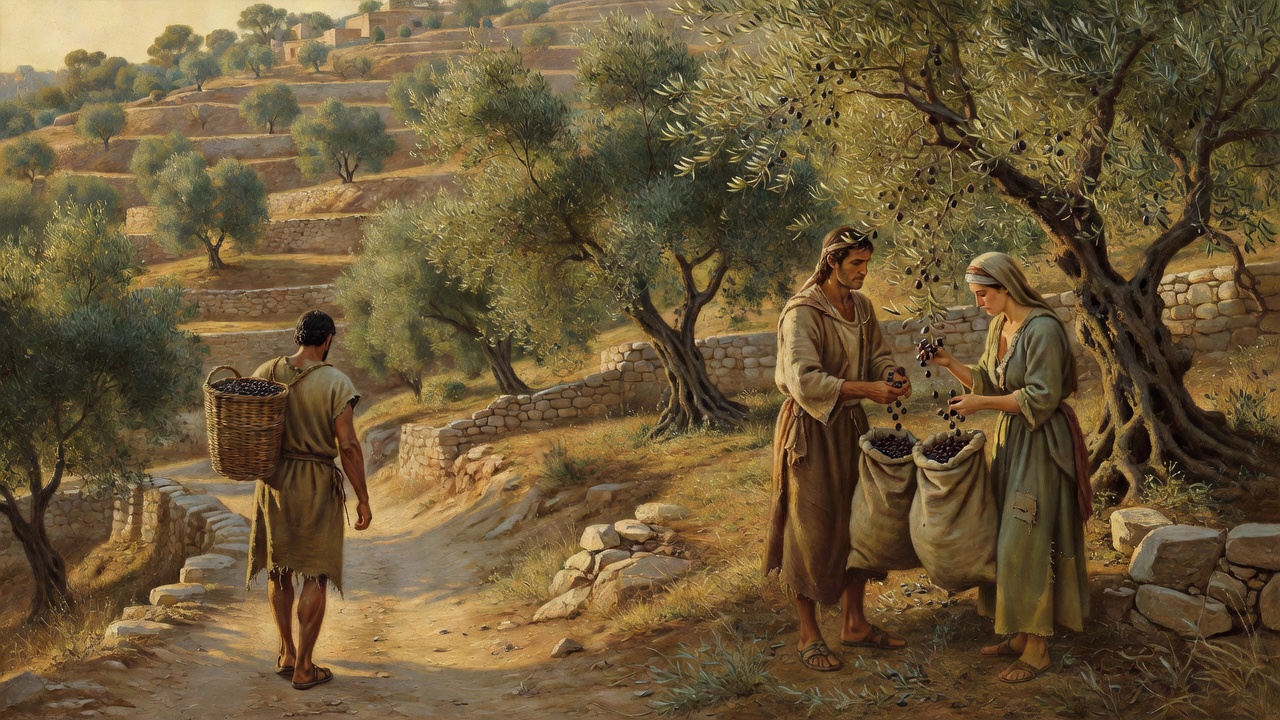
6No man shall take the mill or the upper millstone as a pledge; for he takes a life in pledge. 7If a man is found stealing any of his brothers of the children of Israel [God prevails], and he deals with him as a slave, or sells him; then that thief shall die. So you shall remove the evil from among you. 8Be careful in the plague of tzara'at, that you observe diligently, and do according to all that the priests the Levites [Descendants of United with] teach you. As I enjoined them, so you shall observe to do. 9Remember what Adonai your God did to Miriam [Rebellion], by the way as you came out of Egypt [Abode of slavery]. 10When you lend your neighbor any kind of loan, you shall not go into his house to get his pledge. 11You shall stand outside, and the man to whom you lend shall bring the pledge outside to you. 12If he is a poor man, you shall not sleep with his pledge. 13You shall surely restore to him the pledge when the sun goes down, that he may sleep in his garment, and bless you. It shall be righteousness to you before Adonai your God. (7) 14You shall not oppress a hired servant who is poor and needy, whether he is one of your brothers, or one of the foreigners who are in your land within your gates. 15In his day you shall give him his hire, neither shall the sun go down on it; for he is poor, and sets his heart on it; lest he cry against you to Adonai, and it be crime deserving peanlty, sin ·missing the goal· to you. 16The fathers shall not be put to death for the children, neither shall the children be put to death for the fathers. Every man shall be put to death for his own crime deserving peanlty, sin ·missing the goal·. 17You shall not deprive the foreigner or the orphan of mishpat ·justice·, nor take a widow’s clothing in pledge; 18but you shall remember that you were a slave in Egypt [Abode of slavery], and Adonai your God redeemed you there. Therefore I enjoin you to do this thing. 19When you reap your harvest in your field, and have forgotten a sheaf in the field, you shall not go again to get it. It shall be for the foreigner, for the orphan, and for the widow; that Adonai your God may bless you in all the work of your hands. 20When you beat your olive tree, you shall not go over the boughs again. It shall be for the foreigner, for the orphan, and for the widow. 21When you harvest your vineyard, you shall not glean it after yourselves. It shall be for the foreigner, for the fatherless, and for the widow. 22You shall remember that you were a slave in the land of Egypt [Abode of slavery]. Therefore I enjoin you to do this thing.
Did you know?
Laws of Compassion, Justice, and Social Protection
- Israelite harvesting laws required landowners to leave behind forgotten sheaves of grain, leftover olives, and grape gleanings for vulnerable groups: the resident foreigner, the orphan, and the widow. This social welfare system was grounded in the collective memory that the Israelites had once been oppressed slaves in Egypt.Sources: the Bible text itself · Egypt
- Debtors and hired workers were protected by explicit legal limits. Creditors were forbidden from entering a debtor's house to seize a pledge, taking essential millstones that provided a household's daily bread, or keeping an impoverished person's sleeping cloak past sunset, and day laborers had to be paid before nightfall.Sources: the Bible text itself
- When giving instructions concerning infectious skin diseases and the guidance of Levitical priests, the text points back to the affliction of Miriam, the sister of Moses and Aaron, during the wilderness journey following the Exodus from Egypt.Sources: the Bible text itself · Miriam · Egypt
Notes written with AI assistance from open sources (Theographic Bible Metadata, CC BY-SA 4.0; Easton’s Bible Dictionary, public domain) and reviewed before publishing.
Places in this chapter
Only places identified with high confidence are shown (90% or more according to the scholarly sources compiled by OpenBible). Period map: DARE (Digital Atlas of the Roman Empire), CC BY 4.0; modern map: © OpenStreetMap contributors; places: OpenBible.info (CC BY 4.0).
Credits and license for this translation
One Unity Resource Bible
The One Unity Resource Bible translation of the Holy Bible into American English with some transliterated Hebrew notations
Copyright © 2016,2019 Thomas Robinson
Language: English
Dialect: American
Translation by: Thomas Robinson
This translation is made available to you under the terms of the
Creative Commons Attribution Share-Alike license 4.0.
You have permission to share and redistribute this Bible translation in any format and to make reasonable revisions and adaptations of this translation, provided that:
You include the above copyright and source information.
If you make any changes to the text, you must indicate that you did so in a way that makes it clear that the original licensor is not necessarily endorsing your changes.
If you redistribute this text, you must distribute your contributions under the same license as the original.
Pictures included with Scriptures and other documents on this site are licensed just for use with those Scriptures and documents.
For other uses, please contact the respective copyright owners.
Note that in addition to the rules above, revising and adapting God's Word involves a great responsibility to be true to God's Word. See Revelation 22:18-19.
2024-12-05
Section headings adapted from the Berean Standard Bible (public domain); they are not part of this translation’s text.
Source: http://ebible.org/engourb/ · eBible.org