Leviticus 3
Targum Onkelos Etheridge · Tap a verse to see its cross-references.
Laws for Peace Offerings
1And if his oblation be a victim of the sanctified things; if from oxen, whether male or female, he shall offer it perfect before the Lord. 2And he shall lay his hand upon the head of his oblation at the door of the tabernacle of ordinance; and the priests the sons of Aharon shall sprinkle the blood round about upon the altar. 3And the oblation of the sacred victim the fat that covereth the inwards, even all the fat that is upon the inwards, 4And the two kidneys and the fat which is upon them on the sides, and the caul that is upon the liver with the kidneys, he shall remove. 5And the sons of Aharon shall burn it at the altar, with the burnt offering which is on the wood upon the fire, an oblation to be received with grace before the Lord.
6But if his oblation of a consecrated victim before the Lord be from the flock, whether male or female, he shall offer it perfect. 7If his oblation be a lamb, he shall present it before the Lord, 8and lay his hand upon the head of his oblation, and slay it before the tabernacle of ordinance; and the sons of Aharon shall sprinkle its blood upon the altar round about. 9And of his oblation of the consecrated victim before the Lord, its fat, the entire tail close by the backbone, he shall remove; the fat which covereth the inwards, even all the fat which is upon the inwards, and the two kidneys and the fat which is upon the inwards, 10And the two kidneys and the fat which is upon them upon the sides, and the caul that is over the liver, with the kidneys, he shall take away; 11And the priest shall burn it at the altar; it is the meat (lechem, bread) of an oblation before the Lord.
12But if his oblation be from the young goats, he shall present it before the Lord, 13and lay his hand upon its head, and slay it before the tabernacle of ordinance; and the sons of Aharon shall sprinkle its blood upon the altar round about. 14And of his oblation he shall offer as an oblation before the Lord the fat which covereth the inwards, and all the fat which is upon the inwards, 15And the two kidneys, and the fat which is upon them on the sides; but the caul that is over the liver with the kidneys he shall take away. 16And the priest shall burn them at the altar: it is the meat of an oblation to be received with acceptance; all the fat (shall be offered) before the Lord. 17It is an everlasting statute unto your generations, and in all your dwellings, that neither the fat nor the blood shall be eaten.
Did you know?
Regulations for the Peace Offering
- The peace offering could be taken from the herd or flock, including cattle, sheep, or goats. Unlike certain other sacrifices, the animal offered could be either male or female, as long as it was without blemish.Sources: the Bible text itself
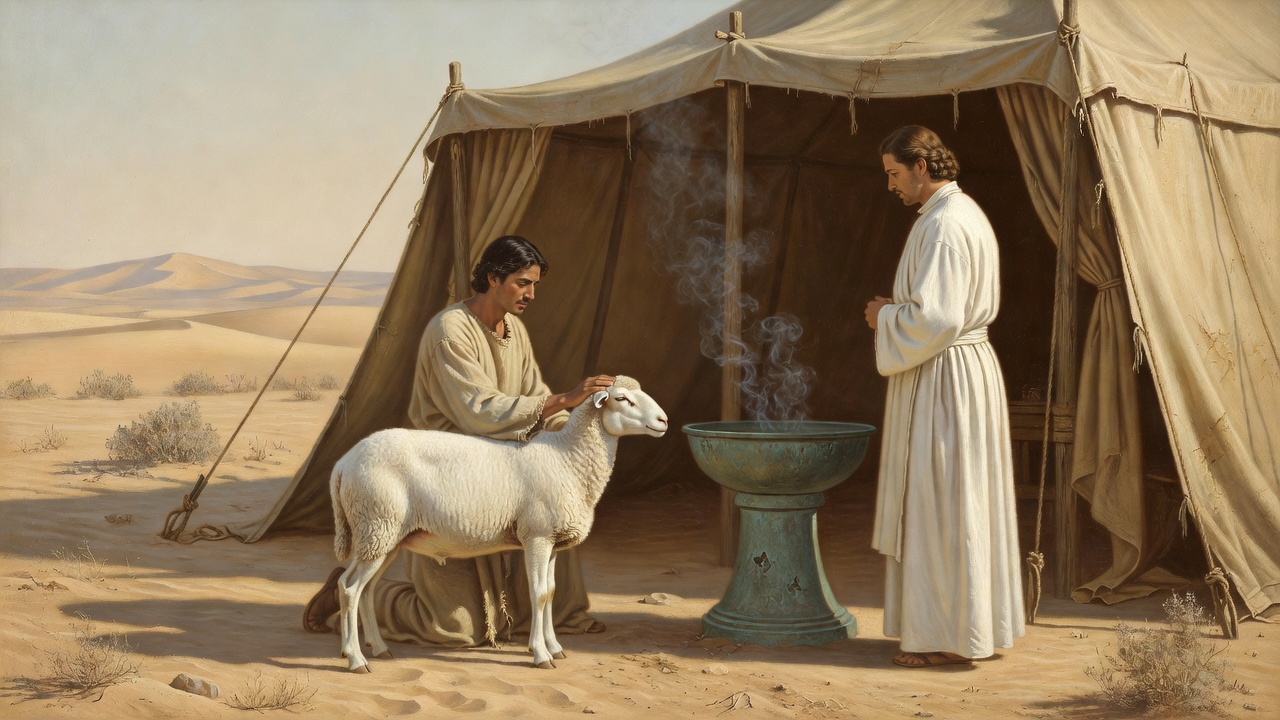
- The worshiper participated directly in the ritual by laying a hand on the animal's head and slaughtering it at the entrance of the Tent of Meeting. Aaron's sons, serving as priests, then splashed the blood on all sides of the altar and burned selected internal fat portions, the kidneys, and the lobe of the liver.Sources: the Bible text itself · Aaron
- The instructions conclude with a permanent statute for all generations: the Israelites were strictly forbidden from eating any fat or blood, establishing that all sacrificial fat belonged to the Lord.Sources: the Bible text itself
Notes written with AI assistance from open sources (Theographic Bible Metadata, CC BY-SA 4.0; Easton’s Bible Dictionary, public domain) and reviewed before publishing.
Credits and license for this translation
Targum Onkelos Etheridge
The Targums of Onkelos and Jonathan Ben Uzziel On the Pentateuch With The Fragments of the Jerusalem Targum From the Chaldee by J. W. Etheridge, M.A. First Published 1862-65.
Public Domain
Language: English
2020-12-20
Section headings adapted from the Berean Standard Bible (public domain); they are not part of this translation’s text.
Source: http://ebible.org/engoke/ · eBible.org